
For years, Japan has been aware of the need for greater use of recycled materials in its manufacturing sector. Progress, though, has been inadequate. There is a supply chain barrier: the cost of recycling materials like non-precious nonferrous metals and plastics. If the manufacturing sector itself can put into practice initiatives that align supply and demand, then the use of recycled materials is sure to expand. Japanese manufacturing is in a position to make that happen provided help from additional public–private measures.
Japan’s Circular Shift: Industrial market for recycled materials
Driven by market value and requirements in public sector procurement
11 December 2025
Business-led initiatives to unlock the market value of recycled materials
Precious metals stand out as recyclable materials with market value. They tend to be scant in ores yet be more abundant in discarded products. And their prices have ridden a wave of investor enthusiasm on their “safe haven” status. Their high concentration in waste and elevated prices mean recycling costs can be more than recouped. Recycling businesses see this as an opportunity and are stepping up their resource recovery and recycling activities.
Items like plastics meanwhile are relatively costly to recycle. As things stand for many recycled materials, unlocking any market value is infeasible. Some hope that government measures will close the gap in price between virgin and recycled materials, but a better course would be for businesses to find ways to make recycled materials marketable—i.e.,valorizethem—on their own.
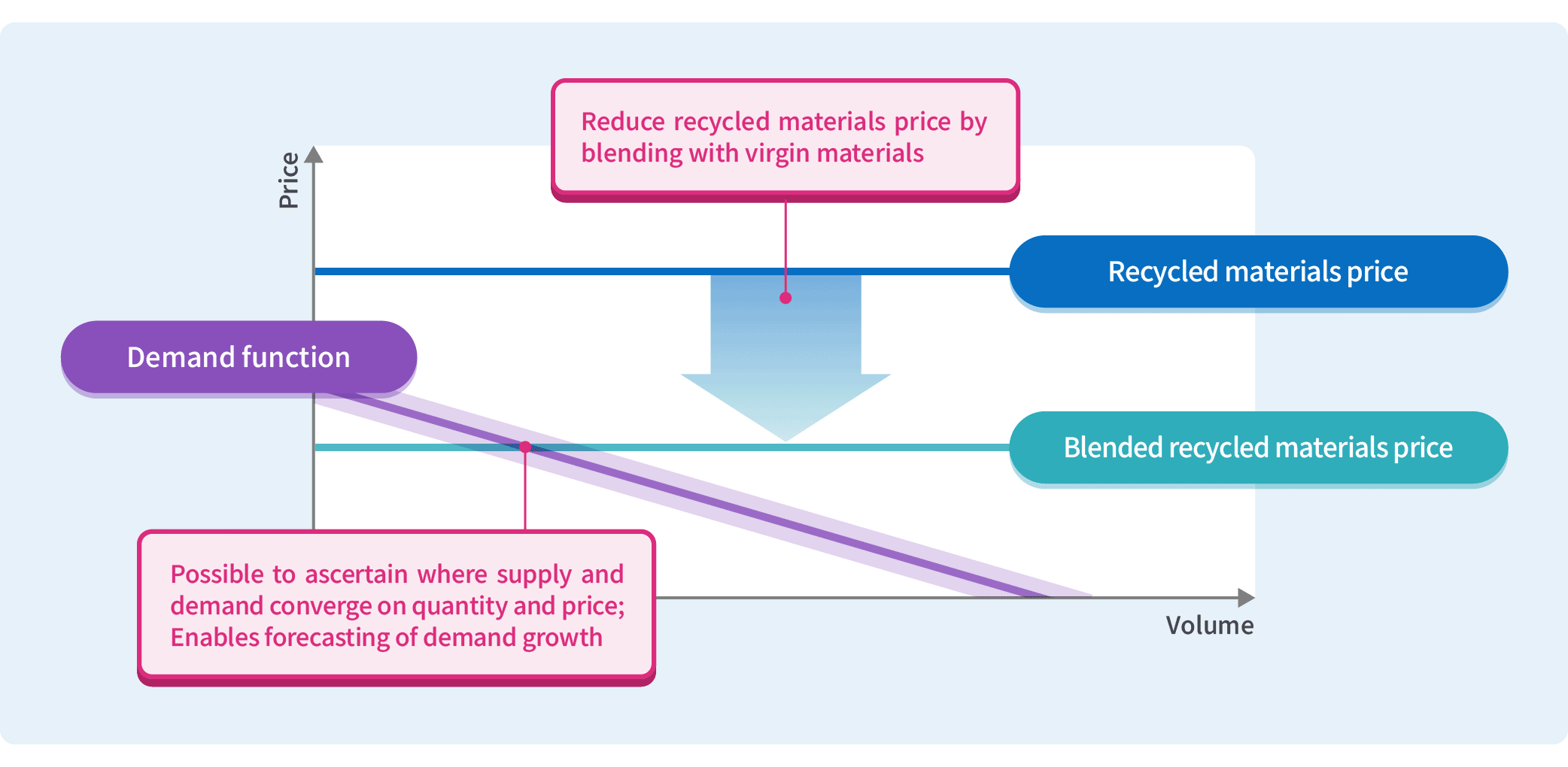
Blending virgin and recycled materials, rather than making a choice between one or the other, will valorize recycled materials and bolster demand.
It would curtail the price of recycled materials and make it possible to ascertain the point where supply and demand converge according to quantity and price. This knowledge would then make it possible to forecast future growth in demand (Figure 1).
Figure 1: Scenario for valorizing recycled materials
Source: Mitsubishi Research Institute, Inc.
Original survey backs blending-based valorization of recycled materials
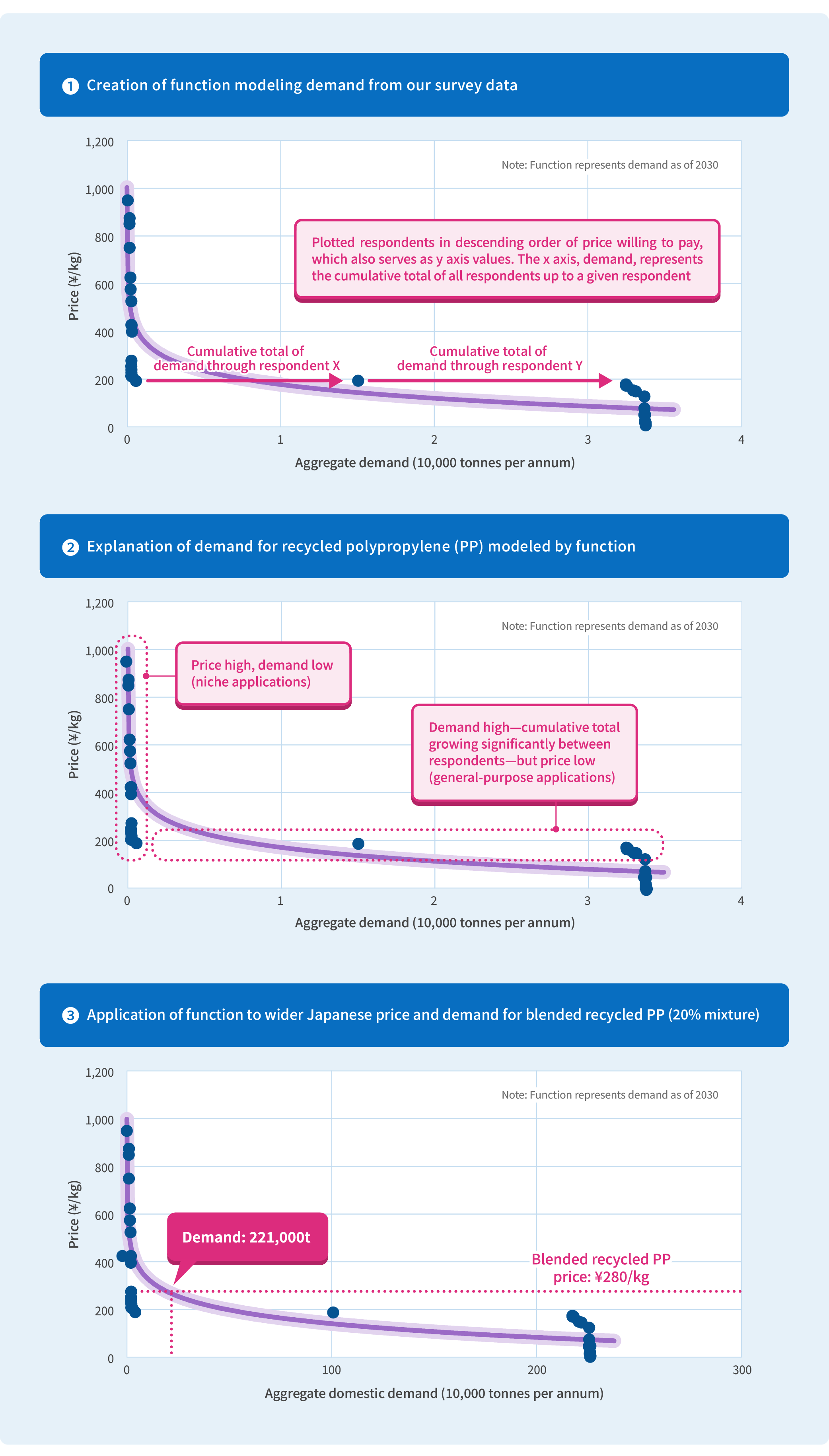
Polypropylene (PP) presents a typical plastics example. We derived a function* modeling demand for recycled PP based on our survey of the price users are willing to pay† and how much they would use (Figure 2).
*Function that shows how much demand will change due to changes in prices and other determinants
†Maximum price users willing to pay for specific goods or services
Figure 2: Valorizing recycled PP: case study
Source: Mitsubishi Research Institute, Inc.
The demand function was used to infer aggregate domestic demand* based on the prices individual survey respondents were willing to pay and the amounts they said they would use. To create the demand function, respondent data was plotted in descending order of price willing to pay, which also serves as y axis values. The x axis, demand, represents the cumulative total of all respondents up to a given respondent (Figure 2-1).
As Figure 2-2 shows, demand tends to be low, only small movement on the x axis between points, among those willing to pay high prices. Respondents with higher demand, wider expanse on the x axis between points, emerge at a price point of ¥200/kg. This seems to show that those dealing in general-purpose PP products have demand for higher volume of recycled PP, but because PP products are inexpensive, they are not willing to pay much for recycled PP.
Figure 2-3 uses our demand function to show Japan’s wider domestic demand for recycled PP. Demand volume is minimal at an assumed chemically recycled PP price of ¥600/kg. Meanwhile, virgin PP prices are roughly ¥200/kg, or one-third that of chemically recycled PP. But blended recycled PP, assuming a mixture of virgin and 20% recycled PP, comes in at ¥280/kg points to a domestic demand of 221,000 tons.
Mixing with virgin materials reduces the volume of recycled materials per product. However, higher sales volume due to valorizing recycled materials outweighs this, ultimately generating greater demand for recycled materials overall.
*Demand function based on limited survey assumed to apply to entire country
A virtuous valorization cycle
While blending imparts value, the task of expanding demand remains. Here, biomass materials are a good illustration.
While generally more expensive than virgin petrochemical-derived materials, biomass materials have natural applications. Biomass ink is often used on wrappers for bottles and other small containers. The tiny amount of ink required and its negligible proportion of the final product price makes it acceptable, despite bio ink being dearer than conventional ink.
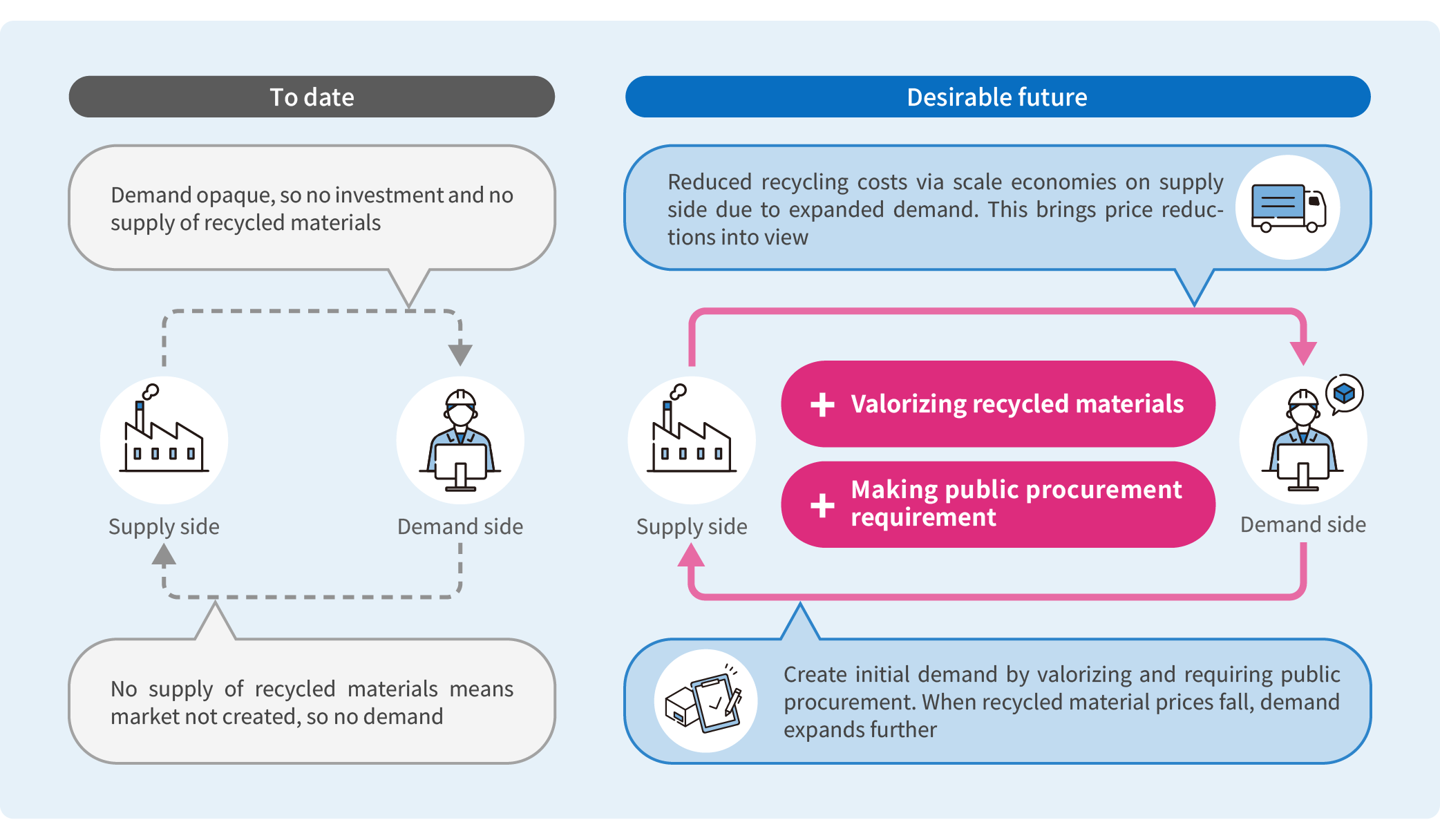
Turning to recycled materials that contain recycled PP, the key to expanding demand is reducing the share of recycled materials in costs. We focus on areas of demand where recycled materials account for a small proportion of the overall cost. Imparting a market value to recycled materials could generate initial demand, expanding supply to meet that demand, and reduced recycling costs due to scale economies, sparking a virtuous cycle of expanding demand via lower recycled materials prices.
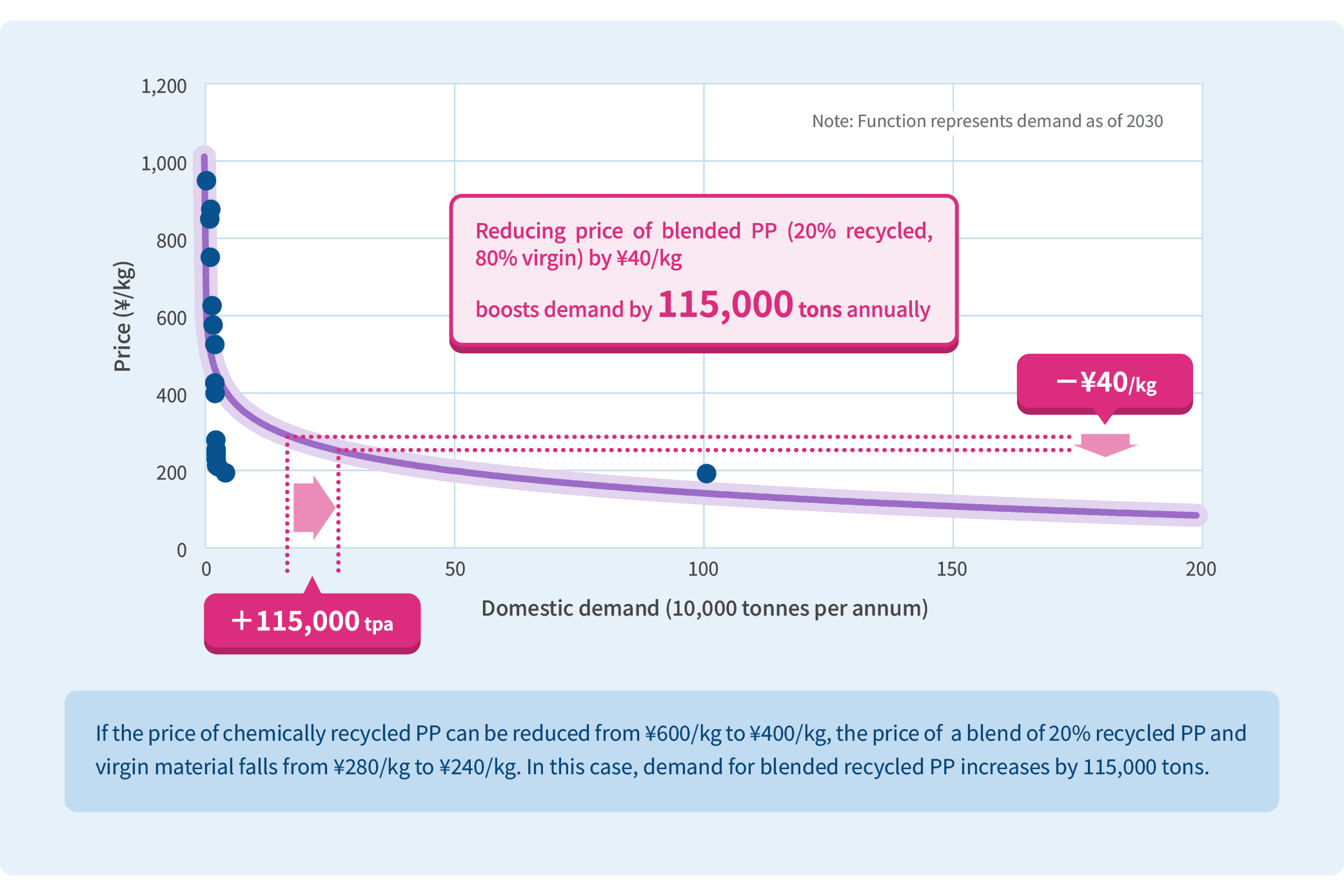
For example, reducing the price of chemically recycled blended PP by ¥40/kg would increase demand by 115,000 tons (Figure 3).
Figure 3: Example of how to expand demand by reducing recycling cost
Source: Mitsubishi Research Institute, Inc.
Using public procurement to generate initial demand to accelerate virtuous cycle
Speeding up the virtuous cycle of expanding demand and reducing costs also requires proactive government involvement. Under our approach of blending virgin and recycled materials, prices are still higher than for virgin materials alone. In addition to high prices, applications of blended products are limited in the initial stage. There are barriers to the uptake of recycled materials which would offset the initial lack of demand. The answer is bulk demand, without which the virtuous cycle will lack impetus.
We believe that speeding up the virtuous cycle with government involvement requires active public procurement (Figure 4). A two-pronged approach of valorization and public procurement requirements could create bulk initial demand and kick off the cycle.
Hefty recycling costs have hindered the use of recycled plastics and non-precious nonferrous metals. Recycled materials can be infused with market value by blending them with virgin materials, and the proactive use of recycled materials through public procurement could speed up a cycle of expanding supply and demand. For this, coordination between the manufacturing sector and the government will be key to rolling out such initiatives and expanding use.
Figure 4: Expanding supply and demand for recycled materials
Source: Mitsubishi Research Institute, Inc.
Author profile
Ryunosuke Funahashi
Business Consulting Division
Ryunosuke Funahashi focuses on technological strengths as the wellspring of corporate competitiveness and helps companies formulate business strategies. Using his extensive knowledge of advanced technologies, deep passion, and commitment, he works with customers to create solutions they are eager to implement.
Jiro Furuki
Center for Policy and the Economy
Jiro Furuki is responsible for research and proposals designed to help resolve societal issues. He focuses primarily on resource circulation and the transition to a circular economy. He hopes his work will help bring about a sustainable society.