
Amid a trend toward institutionalizing greater disclosure on human capital, more and more companies are looking into or actively publishing human capital reports. Many of the more-progressive corporations have been taking their reports beyond mere mandated disclosure to facilitate dialogue with both their workforce and potential hires. Human capital reports can be put to more strategic use.
Human Capital Reporting in Japan
Facilitating dialogue inside and outside the organization
4 February 2026
Common content in Japan’s human capital reporting: Analyzing real-world examples
Publication of human capital reports is a comparatively new phenomenon that grew out of recent moves to make ESG disclosure more informative. Commanding growing interest in recent years, the reports serve as a means of augmenting integrated and sustainability reports with human capital data of greater detail.* They were initially positioned as a tool for communicating with investors and reporting on sustainability issues in the human-resources space. But now corporations are getting serious about orienting them for a wider readership.
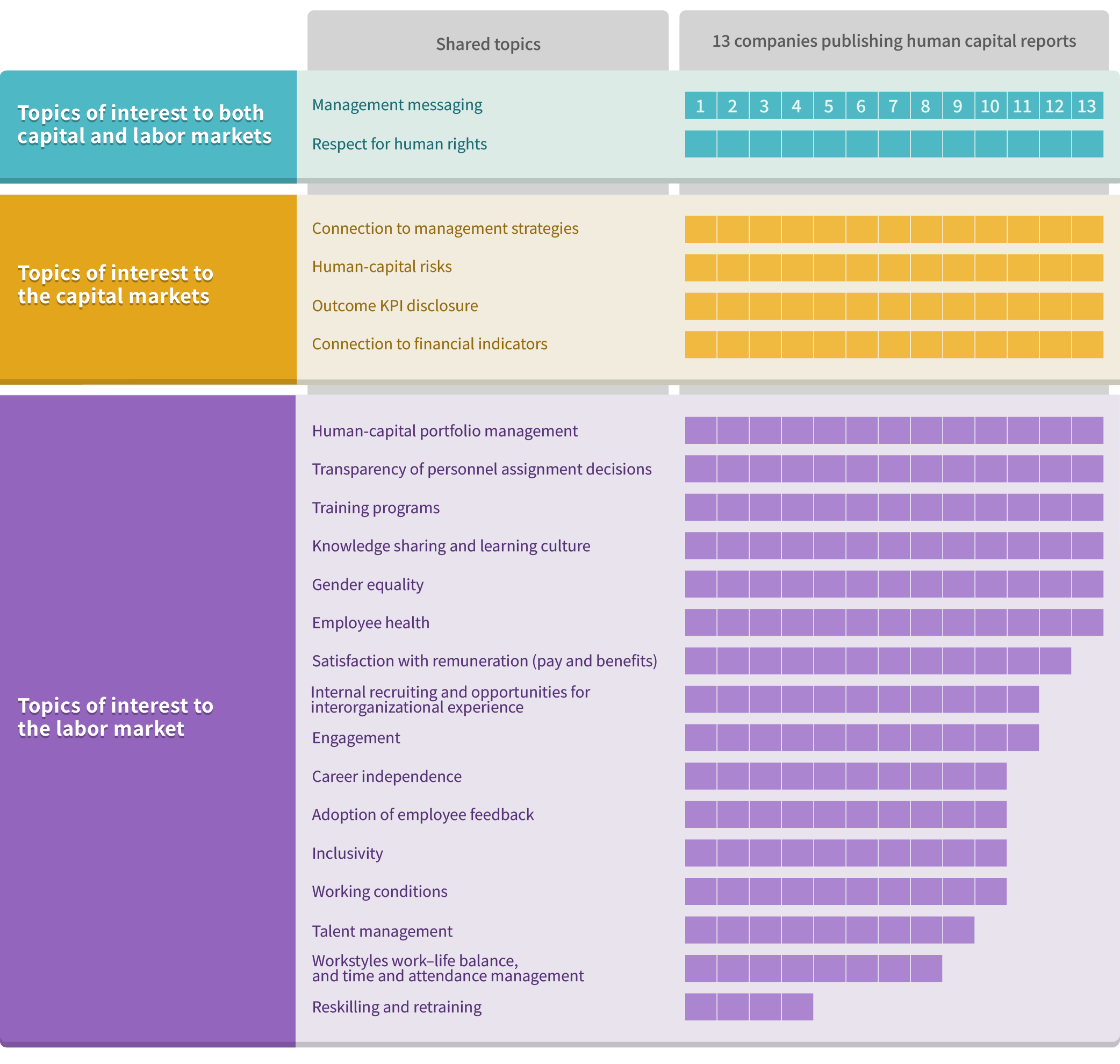
We conducted quantitative analysis of what Japanese organizations disclose in their human capital reports. Specifically, we examined the topics addressed in the reports of the 13 TOPIX100 companies that publish them (Figure 1).† We found that all or most of them had 22 topics in common. Breaking the topics down, we discovered that 16 were of interest to the labor market; four, of interest to the capital market; and two, to both. We then broke down which companies disclosed on what topics and how many of them they touched on in their reports.
*Standards for and guidelines on what to disclose in the human capital area (HCA) have been defined at the international level by the International Standards Organization (ISO 30414: Guidelines for human capital reporting) and the Sustainability Accounting Standards Board (SASB). In Japan, too, companies are now obliged to report on human capital in their securities reports and filings, which has led to huge progress in disclosure on their human-capital situation
†We referenced reports published by the following 13 companies for this article. The reports themselves were not necessarily human capital reports as such, but they all contained disclosures on human capital and were therefore included in our analysis:
Asahi Group Holdings, Ltd.; Chugai Pharmaceutical Co., Ltd.; Eisai Co., Ltd.; Fujitsu Limited; Panasonic Holdings Corporation; Mitsui & Co., Ltd.; Mitsubishi UFJ Financial Group, Inc.; Mizuho Financial Group, Inc.; MS&AD Insurance Group Holdings, Inc.; Dai-ichi Life Holdings, Inc.; Tokio Marine Holdings, Inc.; Mitsui O.S.K. Lines, Ltd.; ANA Holdings Inc. (in TSE stock-code order)
Figure 1: Topics disclosed in human capital reports and the number of companies mentioning them
Source: Mitsubishi Research Institute, Inc. from companies’ human capital reports
Worthy of note is that all 13 companies reported on the four topics of interest to capital markets: connection to management strategies, human-capital risks, outcome KPI disclosure, and connection to financial indicators. This is probably a reflection of human capital reports’ origins as an element of companies’ dialogue with investors.
Next, of the topics of interest to the labor market, six were also subject of disclosures by all 13 companies. Specifically, they are human capital portfolio management, transparency of personnel assignment decisions, training systems, knowledge sharing and learning culture, gender equality, and employee health. All are metrics telling existing and potential employees what kind of human-resource development and working conditions the companies offer. This indicates how human capital reports have begun to facilitate dialogue with the labor market.
Meanwhile, among other topics of interest to the labor market, only a few companies address reskilling and retraining. This is in contrast to training programs, which is covered by all 13 companies’ reports. The relative absence of the reskilling and retraining topic is representative of how low little priority companies give such initiatives.
As a general trend, human capital reports evolved from being a tool in the overall system of disclosure to gradually taking on a broader, dual purpose: Telling the story of what and how much companies are doing to create value through human capital (which is of interest to capital markets), and communicating progress on specific human-resources initiatives (which is of interest to the labor market). Our analysis confirms this shift, and it also reveals that inconsistencies in the content of labor market-oriented disclosure—what and how much companies disclose—emerge easily between companies. This reflects differences in how experienced companies are in translating human-capital concepts into practice.
Through separate analysis, we have found that price book-value ratio (PBR) and total factor productivity (TFP) are influenced by the coverage of human-capital management strategies in investor-facing reports, including integrated reports (IRs) and securities reports. Meanwhile, real examples of human capital reports show that their publishers have greater freedom of scope for what and how much they choose to disclose on human capital compared to what is permitted in IRs and securities reports. As a medium, human capital reports give them room to dig deeper and cover human capital with greater depth and breadth. The implication is that human capital reports are optimal for systematically and frankly reporting on how and to what extent companies’ human capital strategies contribute to corporate growth, achieving their strategies, and realizing their ambitions.
Case studies: Human capital reports facilitating internal and external dialogue
The human capital reports of Eisai Co., Ltd. and Chugai Pharmaceutical Co., Ltd., two players in Japan’s pharma industry, serve as characteristic examples of how Japanese firms use human capital reports to facilitate dialogue with the labor market.
Eisai’s Human Capital Report 2024 opens with an unambiguous message from its Chief HR Officer (CHRO) in which he discusses things he wants the company’s own employees to know about it.* But it is not just in this opening message: The whole report is designed to be “an HCR that shows Eisai as it is, including parts that even employees don’t know about.” This is a clear statement that the report is specifically designed to be a tool for shaping in-house perceptions of the company and inculcating its corporate culture. The intent behind its creation is even stated unequivocally: To disclose “information aimed at our own current employees and future job-seekers.” It is thus one of the more-developed human capital reports inasmuch as it is intended to reach out to human resources in- and outside the company, a step beyond just briefing the public.
Chugai Pharmaceutical’s People & Culture Report 2024 similarly envisions as its target readership a broad spectrum of stakeholders—“investors, employees, their families, future recruits, and patients”, and the company gives the report equal standing with its IR and securities filings within its disclosure ecosystem.†
A salient feature of the report is its presentation of Chugai Pharmaceutical’s distinctive human-capital philosophy. Specifically, the company has encapsulated its thinking into a coherent “envision–enhance–enable” narrative: “Increasing human resources who continuously and ambitiously take on challenges”, “Establishing a human resources support system”, and “Cultivating a culture that encourages facing challenges and personal growth”. It defines these three elements as constituting an “equation (i.e., formula) for Continuous Innovation Creation”. This is more than just a wishlist of platitudes. It embodies the company’s comprehensive approach of aiming for human capital disclosure focused on sharing its human-capital strategy with the labor market.
A salient feature of the report is its presentation of Chugai Pharmaceutical’s distinctive human-capital philosophy. Specifically, the company has encapsulated its thinking into a coherent “envision–enhance–enable” narrative: “Increasing human resources who continuously and ambitiously take on challenges”, “Establishing a human resources support system”, and “Cultivating a culture that encourages facing challenges and personal growth”. It defines these three elements as constituting an “equation (i.e., formula) for Continuous Innovation Creation”. This is more than just a wishlist of platitudes. It embodies the company’s comprehensive approach of aiming for human capital disclosure focused on sharing its human-capital strategy with the labor market.
Eisai and Chugai Pharmaceutical share the clear positioning of their human capital reports as “communication tools for reaching out to not just investors but also to human resources in- and outside the company to, as enterprises, tell these audiences about their approaches to and engagements with human resources.” Human capital reports thus started out as supplements to existing ESG disclosure materials for investors; but Eisai’s and Chugai Pharmaceutical’s are designed to inform existing employees, potential hires, and others in the labor market about their human resource strategies and the working environments they seek to provide, all in accessible terms. They are well-developed examples of how companies can utilize human capital reports in their attempts to coherently present information on human capital along with what they are doing to create corporate value and advance personnel policies.
*Eisai’s Human Capital Report 2024,
Japanese | https://www.eisai.co.jp/ir/
English | https://www.eisai.com/ir/
†Chugai Pharmaceutical’s People & Culture Report 2024,
Japanese | https://www.chugai-pharm.co.jp/sustainability/
English | https://www.chugai-pharm.co.jp/english/
Strategic use of human capital reports
Once a company has decided to publish a human capital report, crucial is that it start by clearly defining a target readership, then tailor its format—content and presentation—appropriately. In particular, for fostering a favorable reception of reports within the company, planners must give human capital reports the role of conveying to employees in an easy-to-understand manner a complete picture of the company’s basic policies on human resources, human-resource strategies, and how the company is working to put them into practice. Further, giving external stakeholders—including potential future hires—an unambiguous picture of how the company positions its human-resources policies and engagement within its growth narrative over the long term, can boost the company’s brand and its ability to compete for talent in the labor market.
Companies should step up their utilization of their human capital reports, employing them as a medium for communicating management’s intentions internally and externally rather than merely using them as capital market-oriented disclosure materials.
Author profile

Takuya Yamagishi
Human Capital and Organizational Strategy Unit
A double-headed approach—one that takes in both the business angle and the human resources angle—is essential to companies’ sustainable growth. A thorough understanding of a company’s organizational culture and formulating details that align with its needs are essential to drawing up a human-resource strategy of excellence. Takuya Yamagishi assists companies in doing that so they can maximize their growth potential. He strives to help enterprises find and maximize on human resources of excellence so they can maximize their business outcomes, walking together with clients as a partner in their pursuit of sustainable success.