
Nuclear-powered data centers have become a prominent topic worldwide in recent years. The hope is that this combination, an example of watt–bit integration, can fill generative AI’s mounting appetite for electricity. Nuclear energy is a stable source of power, an essential component to the kind of energy mix required to achieve carbon neutrality. It also stands to bring economic benefits such as a low-cost supply of electricity and new jobs. Going forward, nuclear power’s role, amidst growing electricity demand, must be reimagined so that power-source development can proceed with a focus on additionality.
Watt–Bit Integration Via Nuclear Powered Data Centers
Benefits spanning AI, carbon neutrality, employment, and the economy
3 December 2025
Data-center–nuclear teamups are gaining steam worldwide
Data centers and nuclear-power providers are partnering up, with increasing attention, around the world. They are driven by the urgent need for reliable, high-capacity, and carbon-neutral electricity among data centers and the need for financial and operational stability in the nuclear-power sector.
For example, Amazon acquired a large-scale data center adjacent to the Susquehanna nuclear power plant in Pennsylvania in March 2024. The firm looks to power it with nuclear energy. Similarly, in December 2024, Meta issued a request for proposal to procure electricity directly from nuclear power plants.1 French utility EDF is also considering supplying nuclear-powered electricity to data centers.2
For example, Amazon acquired a large-scale data center adjacent to the Susquehanna nuclear power plant in Pennsylvania in March 2024. The firm looks to power it with nuclear energy. Similarly, in December 2024, Meta issued a request for proposal to procure electricity directly from nuclear power plants.1 French utility EDF is also considering supplying nuclear-powered electricity to data centers.2
Figure 1: Collaboration between data centers and nuclear power providers gaining momentum

Source: Mitsubishi Research Institute, Inc. from Talen Energy3, Constellation Energy4, Google5, X-energy6, Oklo7, and Meta8
Nuclear power providers too stand to gain significant business opportunities from these partnerships: stable demand, enhanced profitability, and better operational predictability. They also can enjoy improved prospects when it comes to recovering investments. For instance, Constellation Energy announced plans in September 2024 to restart Unit 1 at the Three Mile Island nuclear power plant, which was closed in 2019 due to cost inefficiencies.* This decision was enabled by a 20-year power purchase agreement (PPA) with Microsoft, a boon to their operational and financial concerns. To facilitate the reactor’s restart, Constellation Energy intends to invest $1.6 billion in upgrading plant equipment such as turbines, generators, cooling systems, and control systems. It also plans to apply for regulatory approval from the US Nuclear Regulatory Commission to extend the reactor’s operational license.9
Collaboration between data centers and nuclear-power providers brings substantial regional and national economic benefits too. According to Constellation Energy, the reactor restart in Pennsylvania is expected to create 3,400 new jobs and generate over $3 billion in tax revenue for the state and federal governments over the coming decades.10 Moreover, the partnership is poised to contribute to the state’s carbon-neutral goals. Leveraging electricity demand-driven partnerships and nuclear power’s attributes—reliability, high capacity, and carbon neutrality—advances climate objectives at regional and national levels while creating jobs and driving economic growth. In other words, it is an engine for social value.
Collaboration between data centers and nuclear-power providers brings substantial regional and national economic benefits too. According to Constellation Energy, the reactor restart in Pennsylvania is expected to create 3,400 new jobs and generate over $3 billion in tax revenue for the state and federal governments over the coming decades.10 Moreover, the partnership is poised to contribute to the state’s carbon-neutral goals. Leveraging electricity demand-driven partnerships and nuclear power’s attributes—reliability, high capacity, and carbon neutrality—advances climate objectives at regional and national levels while creating jobs and driving economic growth. In other words, it is an engine for social value.
*An accident occurred at Three Mile Island Nuclear Generating Station’s Unit 2 in 1979. Talks of restart have to do with Unit 1, which was not directly affected by the accident, but still shutdown at the time. After subsequent safety confirmations and regulations, Unit 1 continued commercial operation until 2019
Figure 2: Collaboration between data centers and nuclear-power providers creates synergies for regions and countries

Source: Mitsubishi Research Institute, Inc.
Business conditions need to catch up to growing calls for nuclear
Nuclear-powered data centers are a focal point for Japan too. According to the Organization for Cross-regional Coordination of Transmission Operators (OCCTO)*, "Electricity demand is expected to increase through fiscal 2034 due to economic growth and the continued installation of new data centers and semiconductor plants, offsetting declines caused by population decrease, energy conservation, and efficiency improvements."11 Nuclear power is being revisited against this backdrop.
The Seventh Strategic Energy Plan was adopted via Cabinet decision in February 2025. It emphasizes that, “it is extremely important to maximize the use of both renewable energy and nuclear power”, with the goal of achieving around a 20% share of nuclear power in Japan’s electricity mix by fiscal 2040. As with the case of the US, Japan has potential to build a mutually beneficial relationship among data centers, nuclear power providers, local communities, and the government. It can both prioritize safety and maximizing the technological, economic, and social value of nuclear energy at the same time.
Japan already has public policies in the works to support these efforts. For example, the Long-Term Decarbonized Power Source Auction promotes investment recovery for decarbonized projects, including the restart and safety upgrades of existing nuclear power plants. During the 2024 auction, three reactors were selected for restart.† However, nuclear investments in Japan have not yet achieved the scale seen in the US. The Seventh Strategic Energy Plan outlines objectives to “enhance the predictability of the return on investment in decarbonized power sources and to promote active new investments by operators, and achieve decarbonization and a stable supply of electricity.” However, the way policy should be designed is still up for discussion.
If Japan’s nuclear investment environment stagnates, risks such as higher electricity prices, supply–demand imbalance, and energy-security challenges could escalate over the long term. Securing additional power supply is an urgent issue for Japan when it comes to addressing the anticipated surge in electricity demand driven by generative AI. Data center operators—acting as major off-takers, or entities purchasing electricity on an ongoing basis—must work closely with power companies to drive power source development.‡ The key lies in focusing on projects that provide additionality—newly created carbon-neutral electricity achieved through fresh investments rather than relying on existing capacity.
*OCCTO assumes that the maximum electricity demand nationwide in FY2034 will be 164.59 million kW. This is 3.06 million kW higher than the maximum power demand forecast for FY2033 in the FY2024 supply plan
†In the FY2024 long-term decarbonization power auction, the following companies won bids to invest in existing reactors
・Japan Atomic Power Company: Tokai No. 2 Power Station (1,056,000 kW)
・Hokkaido Electric Power Co., Ltd.: Tomari Nuclear Power Station Unit 3 (902,107 kW)
・Tokyo Electric Power Company Holdings: Kashiwazaki-Kariwa Nuclear Power Station Unit 6 (1,195,000 kW)
‡ There is a limit to the use of existing electricity. If nuclear power plants supply electricity directly to data centers, measures must also be taken to ensure steady supply of power to the grid. In the US, the Federal Energy Regulatory Commission (FERC) has required operators to submit explanation on the issue. The country’s largest grid operator, PJM, has submitted a response and is in discussion with FERC
Nuclear-powered data centers valuable for both electricity demand and decarbonization
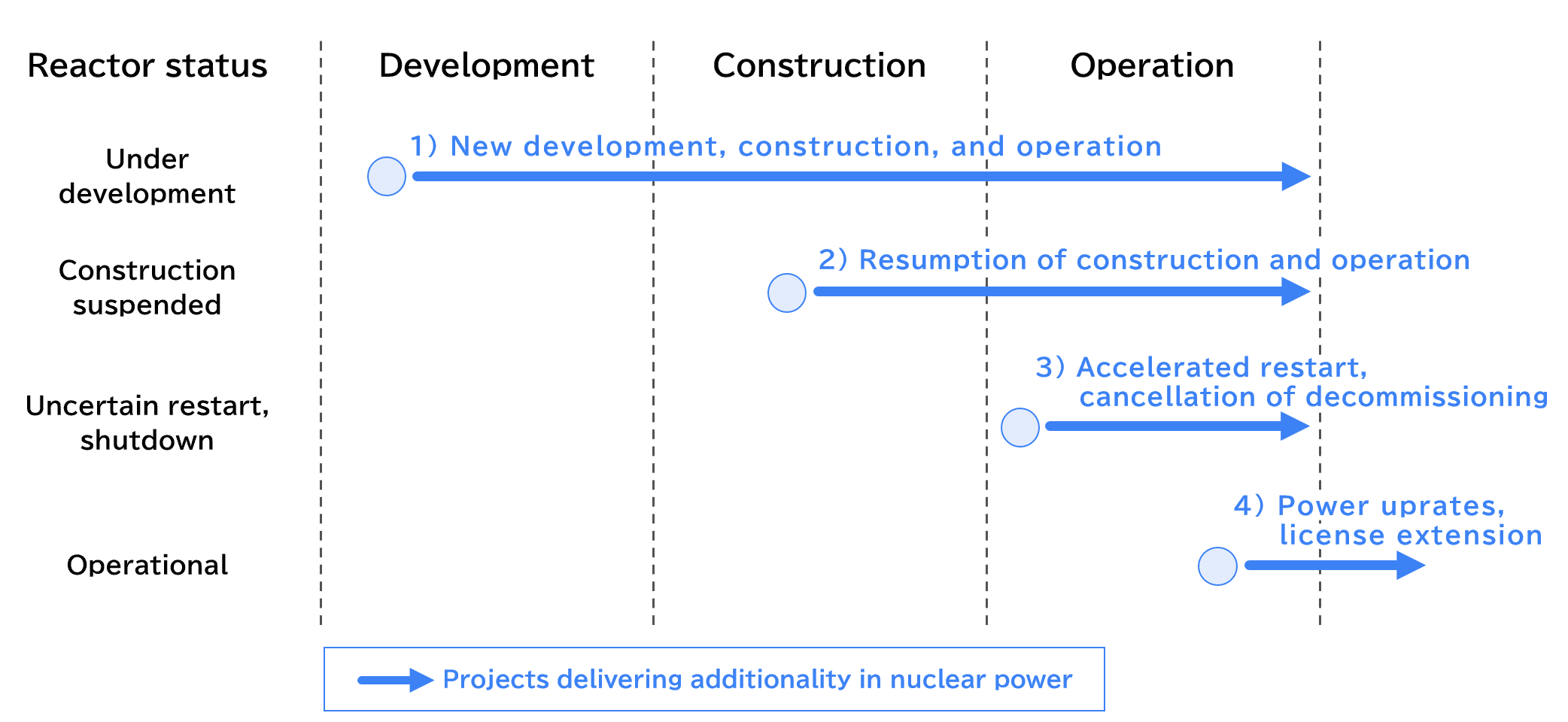
In the nuclear power sector, additionality-oriented development takes on a few forms:
- Development, construction, and operation of innovative reactors*
- Resumed construction of incomplete reactors
- Restart of suspended reactors or those decommissioned for economic reasons
- Uprating† and extension of operational lifespan of existing reactors
*Innovative reactors are next-generation nuclear reactors that are being developed with the aim of improving safety, profitability, non-proliferation, and waste reduction
†Uprating is the process of increasing the licensed level of output for an existing nuclear reactor. Carried out in tandem with safety measures and equipment improvements, evaluations examine the performance of major equipment such as steam turbines and generators. Output is improved by making use of surplus capacity and the latest technologies
Figure 3: Examples of additionality-oriented development in nuclear power
Source: Mitsubishi Research Institute, Inc.
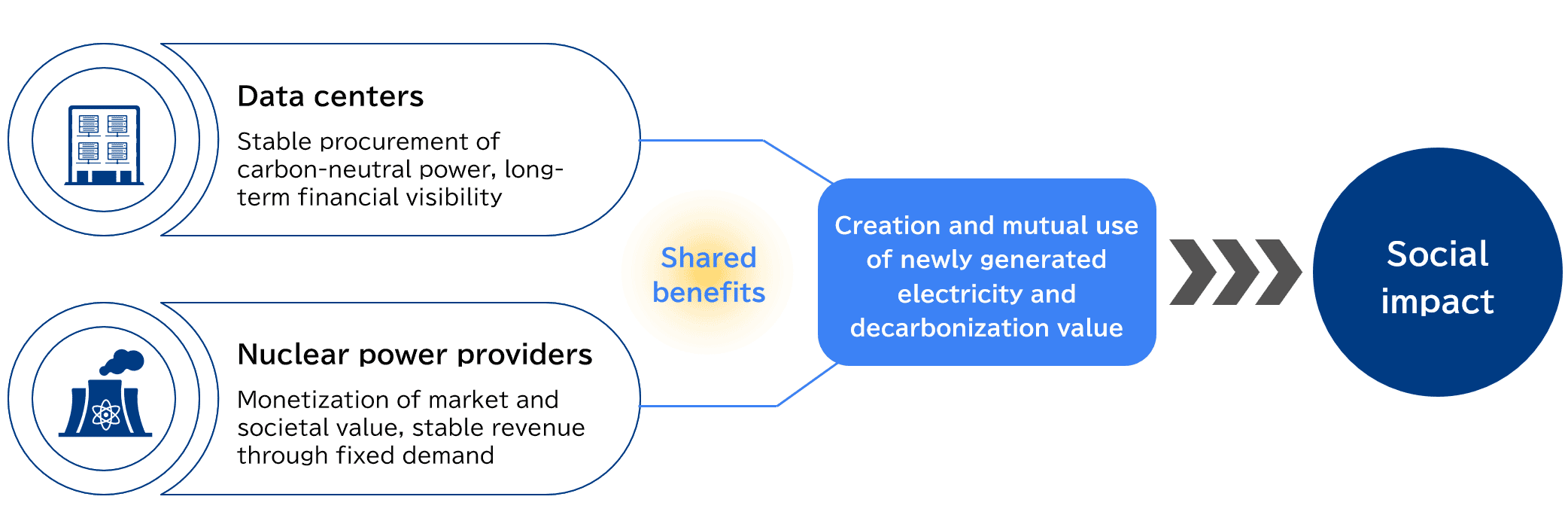
The broad application of additionality-oriented development can be of value in terms of both generational capacity as well as decarbonization. The key will be to orchestrate projects among data center operators, nuclear power providers, and other important stakeholders. For providers, this collaboration creates tangible opportunities to emphasize the market and societal value of nuclear energy. Improved predictability, as a result, helps mitigate operational and financial risks. Similarly, data-center operators benefit by securing stable supply of carbon-neutral electricity, helping to strengthen long-term financial planning and decarbonization goals.
While nuclear power is just one option for securing additionality for Japan, its ability to simultaneously ensure supply stability and carbon reduction makes it indispensable. The partnership between data centers and nuclear-power providers goes beyond by supporting sustainable AI-driven innovation, job creation, and economic stability. It will be crucial to raise awareness of these benefits to foster public understanding of nuclear projects, potentially paving the way for stronger policy support for nuclear investment.
While nuclear power is just one option for securing additionality for Japan, its ability to simultaneously ensure supply stability and carbon reduction makes it indispensable. The partnership between data centers and nuclear-power providers goes beyond by supporting sustainable AI-driven innovation, job creation, and economic stability. It will be crucial to raise awareness of these benefits to foster public understanding of nuclear projects, potentially paving the way for stronger policy support for nuclear investment.
Figure 4: Broadening decarbonized power benefits both data centers and nuclear-power providers
Source: Mitsubishi Research Institute, Inc.
Now is the time to design greater value into the future of energy
Nuclear-powered data centers require reconciling the long lead times of nuclear energy development with the rapidly changing demand of data centers. The expected surge in power demand driven by generative AI indicates that, in the short term, partnerships may focus on restarting existing reactors.* Still, projects will require substantial investment—on the scale of hundreds of billions of yen—alongside bolstered workforce and measures for the transfer and retention of technological expertise.
Sharing projects between data centers and nuclear-power providers will uncover latent demand and expectations among off-takers, potentially accelerating discussions around reactors previously overlooked for restart. For this to happen, additionality-focused projects need policy support, such as direct-supply frameworks for nuclear power providers and electricity bundling options tailored to nuclear energy. Establishing programs that distribute risks and align off-taker expectations is essential for the ideal use of additionality.
Of course, financial support and demand creation alone are insufficient conditions for reactor restarts. Community acceptance, regulatory requirements, and adherence to safety reviews remain essential foundations.
* Only 13.25 million kW—less than half—of Japan’s 33.08 million kW of installed nuclear power generation capacity, excluding reactors deemed for decommissioning, has been restarted12
Figure 5: Broadening nuclear power projects beyond traditional business models

Source: Mitsubishi Research Institute, Inc.
Long lead times are inherent to any new energy project—whether nuclear or renewable. Faced with burgeoning electricity demand driven by the generative AI era, countries must decide how to meet this demand effectively and strategically position renewables and nuclear power. Now is the time for Japan to invest in and shape the sustainable energy future necessary to ensure energy stability, decarbonization, regional economic development, and industrial competitiveness.
Works Cited
1Meta “Accelerating the Next Wave of Nuclear to Power AI Innovation”
https://sustainability.atmeta.com/
2EDF “EDF supports digital companies in developing new data centers in France”
https://www.edf.fr/
3Talen Energy “Talen Energy Announces Sale of Zero-Carbon Data Center Campus”
https://ir.talenenergy.com/
4Constellation Energy “Constellation to Launch Crane Clean Energy Center, Restoring Jobs and Carbon-Free Power to The Grid”
https://www.constellationenergy.com/
5Google “New nuclear clean energy agreement with Kairos Power”
https://blog.google/
6X-energy “Amazon Invests in X-energy to Support Advanced Small Modular Nuclear Reactors and Expand Carbon-Free Power”
https://x-energy.com/
7Oklo “Oklo and Switch Form Landmark Strategic Relationship to Deploy 12 Gigawatts of Advanced Nuclear Power, One of the Largest Corporate Clean Power Agreements Ever Signed”
https://oklo.com/newsroom/
8Meta “Meta and Constellation Partner on Clean Energy Project”
https://about.fb.com/news/
9Constellation Energy “Constellation to Launch Crane Clean Energy Center, Restoring Jobs and Carbon-Free Power to The Grid”
https://www.constellationenergy.com/
10Brattle “Economic Impacts of Establishing the Crane Clean Energy Center (CCEC)”
https://www.pabuildingtrades.org/
11OCCTO “Demand Assumptions for Nationwide and by Supply Area (FY2025)”
https://www.occto.or.jp/
12Japan Atomic Industrial Forum “Japan’s Nuclear Power Reactors (in operation, under construction, planning, etc.) as of April 14, 2025”
https://www.jaif.or.jp/
Author profile

Kyohei Yoshinaga
Center for Policy and the Economy
Kyohei Yoshinaga reviews public policy, conducts scenario-based analysis, and plans public-relations strategies for a variety of projects in the power and energy fields, especially nuclear power. He has extensive knowledge of issues domestic and international, societal and technological, and he works alongside clients to find the best ways to bring new technologies to society at large.