
COP31, to be held in November 2026, will take place amid some of the greatest geopolitical turmoil in the history of climate change negotiations. The arrangement under which two countries, Türkiye and Australia, jointly run the conference is also unprecedented. Although there are few major agenda items requiring agreement, COP31 has the potential to become a COP that shapes future climate change negotiations. Particularly noteworthy are whether the "Action Agenda" advocated by the COP Presidency, Türkiye, including electrification and waste reduction, is reflected in the negotiated outcomes, and what progress is made on adaptation as the impacts of climate change become increasingly apparent. This column examines these key issues and considers what would constitute success at COP31 and what opportunities COP31 suggests for Japan.
Outlook for COP31
What Should Climate Negotiations Aim for amid Chaos and Stagnation?
30 October 2026
Convening amid an unprecedented crisis
The 31st session of the Conference of the Parties to the United Nations Framework Convention on Climate Change (COP31)1 will be held in Antalya, Türkiye, from 9 to 20 November 2026. A distinctive feature of COP31 is that, in the 35-year history since negotiations on the Framework Convention began in 1991, it can be described as a meeting marked by an exceptional confluence of geopolitically destabilizing factors, including international conflicts in Ukraine and the Persian Gulf region, both close to the host country Türkiye, as well as the developments concerning the United States, which has decided to withdraw from the Framework Convention despite being the world's second-largest greenhouse gas emitter.
2026 is also a year in which the impacts of climate change have become even more pronounced. The debris flow triggered by a slope collapse involving a glacier in the border region between Nepal and China in August is still fresh in our memory, and a possible link to climate change has also been suggested. In addition, a report released in September by the United Nations Environment Programme (UNEP) states that, under current policies and emissions trajectories, an overshoot—that is, an exceedance of 1.5°C—is now widely assessed as unavoidable.2
The organizational arrangement of COP31, held under these circumstances, is also unprecedented. Owing to disputes over where to host the conference, two countries will jointly run the conference: the COP President will come from the host country Türkiye, while the President of negotiations will come from Australia, which competed with Türkiye to host the conference. As the two countries differ significantly in many aspects such as the level of economic development and emission targets, there are concerns as to whether the conference will be run smoothly. The following sections look at the main agenda items and points to watch at this session.
Key agenda items at COP31
Since the adoption of the Paris Agreement in 2015, COPs have served as venues for deciding the detailed rules of the Paris Agreement. While there have been no landmark showdowns on the scale of the Kyoto Conference (COP3 in 1997) or the Paris Conference (COP21 in 2015), it also seems that there are fewer lulls between negotiating milestones. The next major milestone in climate change negotiations is the review of progress under the Paris Agreement (the Global Stocktake) to be conducted in 2028 (COP33), followed in importance, arguably, by the "Belém–Addis Vision on Adaptation", an initiative to further elaborate at COP31 the adaptation indicators adopted at COP30, with a view to reaching agreement on their operationalization and related matters at COP32 in 2027. The items to be decided at COP31 include whether to continue the "work programme" on mitigation, the modalities of the Just Transition Mechanism agreed at COP30, as well as various matters that have entered the implementation phase, including Article 6 of the Paris Agreement on the generation and transfer of carbon credits.
Among these, mitigation and just transition deserve attention as indicators of the direction of future negotiations, given the complex and often conflicting interests of developed and developing countries. In addition, Article 6 of the Paris Agreement on the generation and international transfer of carbon credits also affects Japan's Joint Crediting Mechanism (JCM). In light of the above, although COP31 does not appear to be a major milestone in climate change negotiations judging by its agenda, it will serve as a litmus test of whether international climate change negotiations can proceed smoothly and whether countries can take action under the Paris Agreement.
Among these, mitigation and just transition deserve attention as indicators of the direction of future negotiations, given the complex and often conflicting interests of developed and developing countries. In addition, Article 6 of the Paris Agreement on the generation and international transfer of carbon credits also affects Japan's Joint Crediting Mechanism (JCM). In light of the above, although COP31 does not appear to be a major milestone in climate change negotiations judging by its agenda, it will serve as a litmus test of whether international climate change negotiations can proceed smoothly and whether countries can take action under the Paris Agreement.
The role of the cover decision and the Action Agenda
Another point to watch at COP31 is the "cover decision". A cover decision is an official document, separate from the individual negotiation agenda items, that sets out an overarching political agreement or message. Since the adoption of the Paris Agreement, as negotiations have shifted to incremental discussions on specific issues, cover decisions have increasingly been used to present the overall direction of climate action in an easily understandable form, separately from individual agenda items. Such cover decisions also serve to showcase to the world the achievements of the country hosting the COP. At COP30 in 2025, the negotiations focused on the cover decision, culminating in the adoption of the "Global Mutirão" decision, which brought together issues relating to mitigation, adaptation and finance.
As individual climate change negotiation agenda items no longer attract broad global attention, the cover decision is expected to become even more important at COP31. At this session, the content of the cover decision may build on the ten Action Agenda3 items proposed by the Presidency, Türkiye. Of these, electrification, which has a major impact on the energy sector, and waste/methane measures on which the host country Türkiye places emphasis, are considered particularly important. An overview of these is provided below.
As individual climate change negotiation agenda items no longer attract broad global attention, the cover decision is expected to become even more important at COP31. At this session, the content of the cover decision may build on the ten Action Agenda3 items proposed by the Presidency, Türkiye. Of these, electrification, which has a major impact on the energy sector, and waste/methane measures on which the host country Türkiye places emphasis, are considered particularly important. An overview of these is provided below.
Increasing electrification
Driven by growing demand for air conditioning and data centers, global electricity consumption is increasing by 3% per year, roughly double the growth rate of energy consumption. Electrification rates are also expected to rise as measures to reduce greenhouse gas emissions are implemented. Regarding the electrification rate, the Action Agenda advocated by Türkiye includes "35 by 35", which aims to increase the global electrification rate from the current 23% to 35% by 2035.
The 35% figure is broadly consistent with the Net Zero Emissions Scenario by the International Energy Agency (IEA). A target for a higher electrification rate appears less burdensome than an emission reduction target, and the phrase "35 by 35" also has a nice ring to it. Meeting growing electricity demand with fossil fuel-fired generation would increase emissions, but the recent growth in renewables and storage has far exceeded projections made around 2010, raising hopes for emission reductions through higher electrification.
That said, electrification rates vary depending on industrial structure and living environment, and circumstances differ greatly from country to country. A substantial increase in the electrification rate is therefore not easy. Looking at regional trends, however, the increase in China's electrification rate is strikingly pronounced compared with that in other regions. China is highly competitive in supply chains for renewable energy, batteries, electric vehicles and the like. Combined with its abundant domestic critical mineral resources, a target on electrification rates would likely suit China well in securing an overwhelming advantage in electrification.
Figure 1: Trends in electrification rates in major regions of the world
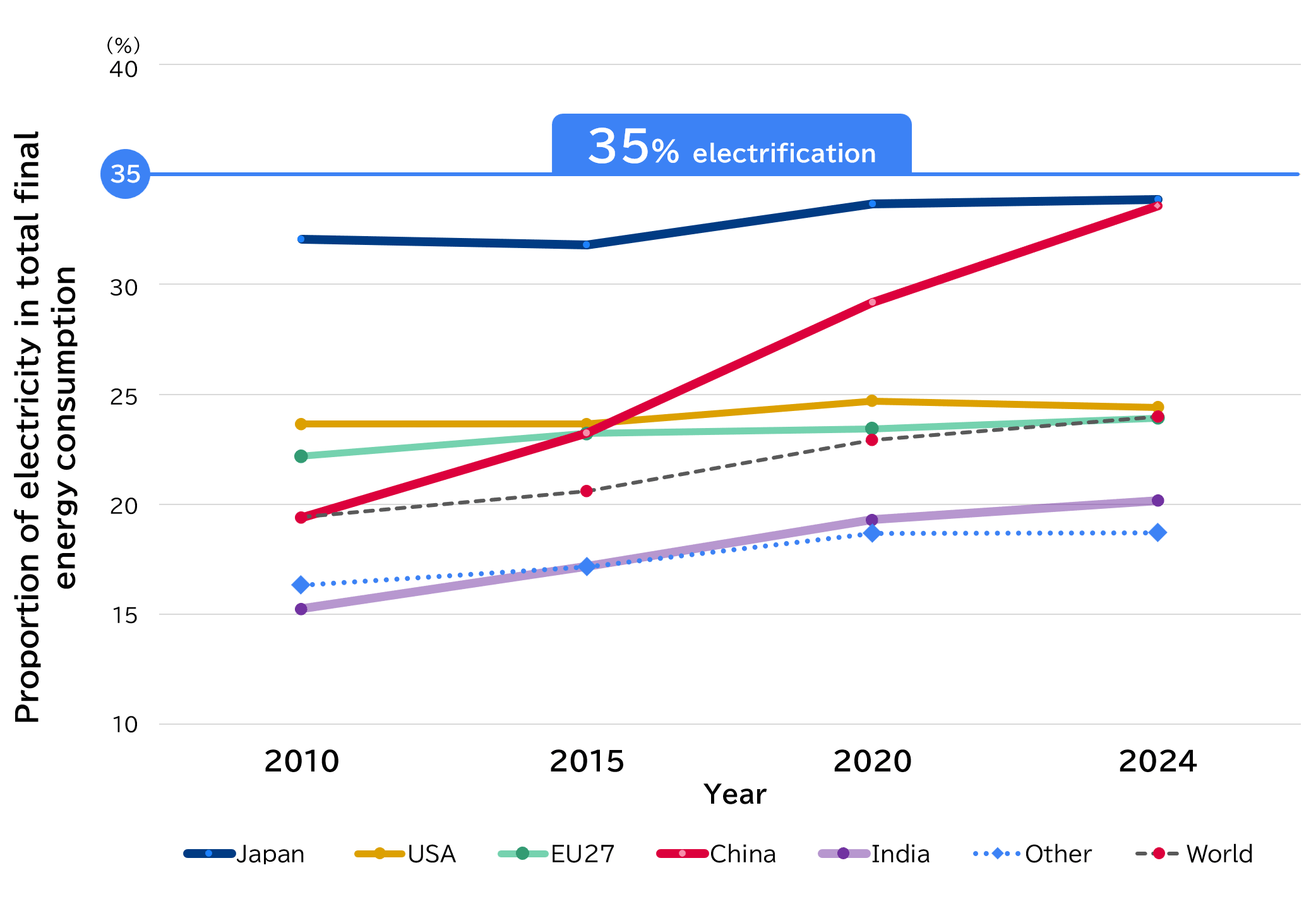
Note: The electrification rate is generally calculated as the share of electricity in final energy consumption, excluding non-energy use. Because each country's electrification rate is influenced by its industrial structure, living environment, energy resources and other factors, rapid changes are difficult; against this background, China's exceptional rise in its electrification rate stands out
Source: Mitsubishi Research Institute, Inc. calculated from IEA World Energy Balances data
Source: Mitsubishi Research Institute, Inc. calculated from IEA World Energy Balances data
Figure 2: Comparison of the projection for 2025 made in 2010, with actual 2025 results
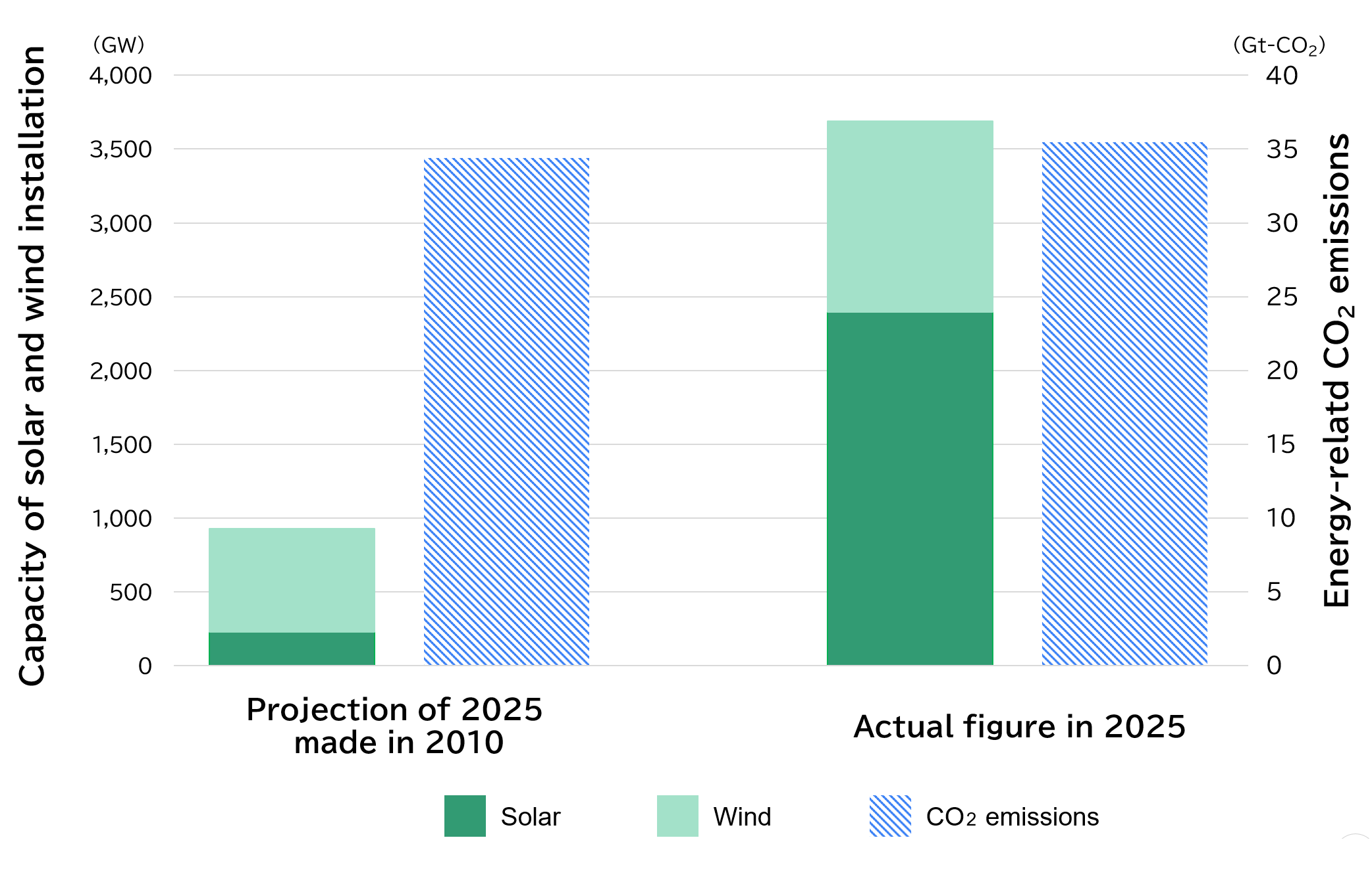
Note: The capacity of renewable energy deployed in 2025 far exceeded the 2010 projection for 2025, with solar PV in particular exceeding it by more than tenfold. However, partly because consumption of energy, including electricity, has also grown more than projected at the time, CO2 emissions have not declined
Source: Mitsubishi Research Institute, Inc. from IEA World Energy Outlook 2010, IEA Global Energy Review 2026, and IRENA Renewable Energy Statistics 2026
Source: Mitsubishi Research Institute, Inc. from IEA World Energy Outlook 2010, IEA Global Energy Review 2026, and IRENA Renewable Energy Statistics 2026
Waste and methane
Waste reduction is a theme championed by the First Lady of Türkiye. Methane is the second most important greenhouse gas after CO2, and 30% of climate change to date is said to be attributable to anthropogenic methane emissions. About one-fifth of anthropogenic methane emissions come from landfilled waste, so waste reduction is also meaningful as a methane emission reduction measure. The target stated in the Action Agenda is reduce the projected increase in municipal solid waste generation by at least 50%. While such a target may be acceptable because it does not call for an absolute reduction in waste, a key challenge in making it effective will be to clarify the basis on which the increase is deemed to have been halved (e.g., how future projections are set).
The Action Agenda, which includes these themes, is being considered separately from the negotiations. This reflects the distinctive nature of this session led by two countries, Türkiye and Australia, and it is hoped that the Action Agenda will be referred to in some form in the cover decision.
The Action Agenda, which includes these themes, is being considered separately from the negotiations. This reflects the distinctive nature of this session led by two countries, Türkiye and Australia, and it is hoped that the Action Agenda will be referred to in some form in the cover decision.
The growing importance of adaptation
Adaptation has also become an important issue in recent climate change negotiations. As a result of climate change, severe disasters such as torrential rain will become more frequent in the short term, while sea levels rise and glaciers and sea ice shrink in the long term; these changes, in turn, have major impacts on areas such as agriculture and health. Adaptation aims to minimize the impacts of climate-related disasters and, together with mitigation (reduction of greenhouse gas emissions), is regarded as one of the two pillars of climate action.
As noted above, the UNEP report's finding that an "overshoot" of 1.5°C is now widely considered unavoidable and the disaster in Nepal were events that strongly highlighted the need for adaptation. On adaptation, the central task at COP31 will be to further elaborate the indicators developed at COP30 in 2025 concerning target setting and the implementation of adaptation measures under the "Global Goal on Adaptation" in Article 7 of the Paris Agreement.
Finance remains the key challenge for adaptation. Unresolved issues remain regarding the "means of implementation" (financial contributions) included in the indicators of the Global Goal, and the modalities for further contributions to the Adaptation Fund associated with the generation and transfer of carbon credits. Progress toward the goal of doubling adaptation finance by 2025 relative to 2019 levels is also likely to be discussed.
Adaptation finance also falls within the scope of "climate finance", but compared with mitigation-related finance for renewable energy and energy efficiency equipment, it is more public in nature, and its main recipients are likely to be the least developed countries facing high climate risks. If, as a result of a shared recognition of the need for adaptation, some form of consensus can be reached on highly concessional adaptation finance, even in modest amounts, discussions on other negotiation items may also move forward.
What would success at COP31 look like?
As described above, COP31 involves a variety of issues beyond its main agenda items. The success or failure of COP31 therefore cannot be measured solely by progress in the formal negotiations on the agenda, but should also be assessed from the perspective of maintaining multilateral cooperation. The reality of international climate negotiations over the past two to three years is that the confrontation between developed and developing countries, a long-standing undercurrent in international negotiations, has come to the surface in the absence of negotiation items that would constitute major milestones, and COP31 is no exception. Moreover, given that the United States is not expected to engage substantively in the negotiations, reaching an agreement that would make its future re-entry difficult would be counterproductive. It is therefore reasonable not to expect significant progress in the negotiations.
Turning to the positions of participating countries, the confrontation between developed and developing countries can be characterized as one between the European Union, which promotes globally common action using tools such as the Carbon Border Adjustment Mechanism (CBAM), and many developing countries, which oppose this on the basis of "common but differentiated responsibilities"4 and call on developed countries to take the lead in action and provide finance. In contrast, Japan and other non-EU developed countries such as Australia and Canada are closer to an intermediate position.
Meeting developing countries' calls for financial contributions is difficult for every country, and Japan is no exception. On the other hand, it is now becoming increasingly clear that the damage from climate change will not wait for stalled international negotiations. Against this backdrop, it is hoped that the "Umbrella Group", to which Australia, which is running COP31, belongs together with Japan, Canada and others, will work with Türkiye, which is keen to make the conference a success, to find a way forward. It is hoped that the increasingly visible impacts of climate change, together with such efforts, will foster a shared recognition of the need for multilateral cooperation and, as a result, lead to an agreement on adaptation that includes some form of support.
Meanwhile, bringing the Action Agenda—including the aforementioned initiatives on electrification and waste reduction—into the COP negotiations with specific numerical targets would impose a heavy negotiating burden and could hinder the kind of agreement described above. It is therefore hoped that, even without numerical targets, a cover decision referring to higher electrification rates, in line with the recent momentum of the energy transition, as well as further waste-reduction measures, will be adopted.
If such an agreement helps ease, even slightly, the deadlock between developed and developing countries and leads to constructive discussions on the "Global Stocktake" and "just transition", COP31 could arguably be called a success.
What opportunities does COP31 suggest for Japan?
With electrification, waste methane measures and adaptation expected to be in the spotlight at COP31, it is hoped that Japan will identify business opportunities in these areas.
Regarding electrification, Japan's electrification rate is calculated to be close to 35% based on IEA data. The outcomes of COP31 could serve as an opportunity to consider the optimal form of electrification for Japan in the process of further decarbonization and electricity system reform, and internationally it could lead to the rollout of initiatives such as energy-efficient data centers. As for waste-derived methane, it accounts for around 4% of global GHG emissions but only around 0.3% of Japan's emissions. Conversely, this means there is scope to deploy abroad the waste incineration/waste-to-energy technologies and 3R5 technologies that Japan has developed, and that could help contribute to methane emission reductions. Such electrification and methane measures overseas could also be supported through initiatives under the JCM and the PACM (Paris Agreement Crediting Mechanism).
Furthermore, with regard to adaptation, Japan, which experiences frequent natural disasters, has technologies and know-how in areas such as early warning systems, monitoring, and disaster-response infrastructure, and COP31 could provide an opportunity to showcase them to the world. Public support for such adaptation measures is one of the forms of climate finance most likely to meet the needs of developing countries. It may well be worth leveraging strategically.
1Hereinafter, COP31 is used as a collective term which also covers the eighth session of the Conference of the Parties serving as the meeting of the Parties to the Paris Agreement (CMA8), and other associated meetings.
2UNEP, 2026, Limiting Overshoot. It should also be noted that the World Meteorological Organization (WMO) estimates that the global average temperature in 2024 was 1.55°C above the pre-industrial level.
3COP31 Türkiye, "Letters from the Presidency"
https://cop31.tr/letters (accessed 23 October 2026)
4Small Island Developing States (SIDS) often take positions similar to those of the EU.
5Reduce, reuse, recycle
Author profile

Kenichiro Yamaguchi
Green Transformation Division
Kenichiro Yamaguchi is a member of the Methodological Expert Panel under Article 6.4 of the Paris Agreement and is internationally recognized as a leading expert on carbon credit quantification methodologies. He has participated in almost every COP since COP3 (Kyoto) and has broad knowledge of, and an extensive network in, climate change measures.

Kikuko Shinchi
Green Transformation Division
Kikuko Shinchi has extensive knowledge of domestic and international CCUS policies and project development gained through initiatives undertaken by Japan’s Ministry of Economy, Trade and Industry (METI), JOGMEC, and the Asia CCUS Network. She serves as a member of the Working Group on Support Measures for CCS Projects and the Working Group on the Development of a Regulatory Framework for CCS Projects under the Subcommittee on Carbon Management.

Kei Sakakibara
Green Transformation Division
Kei Sakakibara provides consulting, policy recommendations and hands-on support on climate change and environmental issues to government and private-sector clients. In addition to extensive experience in carbon credits and adaptation-related business, she is well versed in the field of sustainable finance.

Somei Yanagitani
Green Transformation Division
With a background in environmental chemistry and international cooperation studies, Somei Yanagitani joined Mitsubishi Research Institute and now provides research and hands-on support to government and private-sector clients in climate change fields such as carbon credits and biofuels.