It is essential for Japan to adopt a green-transformation (GX) perspective as it establishes large-scale DC clusters to meet the growing demand for AI.
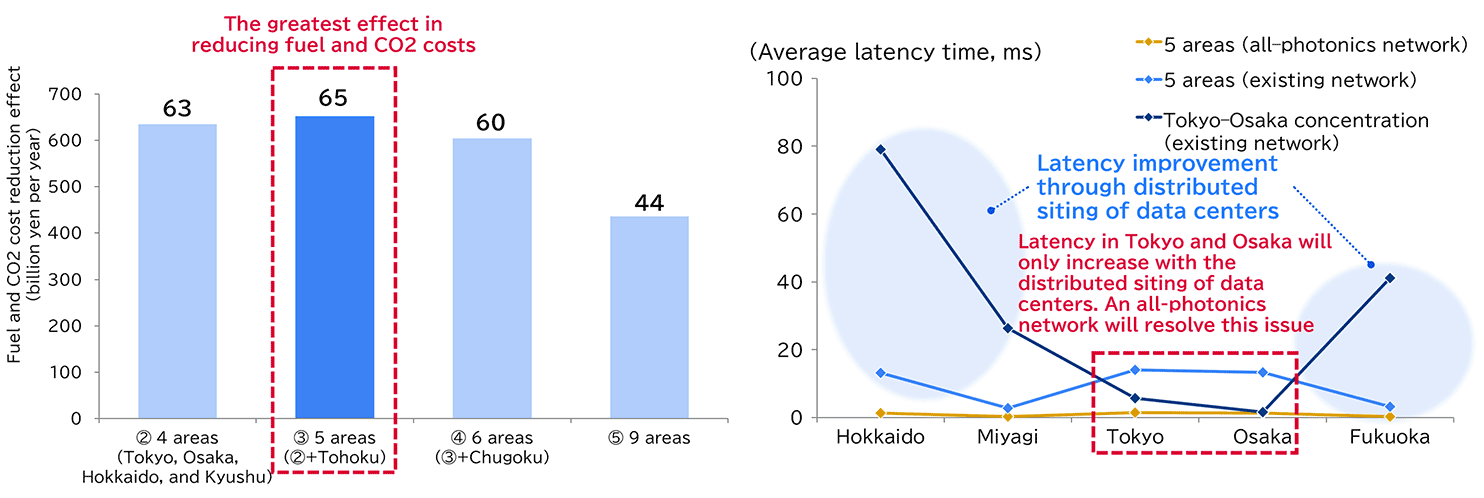
Using its original quantitative model, MRI conducted analysis of distributing data center clusters across five areas—Tokyo, Osaka, Hokkaido, Tohoku, and Kyushu—rather than concentrating them in Tokyo and Osaka. They calculated that such changes would reduce renewable-energy curtailment and lower fossil-fuel consumption and CO₂-mitigation costs by approximately 65 billion yen per year. This configuration enables the most effective use of renewable energy. Today, DC siting prioritizes access to Tokyo and Osaka networks (e.g., internet exchange points, or IXs*). However, with nationwide deployment of all-photonics networks, MRI estimates that latency concerns will diminish even with a more distributed DC footprint.
*Facilities that enable mutual interconnection among Internet service providers (ISPs), data center operators, and other networks
Effects of reducing fuel and CO₂ costs through distribution of clusters (left) and average network latency with advances in network technology (right) in 2040
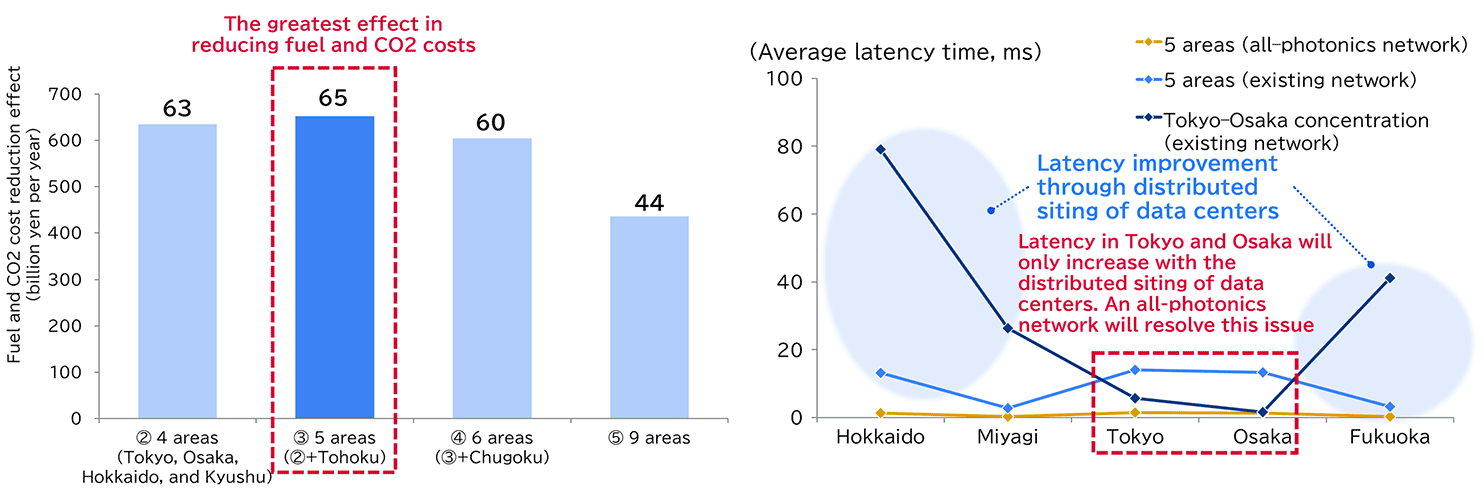
Note: The left-hand figure shows estimated reductions in fossil-fuel consumption and CO₂-mitigation costs, relative to scenario ①, in which data centers are concentrated in the Tokyo and Osaka areas. Estimates assume nationwide adoption of an all-photonics network. In scenario ③ data centers are distributed across five areas: Tokyo, Osaka, Hokkaido, Kyushu, and Tohoku. Here, average latency is illustrated for a representative prefecture in each area
Source: Mitsubishi Research Institute, Inc.