Building Energy Autonomy in an Era of Crisis

Surging fossil fuel costs during emergencies: Transforming energy supply and demand to avoid JPY 1 trillion in additional costs
18 November 2026

Japanese version: 9 September 2026

Mitsubishi Research Institute, Inc.

Mitsubishi Research Institute, Inc. published the English version of its research report and proposals on energy autonomy in an era of crisis. Within, the firm presents the concept of energy autonomy—flexibly reconfiguring energy supply, energy demand, and what is prioritized when it comes to sustaining societal functions—and proposes three policy transformations to achieve it. The document also covers the firm’s detailed analysis of the future structure of energy supply and demand in light of the deterioration of the situation in the Middle East and potential further changes in international affairs, resources, and logistics.

The following is an overview, with the full report available for download below.
1. Background

The deterioration of the situation in the Middle East since late February 2026 has exposed Japan’s energy supply not only to rising prices but also to interconnected constraints spanning procurement, maritime transport, and domestic refining and distribution. Although stockpiling and procurement diversification are effective against short-term disruptions in supply, a prolonged crisis can bring an onslaught of challenges all at once: price surges, logistics and supply constraints, and delays in decisions on long-term contracts and capital investment. These measures alone cannot fully contain the resulting costs borne by society as a whole.

2. Overview

Building energy autonomy in an era of crisis

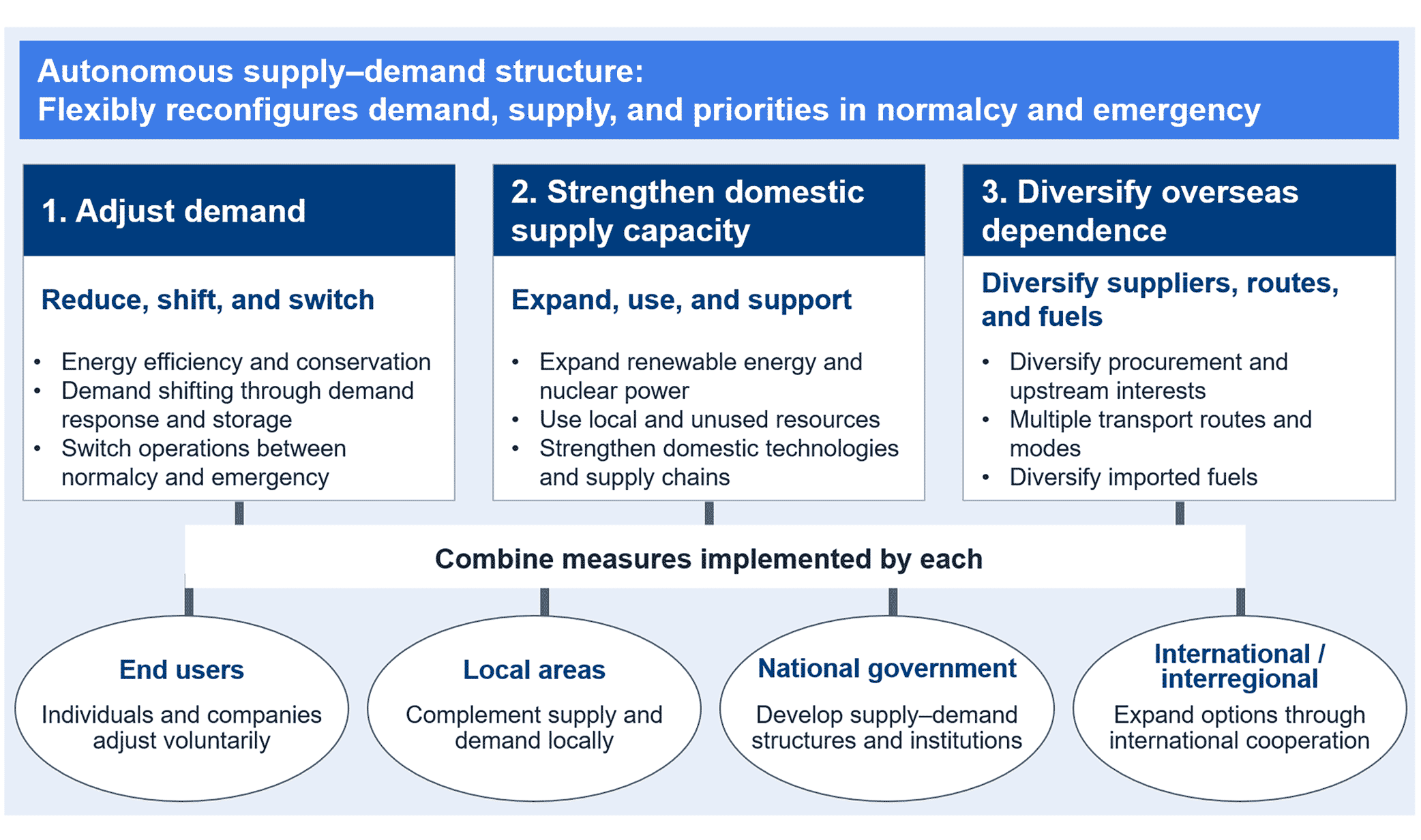
We, Mitsubishi Research Institute, Inc., propose measures to build energy autonomy: securing, during normalcy, options to flexibly reconfigure energy demand and supply, and reviewing the priority placed on each as externalities change, thereby sustaining societal functions. Energy autonomy does not mean complete domestic self-sufficiency. Rather, it means reducing external dependence to some extent while strengthening the ability to adjust and switch supply and demand independently during crises.
Figure 1: Three supply–demand transformations toward energy autonomy
Three supply–demand transformations toward energy autonomy
Source: Mitsubishi Research Institute, Inc.

Mobilizing promising technologies over the short- to medium-term to avoid approximately JPY 1 trillion in costs during emergencies

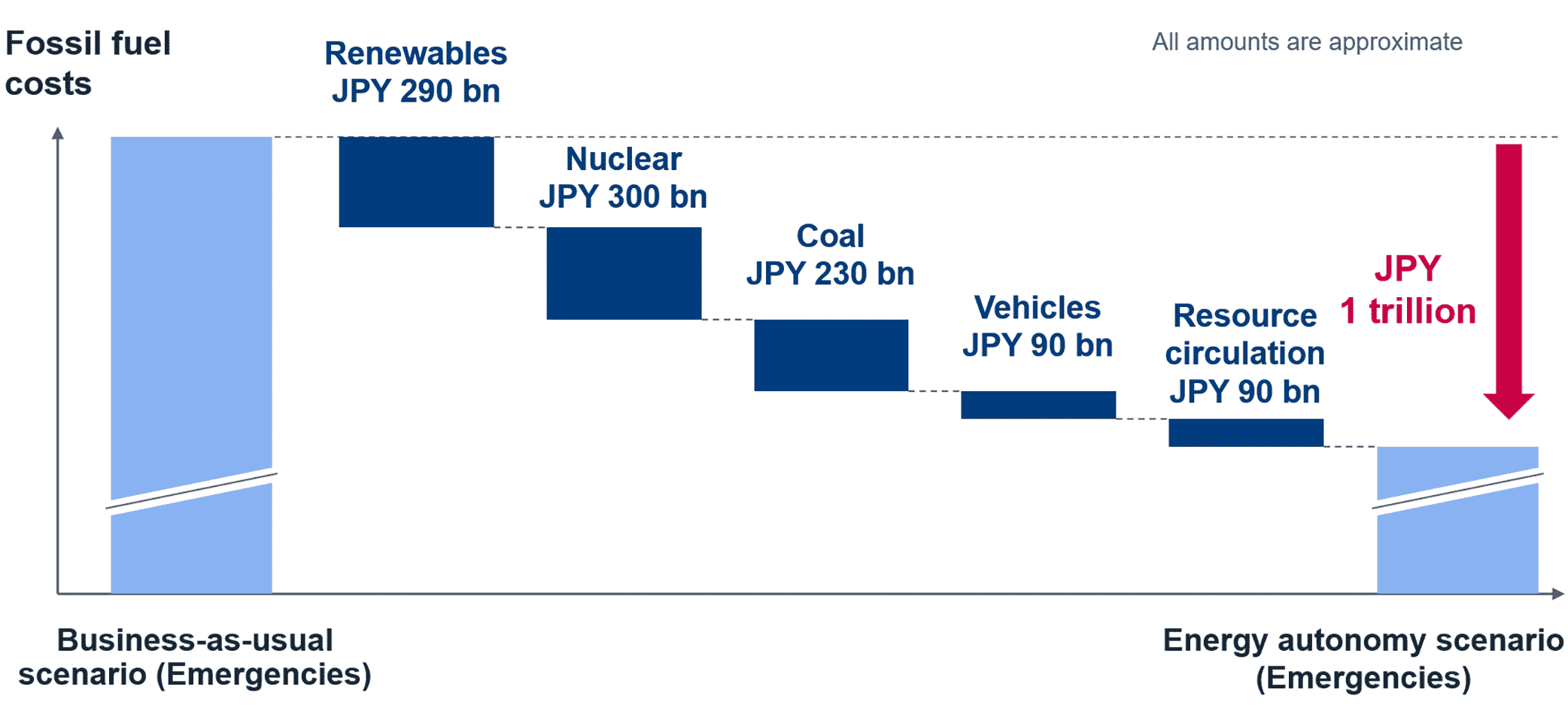
For fiscal year (FY) 2035, we designed an energy autonomy scenario that adds further measures to the business-as-usual (BAU) scenario, which follows current policies and established plans. We evaluated its effects using MRI-TIMES, a model for analyzing energy supply and demand. The analysis compares the two scenarios under an emergency in which elevated fossil-fuel prices persist for one year. The five areas examined are renewable energy, nuclear power, coal-fired power, vehicles, and resource circulation.

Under these assumptions, the five areas together avoid approximately JPY 1 trillion in additional fossil-fuel costs. No single technology delivers this result; combining multiple measures produces a substantial total in avoided costs.
Figure 2: Breakdown of fossil-fuel costs avoided during emergencies under the FY2035 energy autonomy scenario (relative to business-as-usual scenario)
Breakdown of fossil-fuel costs avoided during emergencies under the FY2035 energy autonomy scenario (relative to business-as-usual scenario)
Note: The figure represent reductions in fossil-fuel costs, not net benefits after deducting the capital, operational, maintenance, and other costs required for each measure

Main estimation assumptions
・Emergency fossil-fuel prices are assumed to persist for one year, based on 2022 and the current situation: oil at 1.5 times, LNG at 2.4 times, and coal at 2.1 times their levels in normalcy
・All of the additional 10 GW of renewable capacity is assumed to be solar photovoltaics
・The additional 2 GW of nuclear capacity is added mechanically relative to the business-as-usual scenario, without identifying specific plants
・An additional 3 GW of coal-fired capacity relative to the business-as-usual scenario is assumed to be available in emergency
・For vehicles, fossil-fuel savings are calculated for the electric-driving portion of BEVs and PHEVs
・For resource circulation, naphtha substitution is evaluated through mechanical recycling, chemical recycling, and biomass-derived plastics

Source: Mitsubishi Research Institute, Inc.

Three policy transformations supporting energy autonomy

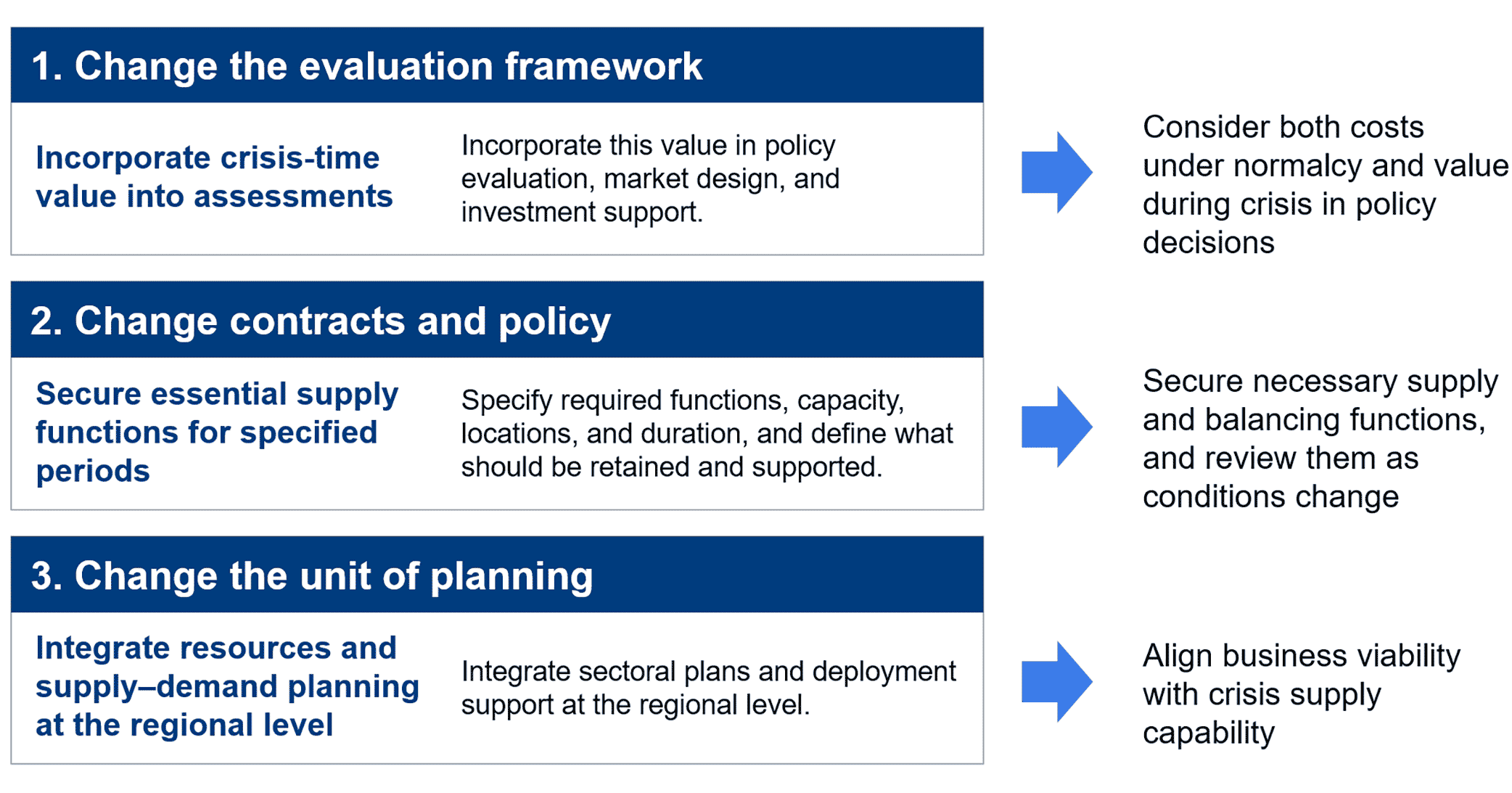
Strengthening Japan’s energy security requires transforming the energy supply–demand structure itself to make it more resilient to crises, in addition to stockpiling and procurement diversification. We propose three policy transformations: incorporating value under crisis into assessments, establishing contracts and policies that ensure essential supply functions, and integrating the use of local resources at the regional level.
Figure 3: Three policy transformations for energy autonomy
Three policy transformations for energy autonomy
Source: Mitsubishi Research Institute, Inc.

3. Moving forward

In light of growing instability in the Middle East, Japan needs to reduce risks associated with dependence on overseas energy and advance energy autonomy. We will deepen our research and proposals on policy and business models that integrate energy security with decarbonization, industrial competitiveness, and regional development.

Full report

Contents

  • Chapter 1: Vulnerabilities exposed by the Strait of Hormuz Crisis (How efficiency in normalcy becomes vulnerability in emergency / A new direction for energy autonomy)
  • Chapter 2: Energy autonomy in an era of crisis (A way to avoid JPY 1 trillion in costs during emergencies / Designing an energy autonomy scenario / Applying the scenario to limit cost increases / Renewable energy, nuclear power, coal-fired power, and oil: vehicles and resource circulation)
  • Chapter 3: Residual oil demand and supply chain redesign (The oil supply–demand structure / Transforming refineries into hubs for diverse carbon resources)
  • Chapter 4: Decentralized resilience through local resources (The value of unused local resources in normalcy and emergency / Untapped local biomass / Underutilized local land resources)
  • Conclusions and proposals: Three policy transformations for energy autonomy

About Mitsubishi Research Institute

Mitsubishi Research Institute, Inc. is one of Japan’s foremost think tanks. For over 50 years, it has provided the public and private sectors with research and consulting services in fields spanning energy, the environment, healthcare, human resources, and digital transformation. This is accompanied by policy recommendations and the real-world application of solutions. Mitsubishi Research Institute will continue to envision the future, resolve societal issues, and lead change to build a sustainable and prosperous world. For more information, please visit: www.mri.co.jp/en/

For more information

General contact

Tetsuya Nomoto, Hiroyuki Ishida, and Jiro Furuki
Center for Policy and the Economy
Mitsubishi Research Institute, Inc.
10-3, Nagatacho 2-chome, Chiyoda-ku, Tokyo 100-8141, Japan
E-mail:pecgroup@mri.co.jp

Media contact

Corporate Communications Division
Mitsubishi Research Institute, Inc.
10-3, Nagatacho 2-chome, Chiyoda-ku, Tokyo 100-8141, Japan
E-mail: media@mri.co.jp