
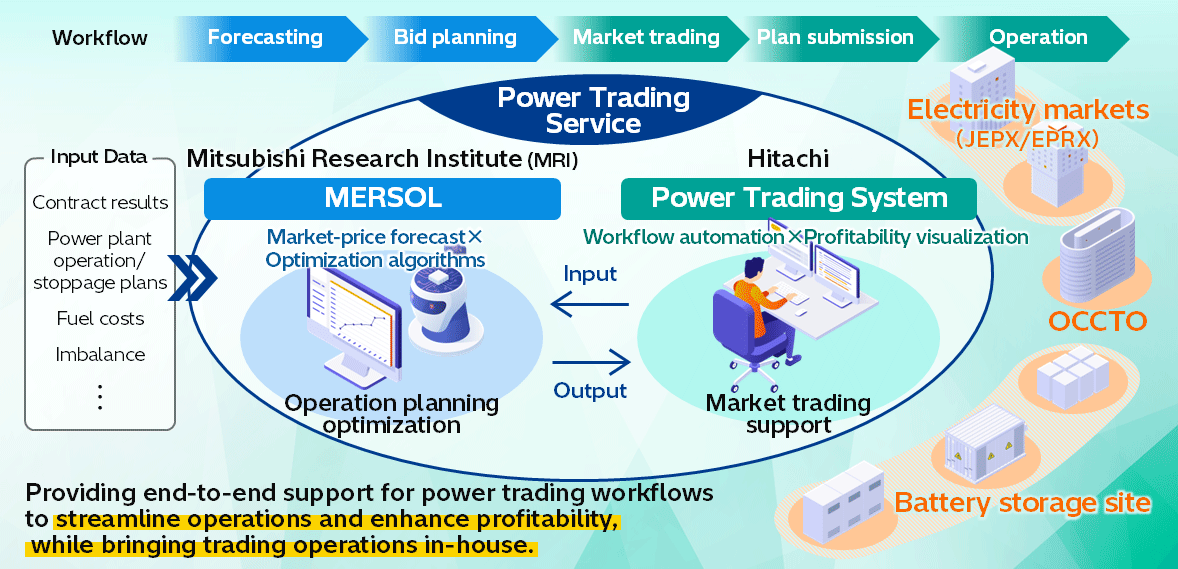
Overview of the Power Trading Service
Tokyo, 27 August 2026—Mitsubishi Research Institute, Inc. (TSE:3636, “MRI”) and Hitachi, Ltd. (TSE:6501, "Hitachi") signed a Memorandum of Understanding (MoU) on 25 August to build a cooperative framework for delivering advanced power-trading support services tailored to grid-scale battery operators in the extra-high voltage segment, including new market entrants. By integrating MRI’s distributed-energy-resource operation-support service, MERSOL (MRI Energy Resource Solution), with Hitachi’s Power Trading System, currently under development, the companies will establish a framework to offer a combined solution: Power Trading Service (the Service)*1.
By linking MERSOL's bid-planning optimization with Power Trading System's market-trading support, the Service will provide integrated, seamless support from automated bid planning to actual market transactions. This integration makes it easier for operators to bring sophisticated trading operations—historically outsourced to aggregators*2—in-house. This will enable operators to streamline operations, capture more revenue, and easily expand across multiple battery-storage sites. Through the Service, MRI and Hitachi will help grid-scale battery businesses improve their profitability and scalability.
By linking MERSOL's bid-planning optimization with Power Trading System's market-trading support, the Service will provide integrated, seamless support from automated bid planning to actual market transactions. This integration makes it easier for operators to bring sophisticated trading operations—historically outsourced to aggregators*2—in-house. This will enable operators to streamline operations, capture more revenue, and easily expand across multiple battery-storage sites. Through the Service, MRI and Hitachi will help grid-scale battery businesses improve their profitability and scalability.
*1Scheduled for launch in fiscal year 2027
*2Aggregators: Businesses that bundle and centrally control multiple distributed-energy resources to provide services such as power adjustment and market trading on behalf of operators