
Environment
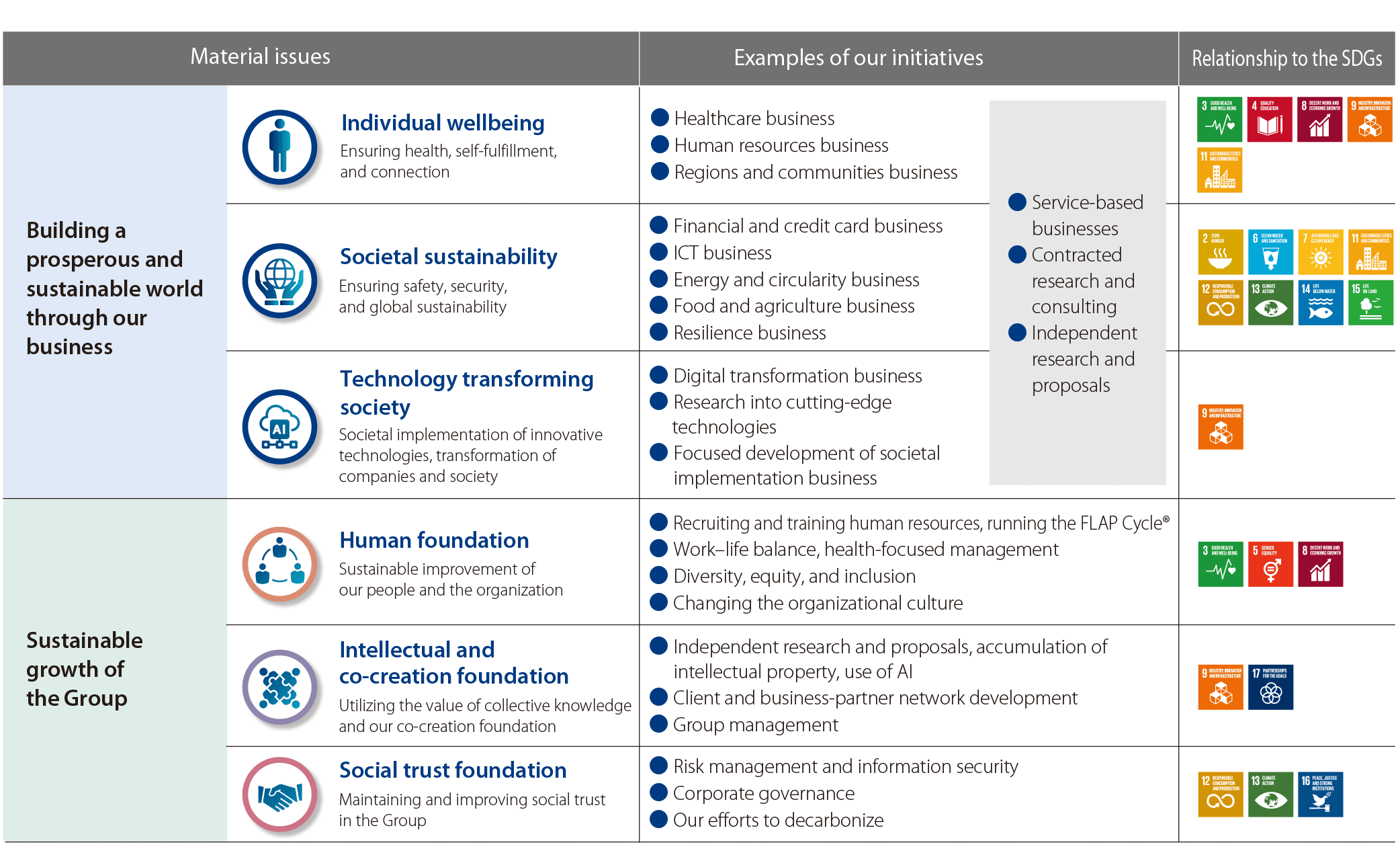
We, the Mitsubishi Research Institute Group, strive to build a sustainable, prosperous world through business. This work is driven by our value triad comprising financial, nonfinancial, and social value.
Our material issues guide our efforts to build up our value triad, particularly our social and nonfinancial values. Enhanced value leads to enhanced capability to resolve societal issues and a stronger social trust foundation, enabling us to help the world overcome its challenges and effect positive impact.
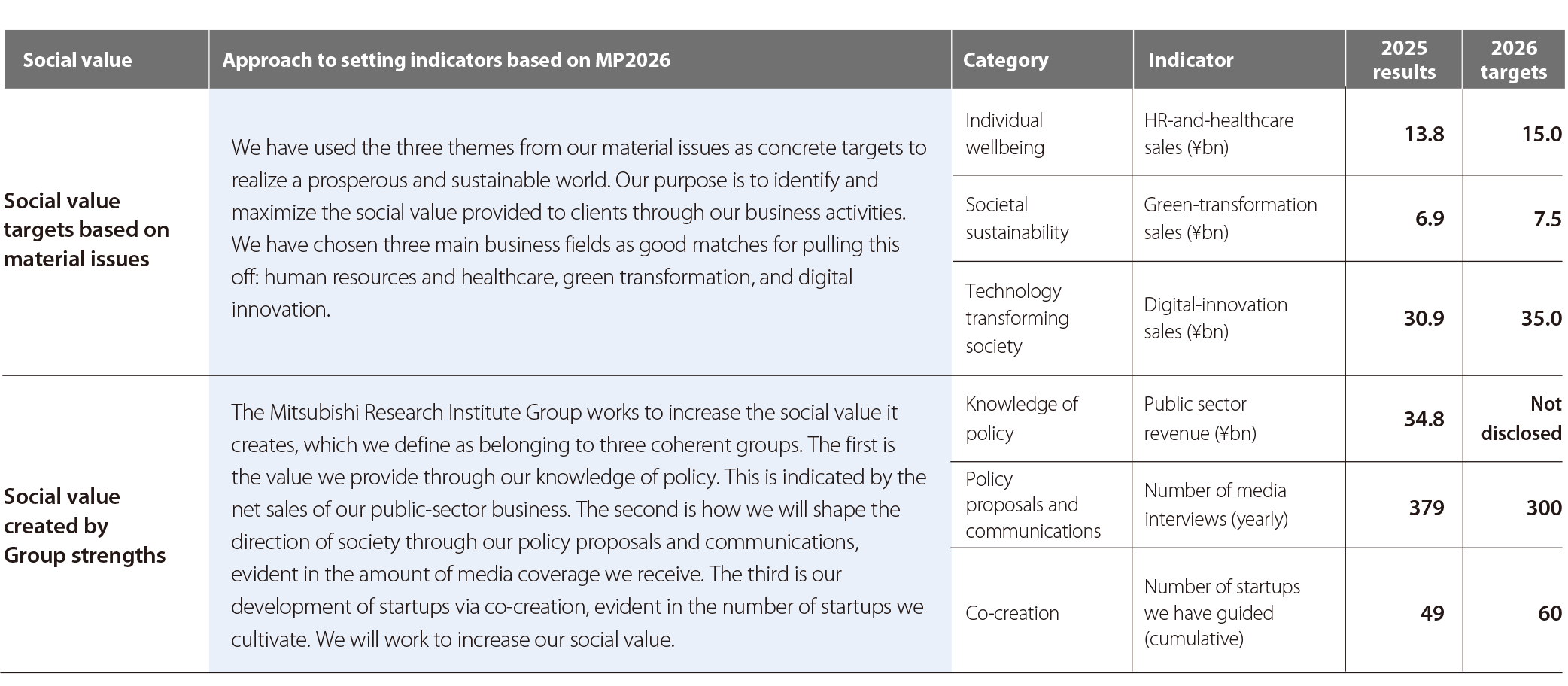
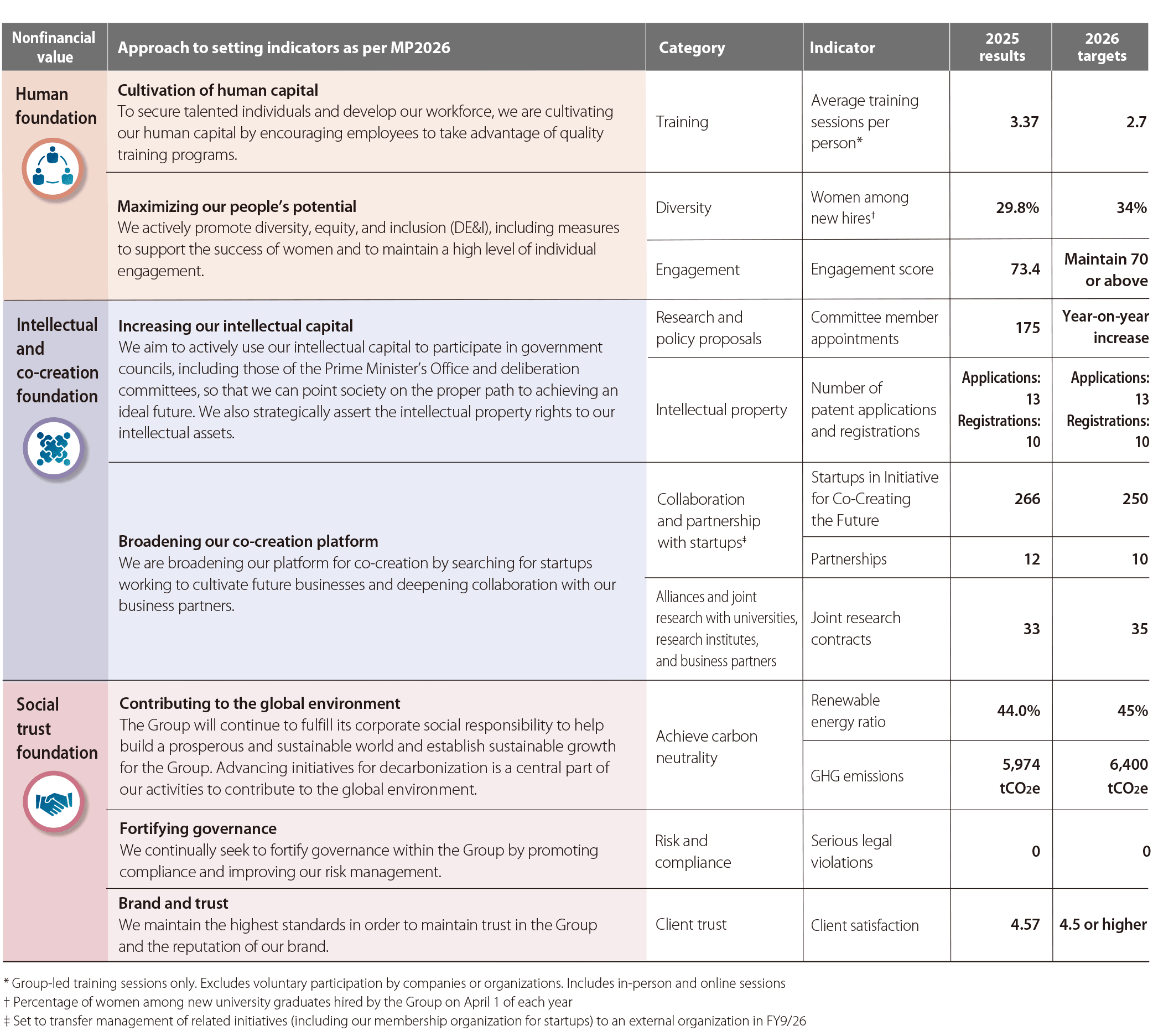
Our materiality framework consists of two pillars: social value and nonfinancial value. Social value is a long-term priority, and nonfinancial value is necessary to enhance the Group’s sustainability and generate social value.
Positioning of material issues

Identification process
We referenced both international frameworks as well as our own original research in identifying material issues. Here, our 50th Anniversary Research Project provided a long-term outlook of the world for the next 50 years. We homed in on specific issues via our Listings of Societal Issues, a report that we create annually by organizing and assessing societal issues from the macro-level perspective we enjoy as a comprehensive think tank.
Every three years, we set a new medium-term management plan, and through that process, we assess and review issues from two perspectives. First, we examine societal importance, taking into consideration public expectations and interest in addressing challenges. Second, we examine corporate importance, exploring our ability to contribute through our corporate mission and the creation of nonfinancial value.
Final selection of material issues is made following discussions at the Executive Committee and the Board of Directors.
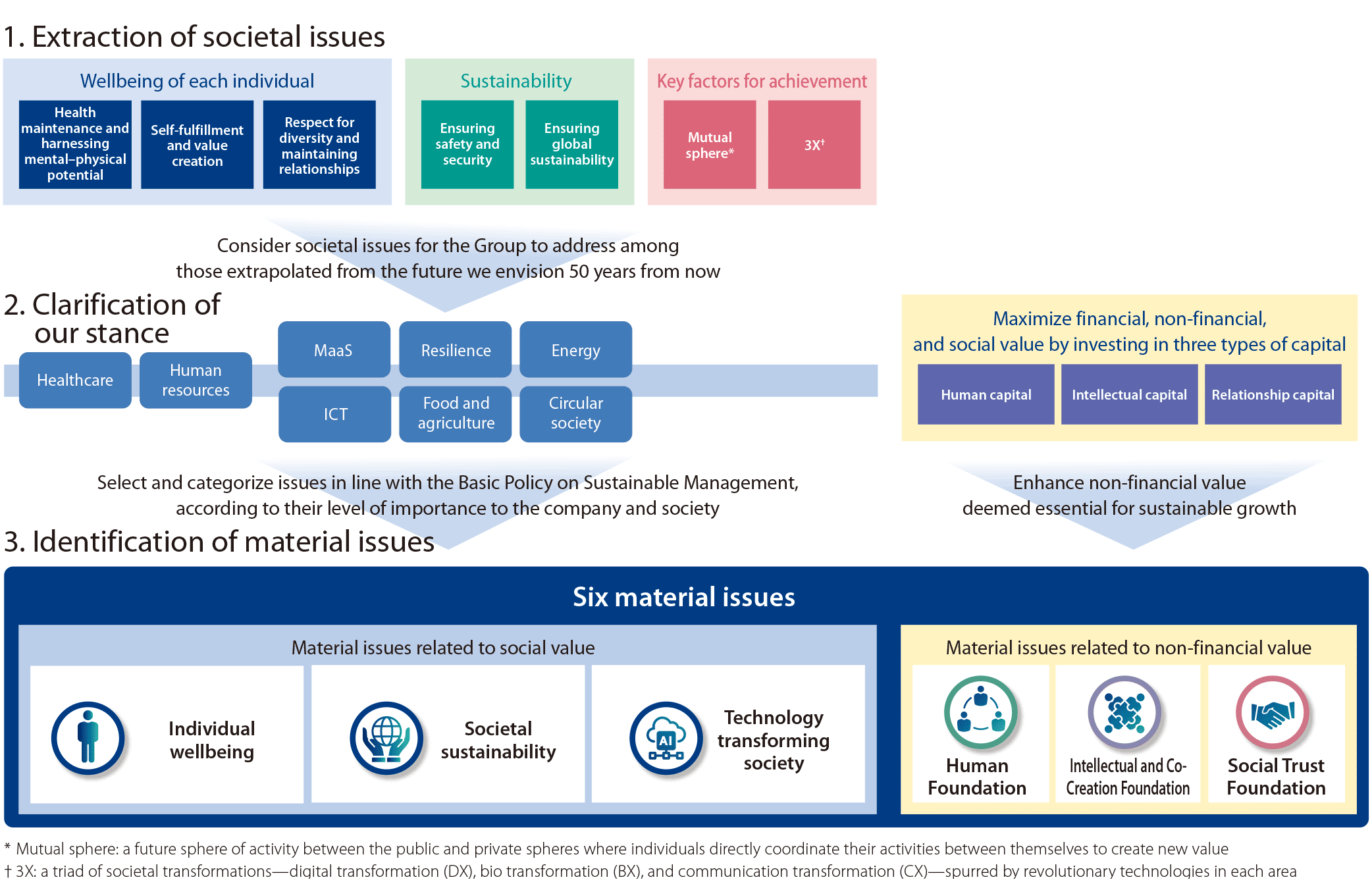
Overview of identification process

Dialogue behind material issues
The discussions of our 50th Anniversary Research in 2020 laid the groundwork for identifying our material issues.
Here, the Group looked ahead to the year 2070, envisioning a world with a population of 10 billion people and lifespans of 100 years. We considered what kind of form society should take to achieve that future as well as the approaches required to get us there in a prosperous and sustainable fashion. We set five goals for realizing individual wellbeing and a sustainable society, and we articulated two key factors essential to achieving these goals (see step 1 in figure below).
We also designated priority domains for our unique value creation process (VCP). These are the key societal-issue areas in which the Group has an established business foundation and through which we are well positioned to contribute to solutions (see step 2 in figure below).
With the introduction of sustainability management in April 2022, the Board of Directors engaged in discussions aimed at identifying the Group’s material issues and set the following four requirements:
- The material-issue framework should reflect the outcomes of both the 50th Anniversary Research Project and dialogue on the VCP priority domains
- Material issues should adopt a dual structure consisting of the social value emphasized by the Group and the nonfinancial value required to create such value
- We should clarify the long-term direction and priorities of each element
- We should incorporate the pursuit of societal transformation and the real-world implementation of solutions through innovative technologies such as digital transformation (see step 3 in figure below)
Dialogue underpinning identification of material issues