
Sustainability management is centered on identifying material issues. These should reflect a company’s agenda and strategies, which in turn reflect its long-term business landscape and how it imagines itself and society down the road. Such factors point companies to original materialities, and this is just how Japanese companies are building up unique forms of sustainability management. Quality case studies from Japan shed light on how to enhance corporate value by identifying material issues.
Management should identify materialities according to its business agenda and strategies
Dialogue with stakeholders and long-horizon thinking are key
How to identify distinctive materialities
Plenty of companies set themselves a broad range of priority issues, or materialities, pertaining to sustainability in response to the varied demands of diverse stakeholders. Meanwhile, a growing number of companies now focus and communicate on only their distinctive materialities. These comprise original issues that set a company apart from competitors and allow it to leverage signature strengths in resolving challenges.
Figure 1: Examples of companies with distinctive materialities
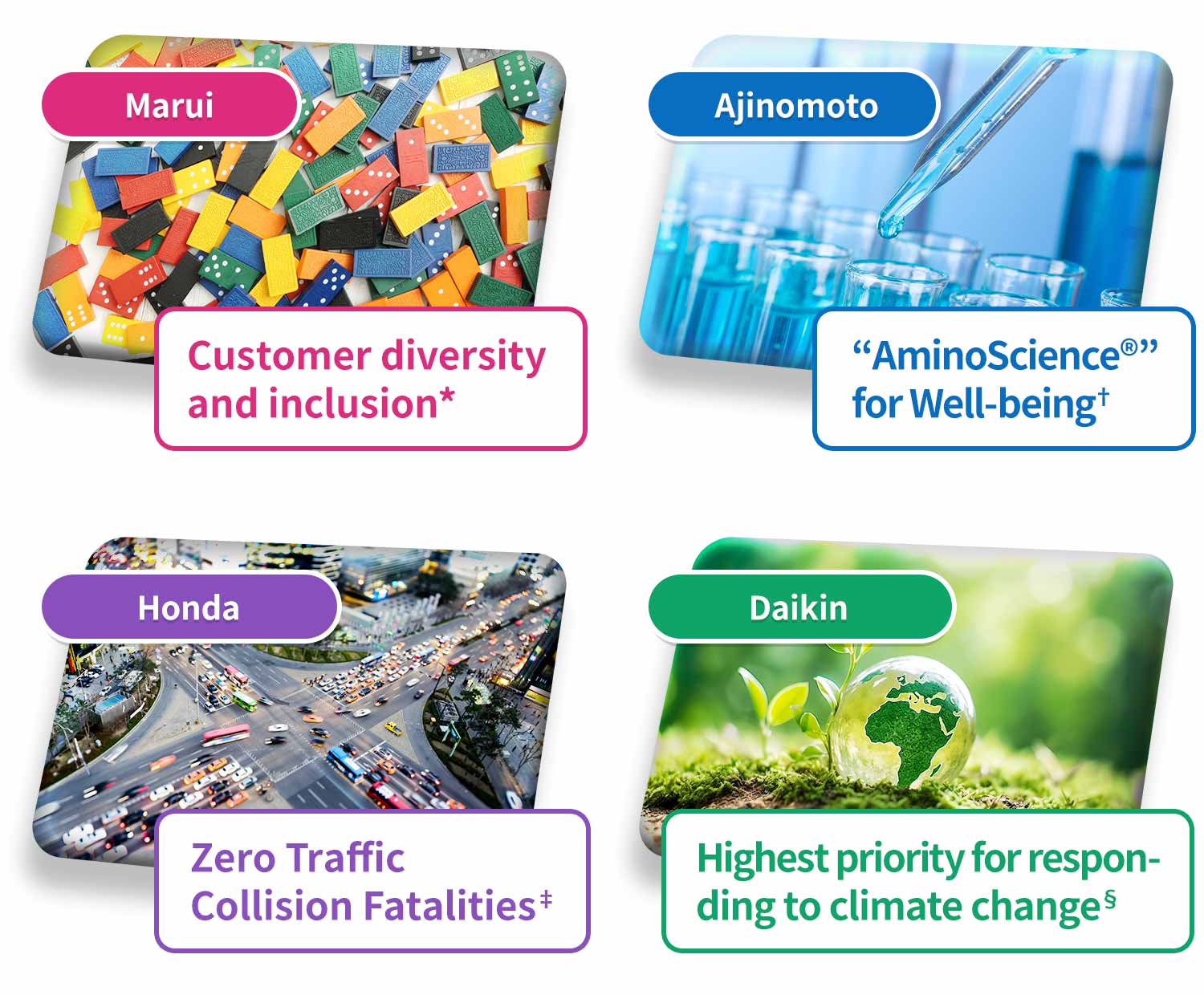
* Marui Group’s four core sustainability themes (As of September 2019)
https://www.0101maruigroup.co.jp/en/sustainability/ (Accessed: 29 May 2024)
† Ajinomoto’s ESG sustainability materialities
https://www.ajinomoto.com/sustainability/materiality.php (Accessed: 29 May 2024)
‡ Honda Group Sustainability: Honda’s priority issues (materialities)
https://global.honda/en/materiality/ (Accessed: 29 May 2024)
§ Daikin Group Sustainability Report 2023
https://www.daikin.com/-/media/Project/Daikin/daikin_com/csr/new/pdf/report/2023_all_browsing-pdf.pdf?rev=-1&hash=2BF7F537EA1018AD8D758B8FF3CBBDFB (Accessed: 29 May 2024)
Source: Mitsubishi Research Institute, Inc. using excerpts from the respective companies’ websites
https://www.0101maruigroup.co.jp/
† Ajinomoto’s ESG sustainability materialities
https://www.ajinomoto.com/
‡ Honda Group Sustainability: Honda’s priority issues (materialities)
https://global.honda/
§ Daikin Group Sustainability Report 2023
https://www.daikin.com/
Source: Mitsubishi Research Institute, Inc. using excerpts from the respective companies’ websites
In the near future, organizations will likely be required to adhere to the Ministry of Economy, Trade and Industry’s (METI) Guidance for Collaborative Value Creation and Sustainability Standards Board of Japan (SSBJ)* Disclosure Standards (published draft). These stipulate that companies disclose the linkages between their sustainability initiatives and their creation of corporate value. This makes it all the more crucial for companies to choose their materialities wisely (Figure 2).
*The Sustainability Standards Board of Japan. Since 2023 it has been developing disclosure guidelines for Japan based on IFRS sustainability guidelines
Figure 2: Examples of what companies will be asked to disclose on how sustainability and corporate value relate to each other
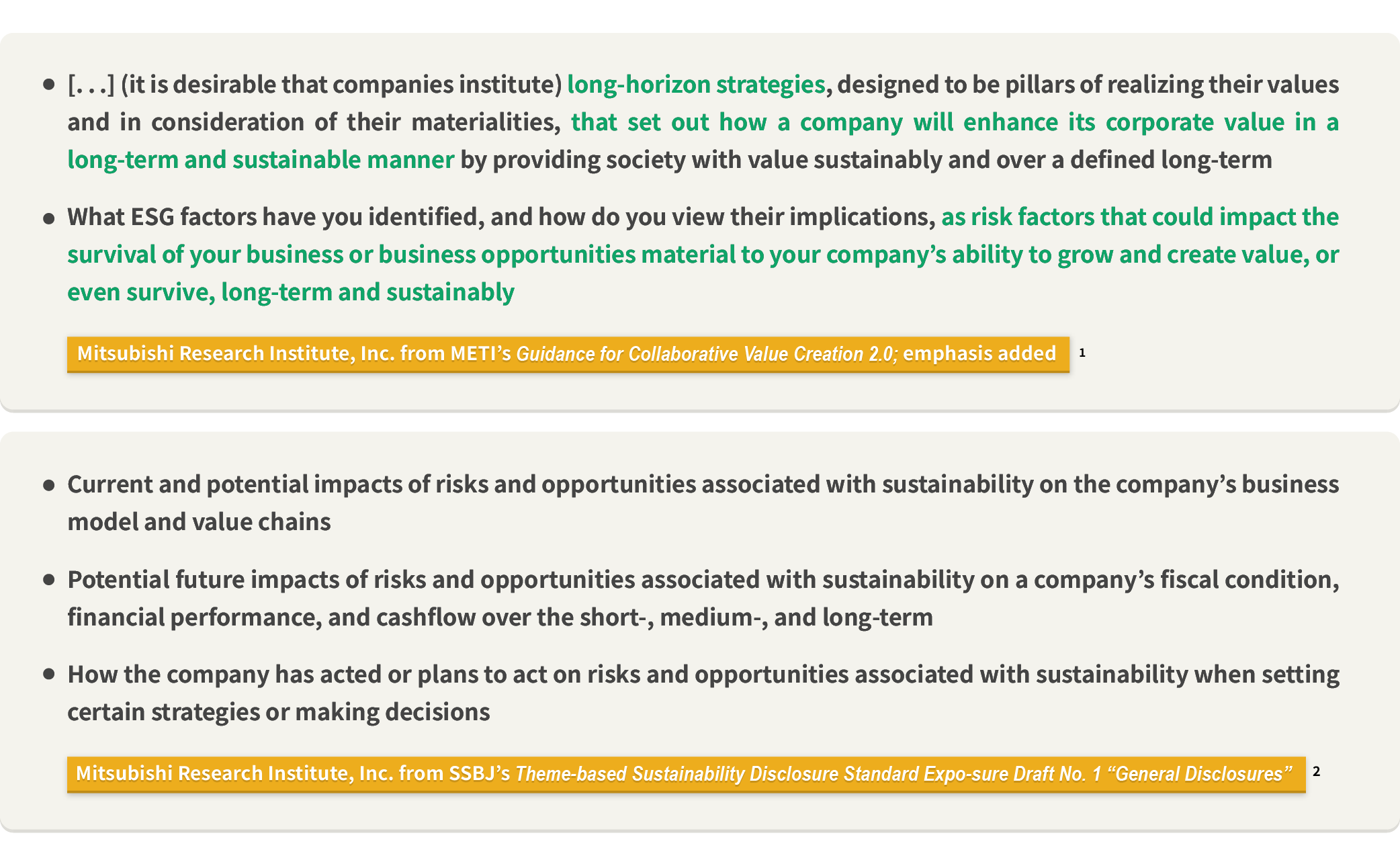
1 Mitsubishi Research Institute, Inc. from METI’s Guidance for Integrated Corporate Disclosure and Company-Investor Dialogue for Collaborative Value Creation 2.0 (“Guidance for Collaborative Value Creation 2.0,” revised 30 August 2022),
https://www.meti.go.jp/policy/economy/keiei_innovation/kigyoukaikei/guidance_for_collaborative_value_creation_2.0_en.pdf (Accessed: 29 May 2024)
2 Mitsubishi Research Institute, Inc. from SSBJ’s Universal Sustainability Disclosure Standard Exposure Draft “Application of the Sustainability Disclosure Standards” of March 2024 at
https://www.ssb-j.jp/jp/wp-content/uploads/sites/6/2024ed01_02.pdf (Japanese; accessed: 29 May 2024)
Source: Mitsubishi Research Institute, Inc.
https://www.meti.go.jp/
2 Mitsubishi Research Institute, Inc. from SSBJ’s Universal Sustainability Disclosure Standard Exposure Draft “Application of the Sustainability Disclosure Standards” of March 2024 at
https://www.ssb-j.jp/
Source: Mitsubishi Research Institute, Inc.
Headlining distinctive materialities tells the world, including insiders, what’s special about a company and where management wants to take it. Requisite for identifying them, though, is that a company define medium- to long-term strategies embodying realizable specifics. This makes it possible to explore the issues material to the company’s value over time—its materialities—and more easily allocate resources while steadily advancing its sustainability agenda. Further, appropriately disclosing data on progress on the issues helps make stakeholder communication more effective, ultimately enhancing corporate value long-term.
Real-world examples from progressive Japanese companies offer insights in how to pull this off.
Real-world examples from progressive Japanese companies offer insights in how to pull this off.
Approach 1: Find fundamental challenges with long-horizon thinking
It is extremely important for businesses to use long-horizon thinking in validating their sustainability. This helps in avoiding assumptions premised on future businesses being extensions of existing ones. It also helps planners spot non-linear risks and opportunities.
Scenarios of society-wide carbon neutrality by 2050 have permeated climate change analysis; but companies must conduct analyses with horizons 10- to 20-years out, and these analyses need to look into the specifics of how changes in other areas (say, biodiversity or human resources) will impact the business landscape. Peering into the distant future this way enables companies to grasp essential challenges—such as how existing business resources, business models, and stakeholders—will impact business sustainability over the long run.
Scenarios of society-wide carbon neutrality by 2050 have permeated climate change analysis; but companies must conduct analyses with horizons 10- to 20-years out, and these analyses need to look into the specifics of how changes in other areas (say, biodiversity or human resources) will impact the business landscape. Peering into the distant future this way enables companies to grasp essential challenges—such as how existing business resources, business models, and stakeholders—will impact business sustainability over the long run.
Approach 2: Imagining the future for business and society in detail
Many are the companies that cite sustainable society and societal issues in their corporate philosophies and vision statements; so for clearly distinctive materialities, it is vital that companies be specific about what they aim for. To this end, they must clarify what and whose issues they will try to resolve, by when, and to what degree, in light of the business-environment changes discerned through their analyses. Companies must then identify the issues they want to tackle and define them as materialities; this will enhance their ability to resonate with and persuade their audiences.
In addition to becoming a driving force for corporate transformation, this process will help motivate other stakeholders to take part in tackling target issues.
In addition to becoming a driving force for corporate transformation, this process will help motivate other stakeholders to take part in tackling target issues.
Approach 3: Prioritizing stakeholder connection
In the process of developing distinctive materialities, differences will emerge between measures of high and not-so-high priority. Some stakeholders might in turn hone their feedback on measures that fall short in some respect. Such negative feedback usually will stem from stakeholders’ desire to learn more about what the company is doing for sustainability and its stance on corporate and social value. This being the case, it is vital for companies to clearly explain their distinctive sustainability agenda and strategy. Also, stakeholder feedback is often an opportunity to gain new insights. When that happens, planners should take a hard look at those strategy considerations and frankly convey the results of the hard look.
Making materialities distinctive, earnestly telling society about them, and engaging in appropriate dialogue will resonate loudly with stakeholders who are interested in the future being pursued for the company and society. They will make it easier to access investment, financing, and other forms of cooperation and support. And building and strengthening relationships of this sort is one significance of pursuing sustainability.
Making materialities distinctive, earnestly telling society about them, and engaging in appropriate dialogue will resonate loudly with stakeholders who are interested in the future being pursued for the company and society. They will make it easier to access investment, financing, and other forms of cooperation and support. And building and strengthening relationships of this sort is one significance of pursuing sustainability.
Quality case studies from Japanese companies
Japan offers case studies of companies putting these three approaches into practice.*
*The case studies cited here and the correlations between them and the approaches were formulated by Mitsubishi Research Institute, Inc. drawing on original analysis of publicly available information; as such, they are not necessarily premised on what the respective companies had in mind when they formulated their programs
NGK Insulators (approaches 1 and 2)
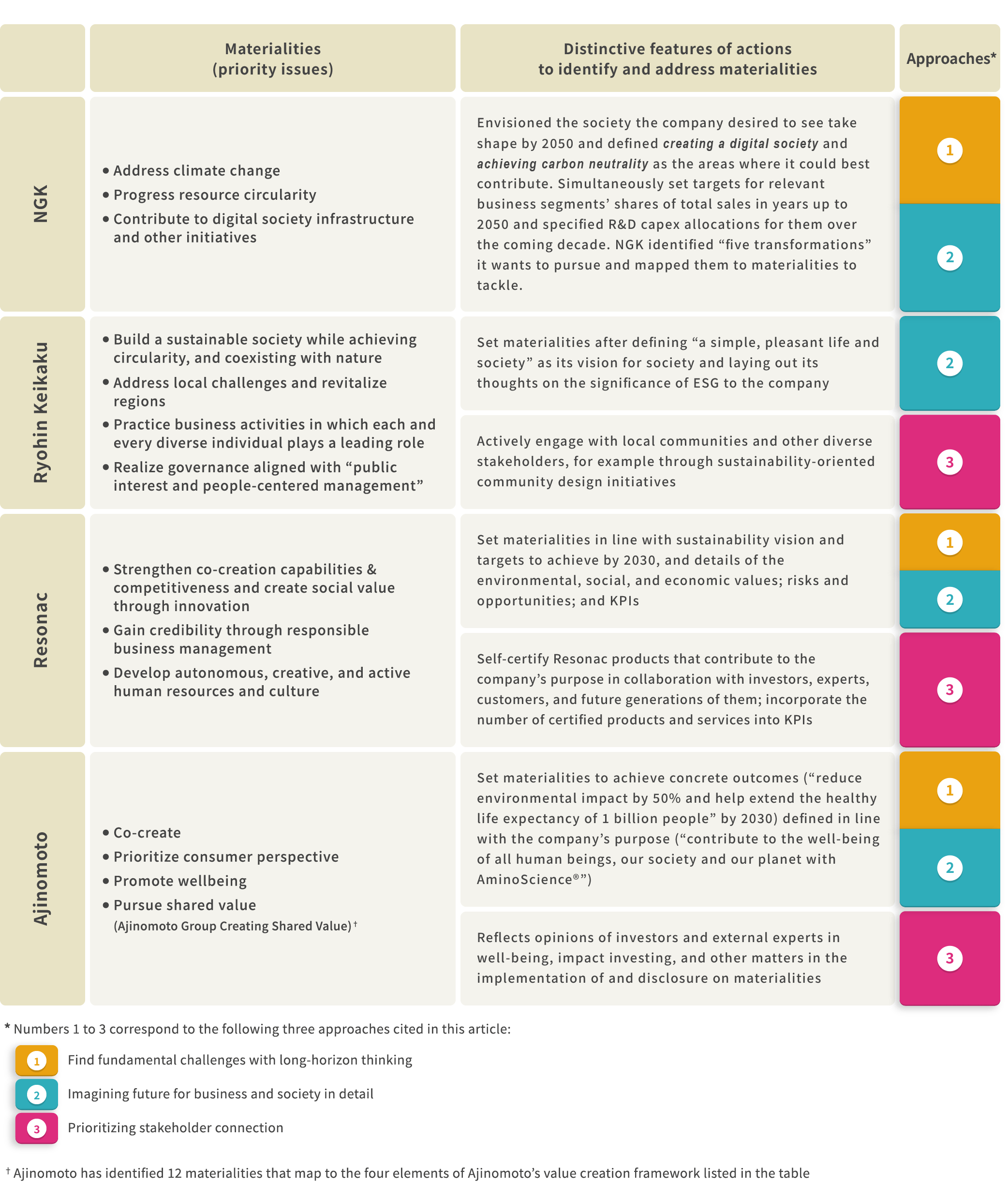
Envisioning society in 2050, NGK defines it as one where “actions to protect the global environment will be widely accepted along with the concept that companies should act in an ethical and just manner, and that renewable energy will be the key source of electricity and other forms of energy.” From this, the company then backcast to determine that creating a digital society and achieving carbon neutrality are the aims it can contribute to the most. It identified five transformations and associated materialities it needs to pursue to bring about the future it envisions. Along with transforming its business structure to align with these aims, NGK allocated R&D expenditures over the coming decade for the fields relevant to its two social visions (digitalization of society and carbon neutrality) and set bold sales targets to achieve by 2030 and 2050.1
Ryohin Keikaku Co., Ltd. (approaches 2 and 3)
Working to live by its corporate philosophy*, Ryohin Keikaku defined the social values it aims to create from three angles: its products, its business activities, and its community-rooted initiatives. In the process, it identified four challenges as its materialities to achieve by 2030.2
One is initiatives involving local communities to help them address their challenges or revitalize themselves. A hugely distinctive characteristic of this is focus on dialogue and collaboration with stakeholders transcending engagement with just customers and shareholders. Specifically, the company advanced co-creational programs with a broader based of stakeholders3 that include signing collaborative agreements with over 30 government-services organizations and forming tie-ups with diverse actors, from local public libraries to businesses, to do things like undertake sustainable community design.4
One is initiatives involving local communities to help them address their challenges or revitalize themselves. A hugely distinctive characteristic of this is focus on dialogue and collaboration with stakeholders transcending engagement with just customers and shareholders. Specifically, the company advanced co-creational programs with a broader based of stakeholders3 that include signing collaborative agreements with over 30 government-services organizations and forming tie-ups with diverse actors, from local public libraries to businesses, to do things like undertake sustainable community design.4
*The company’s philosophy commits it to contributing to “the creation of a truthful and sustainable life for all through our products, services, stores and business activities; believing human society rich in heart, with balanced relationship between human, nature and artifacts.”
Resonac Holdings (approaches 1, 2, and 3)
Having positioned sustainability as an essential component of its management, Resonac formulated its Sustainability Vision 2030, premising it on two pillars: “Achieve corporate growth through the resolution of social issues” and become “A company with like-minded partners throughout the world.” It then identified three materialities5 and, for each, defined its ambitions, 2030 targets, values it wants to create, risks, opportunities, KPIs, and other details.
To communicate with stakeholders on its “Strengthen co-creation capabilities & competitiveness and create social value through innovation” materiality, Resonac created a process through which it certifies its products and services for the customer and social value provided. It then incorporates product and service figures into its KPIs. It also plans to involve investors, experts, customers, and future stakeholder cohorts in the process, a facet that confers the scheme distinctiveness.
To communicate with stakeholders on its “Strengthen co-creation capabilities & competitiveness and create social value through innovation” materiality, Resonac created a process through which it certifies its products and services for the customer and social value provided. It then incorporates product and service figures into its KPIs. It also plans to involve investors, experts, customers, and future stakeholder cohorts in the process, a facet that confers the scheme distinctiveness.
Ajinomoto Group (approaches 1, 2, and 3)
In its purpose, the Ajinomoto Group says it is working to contribute “to the well-being of all human beings, our society and our planet with AminoScience®” and “to reduce [its] environmental impact by 50% and to help extend the healthy life expectancy of 1 billion people” by 2030. Distilling its materialities for achieving these goals in “well-being through AminoScience®,” it identified and prioritized its principal risks and opportunities and defined targets and KPIs6 in line with them.
A distinctive feature of Ajinomoto’s programs from the dialogue-with-stakeholders angle is that the company has instituted a Sustainability Advisory Council, a subordinate body of the Board of Directors, through which it reflects the views of experts on investors, well-being, impact investment, and relevant fields in implementing and disclosing on its materialities.7
A distinctive feature of Ajinomoto’s programs from the dialogue-with-stakeholders angle is that the company has instituted a Sustainability Advisory Council, a subordinate body of the Board of Directors, through which it reflects the views of experts on investors, well-being, impact investment, and relevant fields in implementing and disclosing on its materialities.7
Table 1: Examples of materialities informed by practice of our approaches
Source: Mitsubishi Research Institute, Inc.
Both management and stakeholders can get behind the goal of creating unique social value and consistently enhancing corporate value over the long haul. Businesses working to that end are sure to see the outcomes they set out to achieve provided they devise and repeatedly revise, execute, and communicate their strategies armed with a clear vision of where they want to go.
1NGK Insulators NGK REPORT 2023
https://www.ngk-insulators.com/
2Ryohin Keikaku Co., Ltd. “Ryohin Keikaku and Sustainability: Basic Policy and ESG Management Structure”
https://www.ryohin-keikaku.jp/
3Ryohin Keikaku Co., Ltd. “Community Engagement: Connecting with Local Communities”
https://www.ryohin-keikaku.jp/
4Ryohin Keikaku Co., Ltd. Muji Report 2023
https://ssl4.eir-parts.net/
5Resonac Holdings Corporation Resonac Report 2023
https://www.resonac.com/
6Ajinomoto Co., Inc. “Sustainability: Materiality” webpage
https://www.ajinomoto.com/
7Ajinomoto Co., Inc. “Sustainability Advisory Council Second Phase”
https://www.ajinomoto.com/
Author profile
Hiroki Sugishita
Business Consulting Division
Hiroki Sugishita guides clients in moving their sustainability and other ESG efforts forward, providing end-to-end assistance from formulation of a corporate vision, basic policies, and business strategies, all the way through to their execution. Emphasizing resonance and co-creation with stakeholders, he advises clients on long-term corporate and social value creation that goes beyond merely satisfying legal requirements and disclosure mandates.
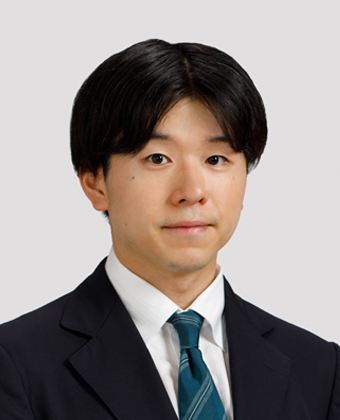
Kohei Futajima
Business Consulting Division
Kohei Futajima advises and supports clients across business sectors from infrastructure to trading, real estate, and manufacturing. He helps them formulate and carry out growth strategies and sustainability strategies as well as enhance their organizational resilience.