
The spring 2024 wage campaign resulted in the biggest wage hikes in 33 years. Improving corporate productivity is essential if this is to spark a turnaround in the Japanese economy. The key to this in turn is investment in people. However, there is little visibility into human capital investment in Japan. Companies do not know what is effective and lack evidence to ground their views on. Focusing on a few key elements will help bring about wise investing—that flows through to improving corporate value.
Corporate Value and Investing in People in Japan
Guidelines for effective investment and timely, appropriate disclosure
Investment in people on cusp of growth after 30-year hiatus
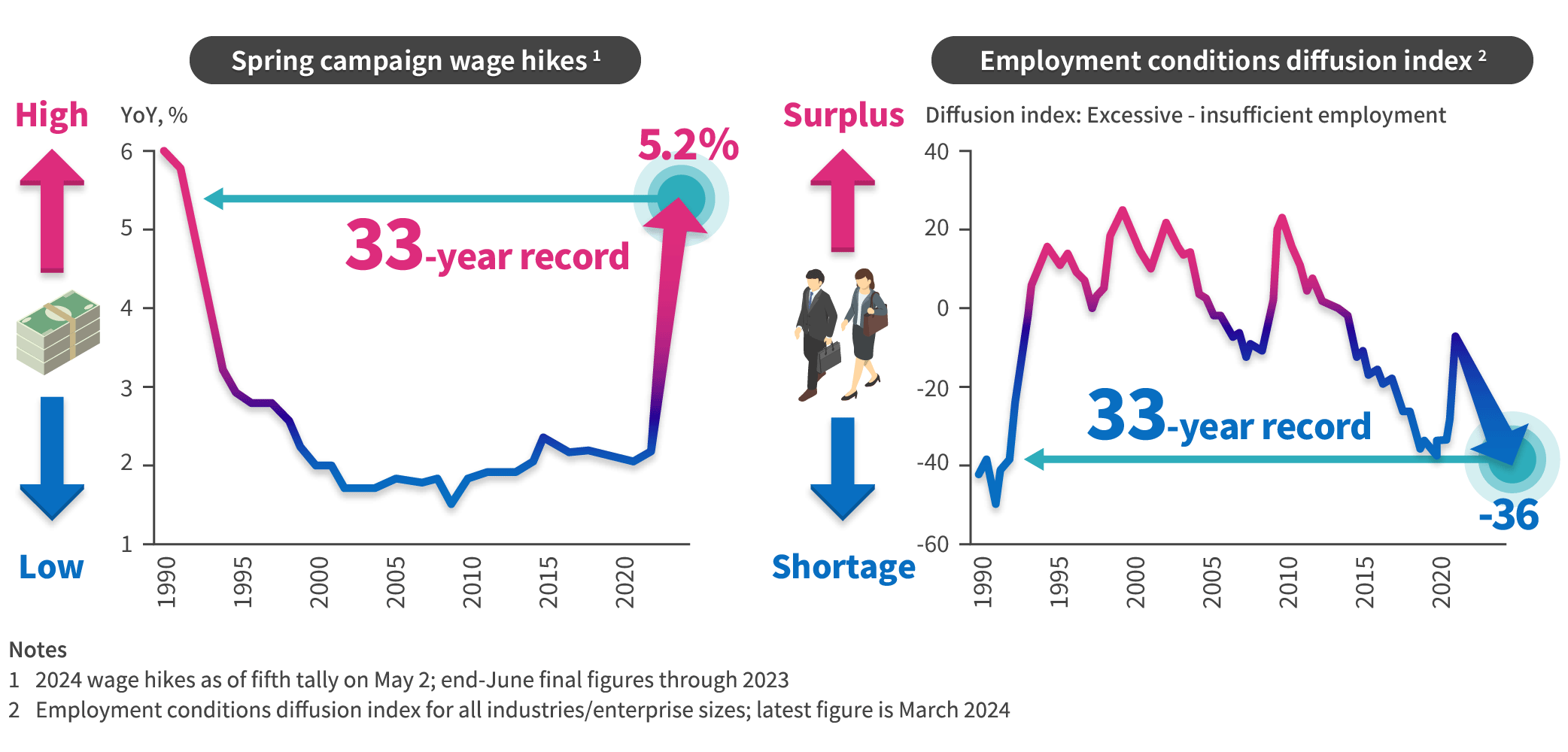
According to the Japanese Trade Union Federation (Rengo), the 2024 spring wage campaign resulted in average hikes of 5.2% (fourth estimate), the biggest increase in 33 years. Significant inflation since 2022 is certainly exerting upward pressure. That said, the labor shortage is the key driver of widespread wage hikes, including at smaller enterprises. The employment diffusion index (DI)* in the Bank of Japan’s Tankan business sentiment survey, which shows corporate sector labor shortages, came in at −36 in March 2024, also a 33-year record—on the low side. Finding people to fill job openings is bound to get tougher across the board, given ongoing downward pressure on the labor supply, so firms are likely to continue hiking wages to attract employees for the foreseeable future.
Figure 1: Spring campaign wage hikes and employment conditions diffusion index
Source: Mitsubishi Research Institute, Inc., from Japanese Trade Union Federation, Spring Wage Campaign Survey, Bank of Japan Tankan Survey
Companies should be investing in transforming their business models to earn revenue amid dwindling workforce, which would then be used to fund wage hikes. This is a prerequisite for the viability of a business. If Japanese companies fail to boost their productivity following recent wages hikes, they will face pressured corporate earnings and in the worst case, existential crises. While the investing discourse has focused on intangible assets—like R&D and software—to boost productivity Japan will need to focus on its people, i.e. human capital investment.
Japanese corporations have fallen short on investing in their people for some 30 odd years. Caught between demands of cost-cutting under deflation and maintaining the lifetime employment system, they had to curtail spending on personnel and training while boosting the proportion of non-permanent employees. The result was that Japan ranks the lowest among OECD countries in human capital investment.† However, with an increasingly scarce labor force, companies now need to provide employees with an attractive working environment, compensation that accurately reflects performance, and a chance to perform to their best of their ability. Companies that fail to do so risk their very survival. With a shrinking labor market, and deflation a thing of the past, Japan’s economy is at a 30-year turning point. Investment in people is poised to start growing again.
Japanese corporations have fallen short on investing in their people for some 30 odd years. Caught between demands of cost-cutting under deflation and maintaining the lifetime employment system, they had to curtail spending on personnel and training while boosting the proportion of non-permanent employees. The result was that Japan ranks the lowest among OECD countries in human capital investment.† However, with an increasingly scarce labor force, companies now need to provide employees with an attractive working environment, compensation that accurately reflects performance, and a chance to perform to their best of their ability. Companies that fail to do so risk their very survival. With a shrinking labor market, and deflation a thing of the past, Japan’s economy is at a 30-year turning point. Investment in people is poised to start growing again.
*Diffusion index: The difference between the percentage of companies reporting “excessive” employment minus those responding “insufficient”
†For example, according to a Euklems & INTANProd database of human capital investment as a share of GDP in leading industrialized countries, since the late 1990s Japan has been consistently well below the US, UK, France, Germany, and Italy
Importance of sketching human capital investment scenario
One barrier to investment in people could be a lack of data to base a decision on. Data should be readily available to answer questions such as what sort of people and what areas should a company invest in to deliver sustainable growth. Investing in human capital risks crimping earnings in the short term, so it is important to have an idea of potential returns. Evidence to inform decision-making is essential if investments are to align with business strategy. Legacy HR arrangements built on the bulk hiring of fresh graduates, seniority-based pay, and lifetime employment have hindered human resources mobility. Japanese companies have historically not needed to provide a window to outsiders about their employees’ skills and personnel requirements.
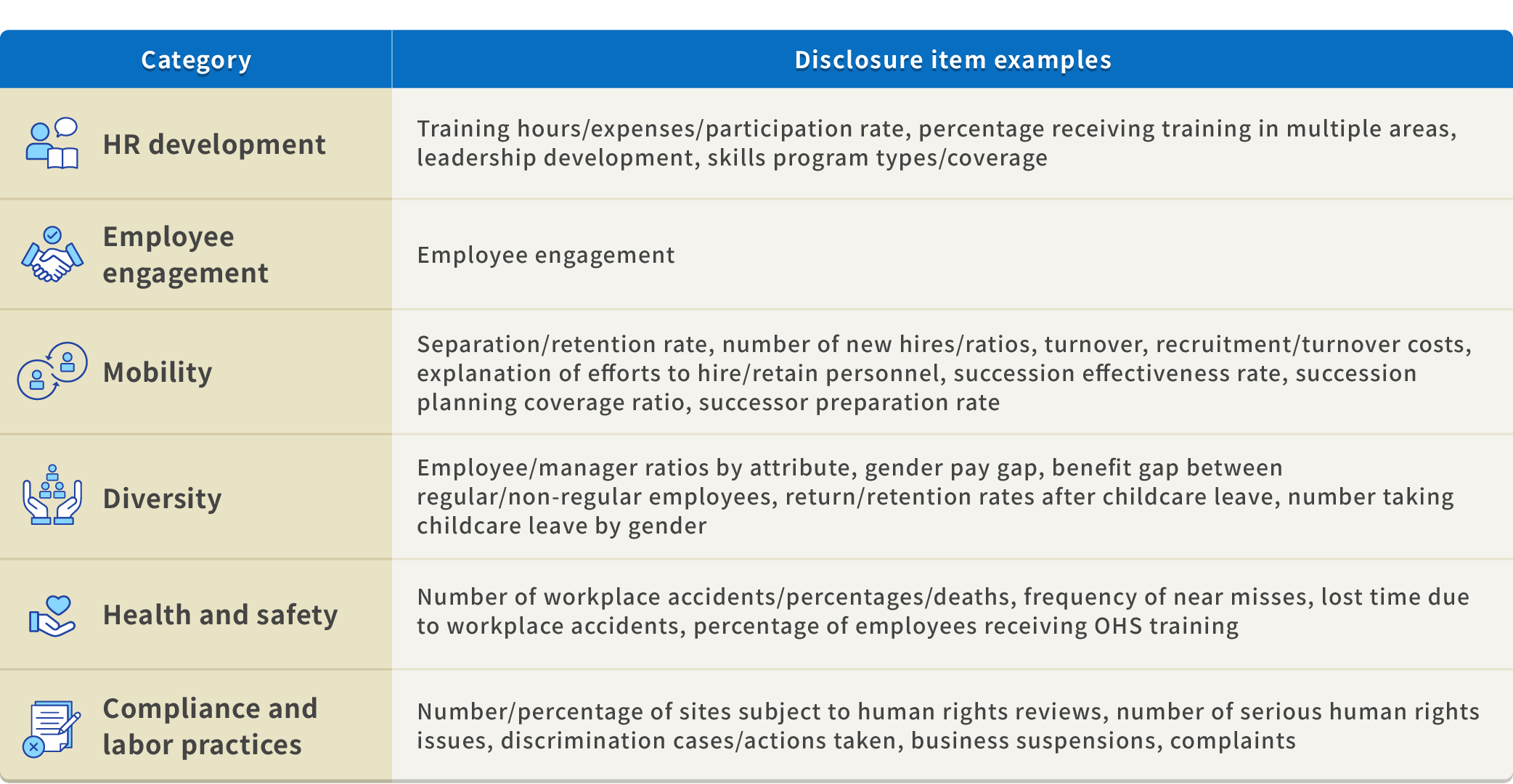
A body looking into visualizing non-financial information under the Japanese government’s Council of New Form of Capitalism Realization has released guidelines for disclosure of investment in human capital, listing necessary items by sector (Figure 2). These cover a wide range of areas related to human capital in addition to skills requirements. The guidelines go beyond offering a list of disclosure items to point out the importance of management using such information to sketch a scenario of how investment in people will drive growth. Providing information on HR strategy is needed not just by the capital markets, but it is a vital tool to deepen mutual understanding between investors, employees, and other stakeholders. Talking about HR strategy and its connection with business strategy; building up evidence piece by piece; and presenting an easily understandable scenario of investment in people driving improvements in corporate value should lay the foundation for expanding investment in human capital in Japan.
A body looking into visualizing non-financial information under the Japanese government’s Council of New Form of Capitalism Realization has released guidelines for disclosure of investment in human capital, listing necessary items by sector (Figure 2). These cover a wide range of areas related to human capital in addition to skills requirements. The guidelines go beyond offering a list of disclosure items to point out the importance of management using such information to sketch a scenario of how investment in people will drive growth. Providing information on HR strategy is needed not just by the capital markets, but it is a vital tool to deepen mutual understanding between investors, employees, and other stakeholders. Talking about HR strategy and its connection with business strategy; building up evidence piece by piece; and presenting an easily understandable scenario of investment in people driving improvements in corporate value should lay the foundation for expanding investment in human capital in Japan.
Figure 2: Guidelines for Human Capital Visualization: Disclosure areas and key items
Source: Mitsubishi Research Institute, Inc. from Cabinet Secretariat Study Group on Visualizing Non-financial Information “人的資本可視化指針(2022年8月)” (Human Capital Visualization Guidelines (August 2022))
Maximum impact of human capital investment in sixth year
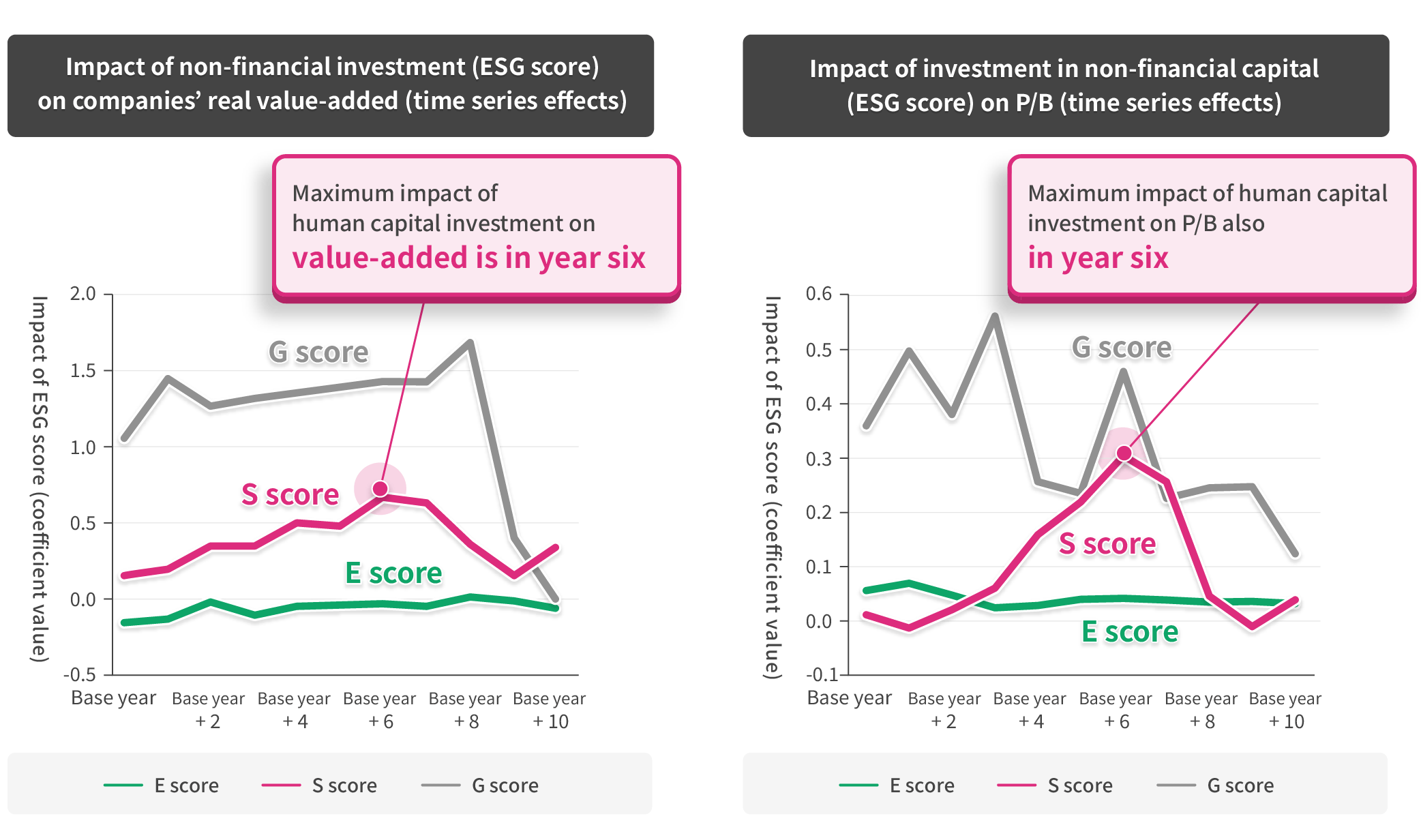
Investment in human capital has a positive and significant impact on financial performance of Japanese companies (Figure 3).*† Typically, the impact of such investment comes after a considerable lag. The maximum impact on both the real value added and price/book ratio (P/B) comes in the sixth year after the investment‡. While some benefits emerge in the short term, human capital investment usually takes a long time to be reflected in returns. It is important to avoid concluding such spending is wasted because benefits are not immediately apparent.
Further, the P/B (which factors in equity market expectations) increases at the same time as value added. This has subtle implications. Normally, assuming investors assess human capital investment in an appropriate and timely manner, the P/B should rise in advance of increases in value-added on mounting corporate growth expectations. That the market is not forward-looking in this respect can be interpreted in two ways. It could be that while human capital investment drives improvements in corporate value, Japanese corporations are not disclosing it properly. Alternatively, investors may not be evaluating this information appropriately and in a timely manner.§
Further, the P/B (which factors in equity market expectations) increases at the same time as value added. This has subtle implications. Normally, assuming investors assess human capital investment in an appropriate and timely manner, the P/B should rise in advance of increases in value-added on mounting corporate growth expectations. That the market is not forward-looking in this respect can be interpreted in two ways. It could be that while human capital investment drives improvements in corporate value, Japanese corporations are not disclosing it properly. Alternatively, investors may not be evaluating this information appropriately and in a timely manner.§
Figure 3: Impact of human capital investment on real value added and P/B
Source: Mitsubishi Research Institute, Inc. estimates from Bloomberg and OSIRIS financial data (For details, see notes * and †)
*Data covers 2005–2022 for approximately 1,400 companies listed on the TSE with available time series data on ESG disclosure scores and financial indicators such as value-added and P/B supplied by Bloomberg
†Our analysis used the social or S portion (covering human capital, diversity, health and safety) of the ESG scores provided by Bloomberg as a proxy for human capital investment. For financial performance, we selected two indicators: (1) real value-added (derived from financial statements on operating profit and depreciation in real terms using a GDP deflator) and (2) P/B (share price/net assets)
‡These results are consistent with previous research. For example, Ryohei Yanagi, Visiting Professor at Waseda University Graduate School of Accountancy, quantified the results of non-financial investments by Japanese pharma companies. He found it takes five–ten years for the results of investment become apparent
§The Financial Services Agency’s Progress Report on Enhancing Asset Management Business, 2022 edition, points out that when considering ESG (including human capital investment) fund managers should identify the important ESG elements at the investee. The FSA added that fund managers should develop frameworks for effectively analyzing and identifying potential business opportunities and risks that could affect corporate value by building and improving assessment systems using their own ESG scores
How to make investment in people more effective
Managers can improve corporate value if they invest in people after crafting a scenario from a long-term perspective. Here the important elements are wise (i.e. effective) investing and a skills-based approach.
(1) Wise investing in people who implement business strategies
Companies need to rethink their business strategies to suit the operating environment and align their investments with business process re-engineering concepts to underpin sustainable wage growth. Investment should follow a two-pronged approach: in physical capital such as facilities and digital technologies, and in human capital, commensurate with the former. Wise investing in human capital links the two, thus improving the productivity that enables sustainable wage growth.
(2) Skills-based approach to visualizing HR requirements
Being able to visualize corporate personnel requirements is a prerequisite to executing an HR strategy aligned with business strategy. A skills-based approach is the key to visualizing requirements for a company’s employees and external hires—that is, having a grasp of HR requirements in terms of skills and abilities. Using skills to define the human resources needed to execute a company’s business strategies enables measures such as personnel training, career development, and strategic hiring to work more effectively.
These are early days in visualizing investment in people by Japanese corporations. Human resources are becoming more mobile and increasingly diverse. Questions that linger for companies to answer include: what sort of personnel are needed? Which areas should be invested in to attract the right people? And what sort of impact will that have on long-term corporate value and the sustainability of society at large? Companies will need to persevere and communicate their approach carefully.
Author profile

Masashi Santo
Center for Policy and the Economy
Masashi Santo is involved in policy proposals, primarily in human resources, labor, and social security. He also does work on labor supply and demand, demographics, simulations of healthy longevity, and statistical analysis of data. As Chief of HR Research, he is responsible for coordinating in-house research projects, collaborations with other companies, and policy recommendations in the field of human resources.