Strategy for ASEAN Success in the Dynamic Energy Market

An alternative way to attract support and collaboration from foreign capital

10 January 2025

Japanese version: 20 August 2024

Kyoko Tsuru
Energy and Sustainability Division

Takeaways

  • ASEAN’s energy transition requires massive investments and robust institutional reforms to meet growing energy demands and decarbonization goals
  • Western nations emphasize rulemaking dominance through strategic investments, while Japan offers a collaborative, bottom-up approach to institution building
  • The ASEAN region can succeed by addressing institutional barriers, fostering partnerships with foreign businesses, and enhancing competitiveness in the energy market—all fields in which Japan, and Mitsubishi Research Institute, can help

Southeast Asia’s growing need for energy investment

The Association of Southeast Asian Nations (ASEAN) region, home to approximately 700 million people, represents a vast and dynamic economic region. Over the past two decades, energy consumption has grown at an annual rate of 3%. This rapid economic expansion has created a surge in energy demand. Simultaneously, ASEAN countries are working to meet their decarbonization targets, which requires addressing the challenges of a power sector that remains heavily reliant on carbon-intensive sources.

Additionally, ASEAN countries are under pressure to conduct a comprehensive review of their power sector strategies to align them with environmental goals and swiftly reduce carbon emissions.

The high cost of decarbonization

Decarbonization comes with an enormous price tag. The World Economic Forum estimates that achieving ASEAN-wide decarbonization would require energy investments of approximately USD 75 billion annually under the STEPS scenario—a realistic projection based on current policies. A staggering USD 150 billion annually would be required for the more ambitious SDS scenario. Current investment levels fall far short of these figures, making even the comparatively modest STEPS target, let alone fully achieving decarbonization, a significant challenge.

The power sector faces pressing need to integrate renewable energy. However, decarbonization must not compromise the reliability of the power supply. This dual challenge makes initiatives like the ASEAN Power Grid, which aims to enable cross-border electricity interconnection and system integration across the region, a critical priority. Realizing this vision will require bold policies designed to attract massive private investments from outside the region.
Figure 1: Comparison of ASEAN clean energy investments towards 2030 under different scenarios
Comparison of ASEAN clean energy investments towards 2030 under different scenarios
Source: Mitsubishi Research Institute, Inc. from World Economic Forum (2024) “Energy Transition-How to achieve a just and responsible energy transition in ASEAN”
https://www.weforum.org/agenda/2024/01/how-to-achieve-a-just-responsible-energy-transition-asean/ (accessed 17 May 2024)

Responding to western leadership in decarbonized markets

The decarbonization sector has become a global battleground, with countries vying to dominate rulemaking in this rapidly expanding market. Recognizing the stakes, Western nations are shifting their focus from traditional official development assistance (ODA) to strategic, targeted support aimed at accelerating private investment.

The European Union has implemented the Global Gateway initiative, an infrastructure investment strategy for developing countries. This program aims to mobilize up to EUR 300 billion between 2021 and 2027, targeting projects in energy and decarbonization.1 In the energy sector, the EU has also established the Global Energy Efficiency and Renewable Energy Fund (GEEREF), focusing on Asia-specific green investments.*

The United States has launched similar initiatives, such as USAID’s Clean Power Asia program, which mobilized over USD 700 million for energy projects in Southeast Asia from 2016 to 2021. This effort has been succeeded by the Southeast Asia Smart Power Program (SPP)2, which aims to generate USD 2 billion in investments by 2026. In June 2023, the US signed an agreement with the ASEAN Centre for Energy (ACE) to jointly develop the Action Plan for Energy Cooperation (APAEC).3

These Western strategies highlight a clear ambition: to lead rulemaking in the decarbonization sector. Europe’s strength lies in regulation and institutional frameworks, while the US focuses on driving regional initiatives such as the ASEAN Power Grid4.

*GEEREF has committed 10 million EUR to the Armstrong South East Asia Clean Energy Fund, 12.5 million EUR to the Renewable Energy Asia Fund, and 15.9 million USD to the Renewable Energy Asia Fund II.5

Japan brings alternative opportunities for collaboration

Japan brings a fresh set of opportunities to collaborate on decarbonization in the ASEAN region, providing an alternative to Western strategies. Under the Asian Zero Emissions Community (AZEC) framework, Japan emphasizes collaborative institution-building, tailored to the specific needs of partner countries. For example, Western initiatives tend to focus on creating comprehensive frameworks, often wedging Western governance models into the ASEAN context. While effective for driving investment, these programs can struggle to align with the on-the-ground realities of ASEAN countries, failing to address bottlenecks in local regulations and institutions.

In contrast, Japan’s AZEC framework takes a localized, participatory approach. By providing policy support and technical assistance, Japan collaborates directly with ASEAN governments and businesses to remove institutional barriers and build policies that are practical and feasible. Programs such as the JBIC Green Finance initiatives and the AZEC Advocacy Group are designed to integrate business strategies with government-led frameworks, ensuring mutual alignment and fostering trust.

ASEAN nations can adapt these approaches to create multi-layered initiatives that combine institution building with investment promotion. Japan’s case studies offer insight for ASEAN nations, and, collaborating closely with other global stakeholders, the region can position itself as a leader in the decarbonized energy market.
Figure 2: Main multilateral frameworks led by Japan in the energy sector
Main multilateral frameworks led by Japan in the energy sector
Source: Mitsubishi Research Institute, Inc.

How Mitsubishi Research Institute contributes to resolving issues in the ASEAN region

Mitsubishi Research Institute, Inc. (MRI) plays an active role in helping the rapidly evolving ASEAN energy market, and the initiatives of Japanese companies in the region, to succeed. The strategies of Western firms tend to prioritize external rulemaking dominance, but MRI focuses instead on empowering local institutions and Japanese businesses to improve the local situation.

MRI supports local clients in identifying and addressing regulatory bottlenecks, fostering collaboration with Japanese corporations, and promoting practical reforms aligned with the needs of all stakeholders. MRI also helps Japanese companies to navigate ASEAN’s institutional challenges and contribute to resolving societal issues. By bridging the public and private sectors, ASEAN and Japan, through a bottom-up approach, MRI ensures that ASEAN countries grow competitively while also leading the world in resolving societal issues.

Making ASEAN energy transition a reality

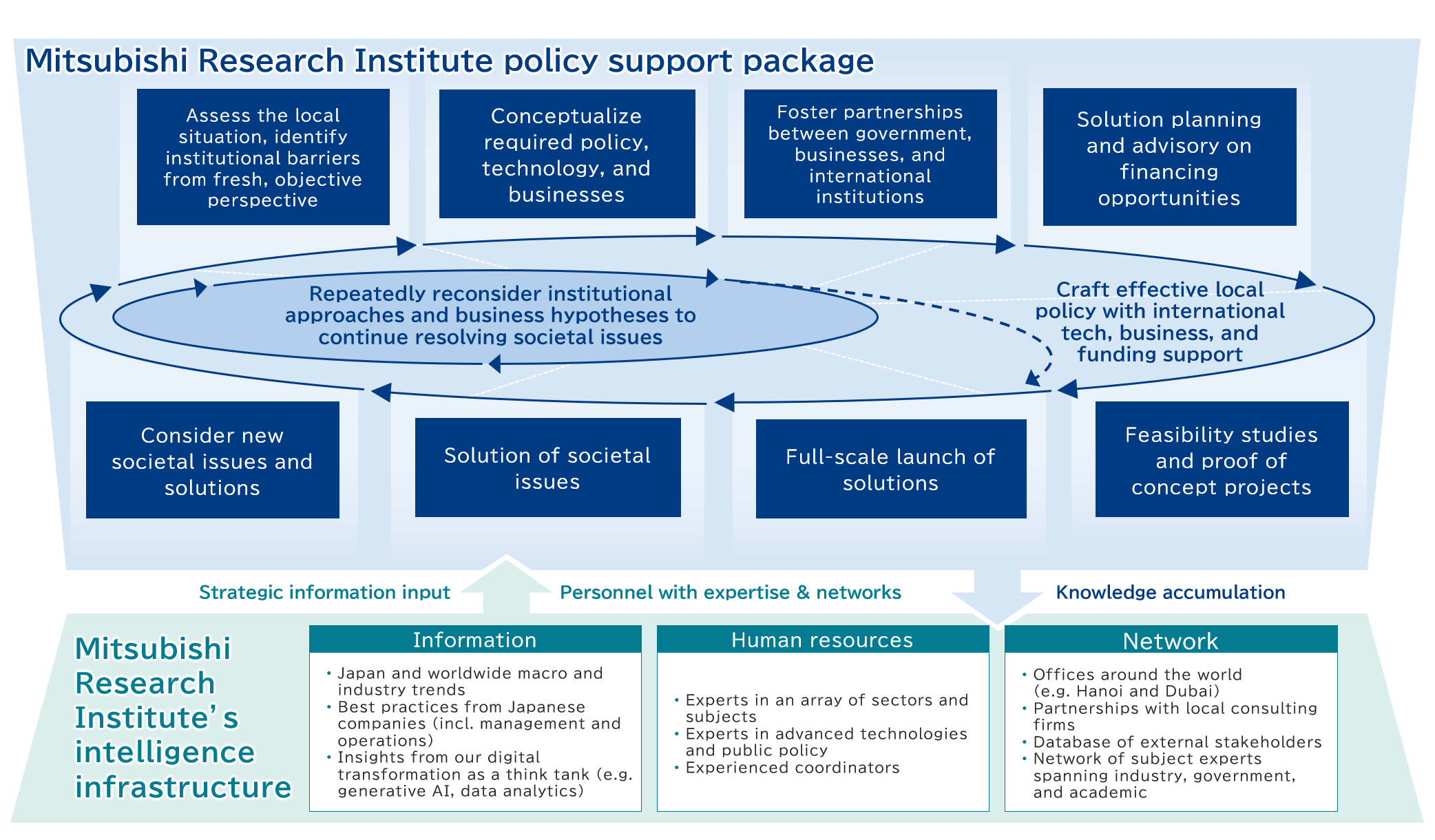
ASEAN’s energy transition requires more than foreign investment—it demands the active engagement of all parties involved in building the best policies and solutions for each country. MRI’s puts to use decades of expertise in crafting public policy to help clients:
  • Transcend traditional institution roles and regulations
  • Foster partnerships with businesses, governments, and international institutions
  • Build sustainable policies, programs, and solutions aligned with the local situation
MRI is committed to empowering the ASEAN nations to successfully set up the institutional frameworks required by their societal issues and involve private-sector support from around the world. Together, we can turn challenges into opportunities, extending the mutually beneficial relationship enjoyed by the ASEAN region and Japan to the energy transition.
Figure 3: Solution Map for Overseas Consulting Business
Solution Map for Overseas Consulting Business
Source: Mitsubishi Research Institute, Inc.

Works Cited

1Deutsche Welle “EU unveils €300 billion global infrastructure plan”
https://www.dw.com/en/eu-unveils-global-gateway-300-billion-global-infrastructure-plan/a-59986009 (accessed 1 July 2024)

2United States Agency for International Development “USAID Southeast Asia Smart Power Program”
https://www.usaid.gov/asia-regional/fact-sheets/usaid-southeast-asia-smart-power-program (accessed 1 July 2024)

3United States Agency for International Development (2023) “USAID Energy Program Signs Agreement with ASEAN Centre for Energy to Advance Regional Clean Energy Priorities”
https://www.usaid.gov/asia-regional/press-releases/jun-22-2023-usaid-energy-program-signs-agreement-asean-centre-energy-advance-regional-clean-energy-priorities (accessed 1 July 2024)

4ASEAN Centre for Energy (2023) Status of Southeast Asia Interconnectivity under ASEAN Power Grid
https://www.unescap.org/sites/default/d8files/event-documents/Status%20of%20South-East%20Asia%20Interconnectivity%20under%20ASEAN%20Power%20Grid_Nadhilah%20Shani%2C%20ASEAN%20Centre%20for%20Energy.pdf (accessed 1 July 2024)

5Global Energy Efficiency and Renewable Energy Fund “Portfolio”
https://geeref.com/portfolio.html (accessed 24 December 2024)

Author profile

Author

Kyoko Suzuki

Energy and Sustainability Division

Kyoko Suzuki’s work focuses on the energy sector, a field that sees constant and dynamic change. The bulk of her work comprises institution building for governments around the world as well as overseas projects for Japanese corporations. She makes it a priority to tailor her approach to the local needs of clients and their stakeholders.