
Japan is on track to launch its very own carbon pricing program, and exactly how much carbon credits will cost is on the minds of all. Through close examination of the GX Promotion Act and estimates for future carbon emissions, it is possible to forecast the price. While the assumptions behind the model can render a range of prices, they are meaningful figures for companies that will have to face them as costs nonetheless. We have forecast Japan’s carbon credit price to provide companies with a point of reference moving forward.
Japanese Carbon Price Forecast Based on the GX Promotion Act
GX Promotion Act gets the ball rolling: Regulations and support programs
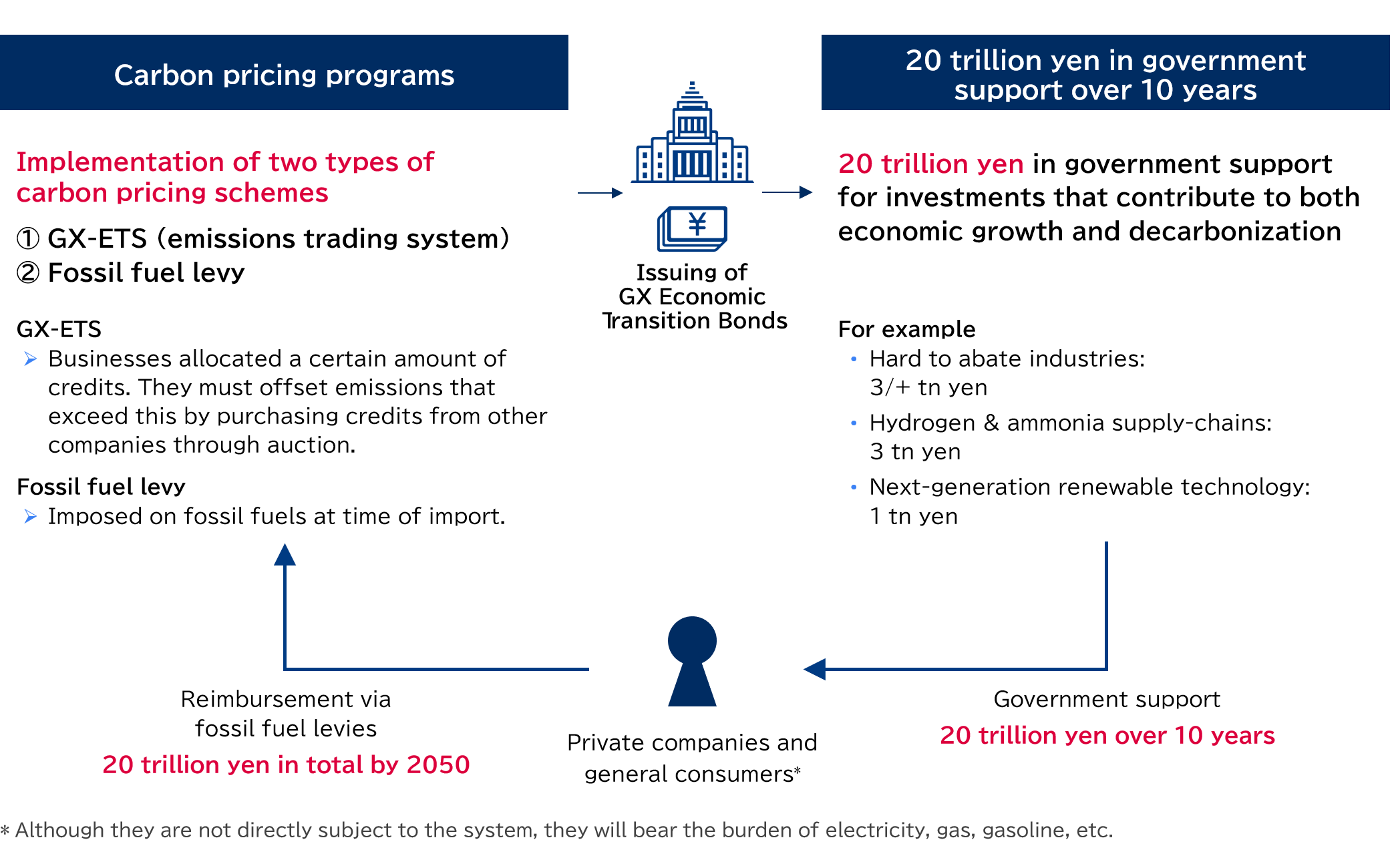
Twenty twenty-three was a busy year for green policy in Japan. February saw cabinet approval of the Basic Policy for GX Implementation1, and May enactment of specific policies: the GX Promotion Act2 and the GX Decarbonized Power Act3. These policies have the potential to significantly impact the private sector (Figure 1). The introduction of a carbon pricing mechanism and government support totaling 20 trillion yen over the next 10 years serve as crucial aspects of the GX Promotion Act.
Figure 1: Overview of the GX Promotion Act
Source: Mitsubishi Research Institute, Inc.
Carbon pricing as defined by Japanese policy
The newly introduced carbon pricing program comprises an emissions trading system (i.e. the GX-ETS) and a fossil fuel levy. The plan is to fund the 20 trillion yen needed for government support programs with the revenue from these carbon pricing mechanisms. In other words, the total revenue from the auction* of credits under the GX-ETS, which will begin in FY2033, and the revenue from the fossil fuel levy, which will be introduced in FY2028, will be set at a level of at least 20 trillion yen.
This is directly reflected in the carbon price, with the 20 trillion yen acting as a lower-bound for the program. Minimum annual prices can be deduced for the GX-ETS trading and the fossil fuel levy needed to ensure full repayment of the 20 trillion yen by the time Japan achieves carbon neutrality by 2050.
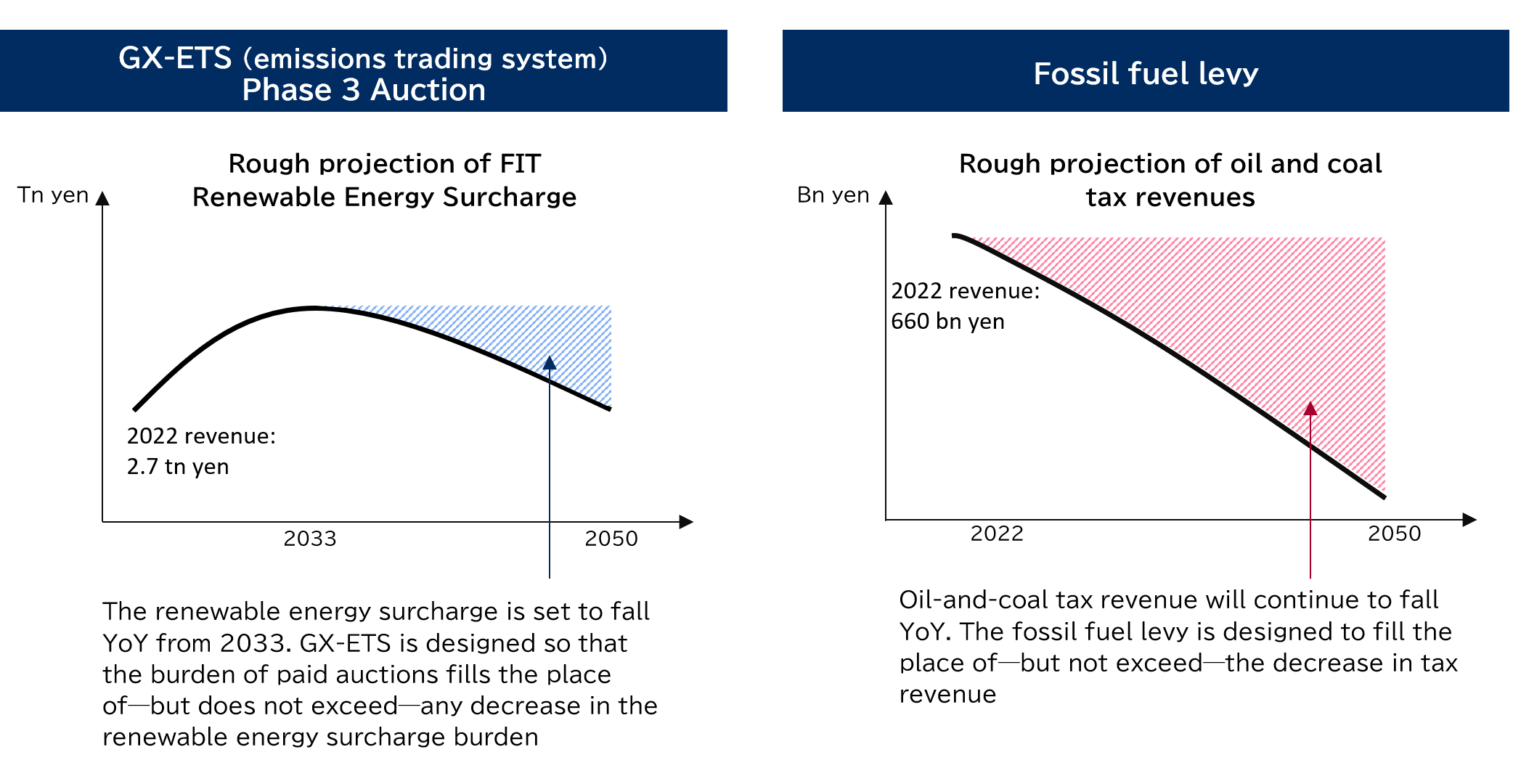
The upper bounds of the program can also be deduced thanks to government policies to introduce carbon pricing without increasing the overall burden for the cost of energy. Specifically, the upper price limit for trading will be set so that its revenue does not exceed the reduction in the total revenue from the feed-in tariff (FIT) program’s FY2032 figures. For the fossil fuel levy, the upper price limit will be set so that its revenue does not exceed the reduction in revenue from the oil and coal tax’s FY2022 figures (Figure 2).
*A method in which businesses bid in an auction to obtain emission allowances equivalent to the amount of emissions they need
Figure 2: Overview of pricing under Japan’s carbon pricing program
Source: Mitsubishi Research Institute, Inc.
Forecasting Japan’s carbon price
Japan’s carbon price can be forecast by combining the key price factors for each system with assumptions about future emission. Mitsubishi Research Institute, Inc. conducted an independent analysis based on this approach.
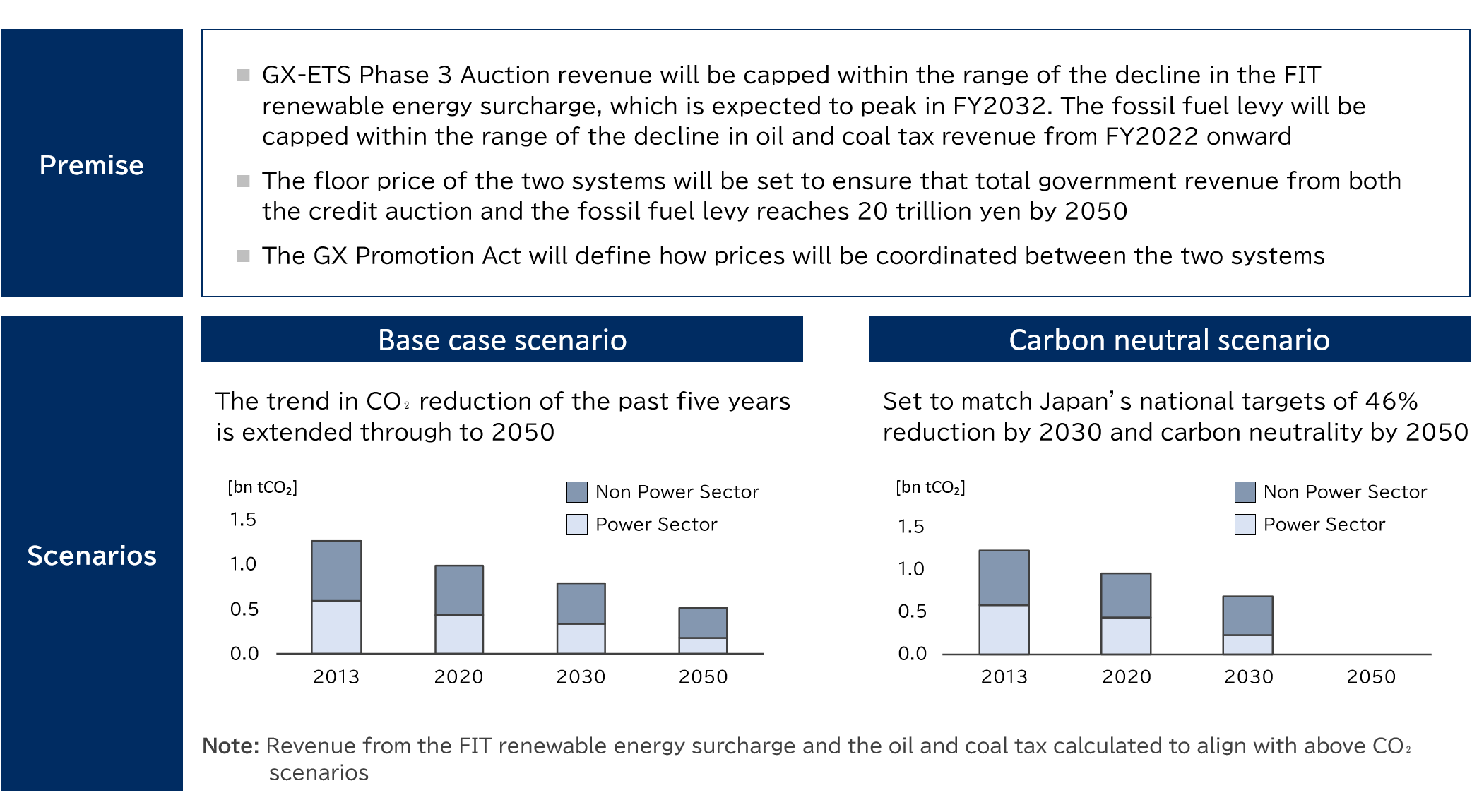
Two different scenarios were considered for future emissions (Figure 3), and assumptions were set regarding revenues for the FIT program and the oil and coal tax. The upper and lower price limits were then applied to calculate the total costs under both systems. Here, it was assumed that prices would remain at their lowest value for all cases. This serves as just one scenario as real-world GX-ETS trading will be influenced by the bidding behavior of participants. If carbon prices end up exceeding the lower limit, the 20 trillion yen will be repaid early.
Two different scenarios were considered for future emissions (Figure 3), and assumptions were set regarding revenues for the FIT program and the oil and coal tax. The upper and lower price limits were then applied to calculate the total costs under both systems. Here, it was assumed that prices would remain at their lowest value for all cases. This serves as just one scenario as real-world GX-ETS trading will be influenced by the bidding behavior of participants. If carbon prices end up exceeding the lower limit, the 20 trillion yen will be repaid early.
Figure 3: Assumptions behind carbon price forecast
Source: Mitsubishi Research Institute, Inc.
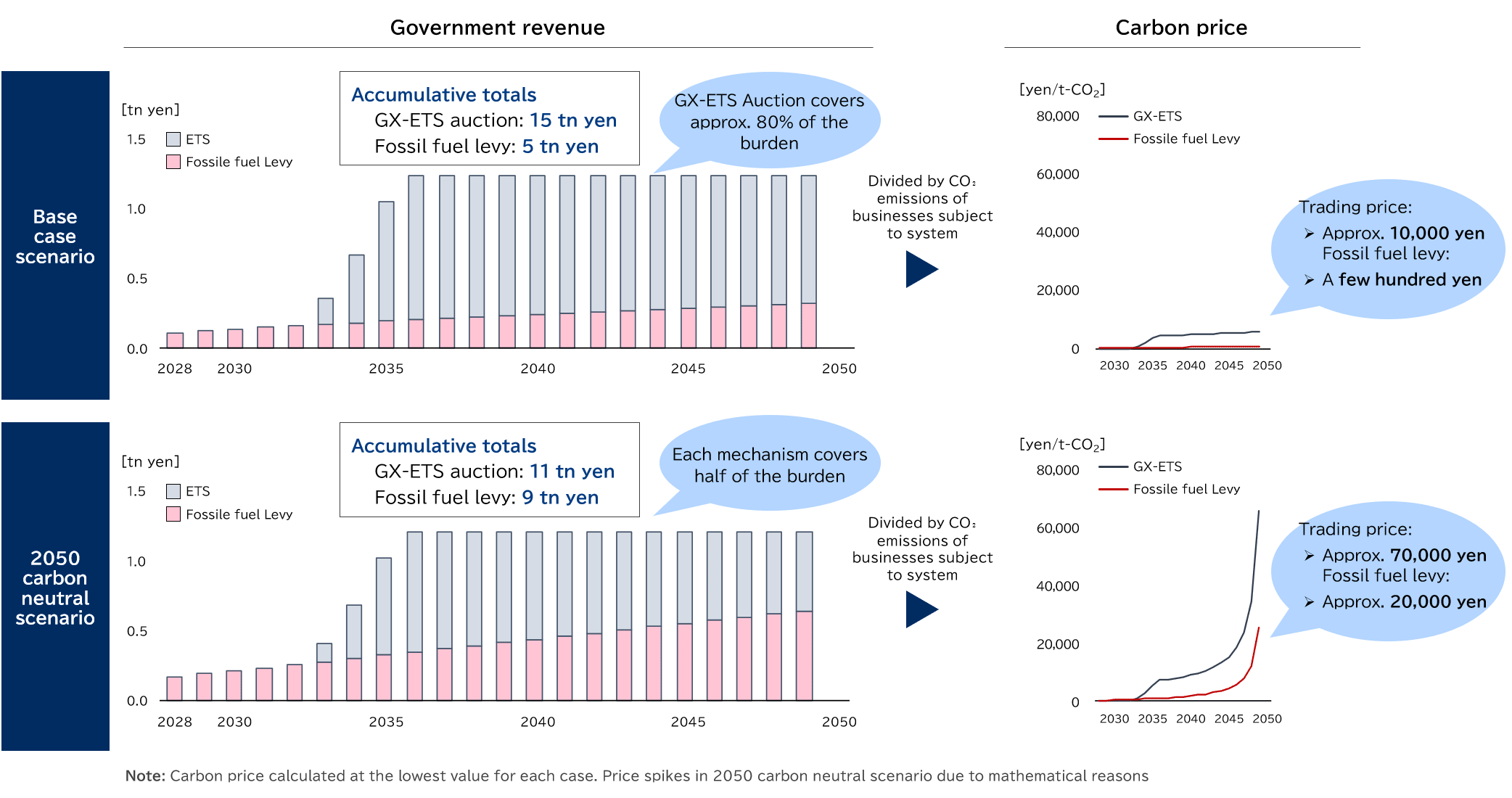
In the base case scenario, GX-ETS trading and the fossil fuel levy would generate 15 trillion yen and 5 trillion yen respectively. In the carbon neutral scenario, GX-ETS trading would generate 11 trillion yen while the fossil fuel levy would generate 9 trillion yen.
Carbon prices are determined by dividing the totals for each system by the CO2 emissions of the businesses subject to the carbon pricing program. In the base case scenario, the carbon price remains below 10,000 yen/tCO2. However, in the carbon neutral scenario, prices surge as they approach the 2050 carbon-neutral deadline, with the late 2040s seeing over 60,000 yen/tCO2 for GX-ETS trading and 20,000 yen/tCO2 for the fossil fuel levy (Figure 4).
It is clear that future swings in emissions will significantly impact carbon prices, ranging from a few hundred yen to tens of thousands of yen per ton of CO2. The private sector could face substantial costs depending on which scenario plays out.
And although an array of different scenarios could be run, the private sector will inevitably face costs somewhere within this projected range.
Figure 4: Forecast of Japan’s carbon price
Source: Mitsubishi Research Institute, Inc.
Key considerations for the future design of Japan’s carbon pricing program
The fundamental framework for GX-ETS trading and the fossil fuel levy has already been established. However, a major point of discussion moving forward will be the scope, duration, and intensity of fossil fuel levy exemptions* . Additionally, many details regarding the second phase of GX-ETS have yet to be determined, warranting close attention from the private sector.
While the carbon pricing program raises concerns about potential constraints on industrial and economic growth due to increased cost burden on the private sector, it also holds the potential to drive growth by incentivizing investment. When designing the details of free allocations under GX-ETS, set for discussion in 2025, Japan will need to carefully balance both positive and negative economic impacts by taking into account the burden imposed by GX-ETS trading and the fossil fuel levy. Achieving an appropriate and well-balanced design can help align the carbon pricing program with Japan’s long-term goals for economic growth.
While the carbon pricing program raises concerns about potential constraints on industrial and economic growth due to increased cost burden on the private sector, it also holds the potential to drive growth by incentivizing investment. When designing the details of free allocations under GX-ETS, set for discussion in 2025, Japan will need to carefully balance both positive and negative economic impacts by taking into account the burden imposed by GX-ETS trading and the fossil fuel levy. Achieving an appropriate and well-balanced design can help align the carbon pricing program with Japan’s long-term goals for economic growth.
*Regarding the scope of the fossil fuel levy, the Basic Policy for GX Implementation states that "taking into account the organization of existing similar systems, necessary measures, including exemptions, will be considered for the time being." The specific scope of application remains a topic for further discussion
Works Cited
1Ministry of Economy, Trade and Industry (METI) (2023) "Cabinet Decision on the Basic Policy for the Realization of GX"
https://www.meti.go.jp/
2Ministry of Economy, Trade and Industry (METI) (2023) "「脱炭素成長型経済構造への円滑な移行の推進に関する法律案」が閣議決定されました" (The Bill for the Smooth Transition to a Decarbonized Growth-Oriented Economic Structure Has Been Approved by the Cabinet)
https://www.meti.go.jp/
3Ministry of Economy, Trade and Industry (METI) (2023) "「脱炭素社会の実現に向けた電気供給体制の確立を図るための電気事業法等の一部を改正する法律案」が閣議決定されました" (The Bill for Partial Amendments to the Electricity Business Act and Other Related Laws to Establish an Electricity Supply System for a Decarbonized Society Has Been Approved by the Cabinet)
https://www.meti.go.jp/
Author profile

Kohei Takagi
Energy and Sustainability Division
Kohei Takagi is an energy analyst, focusing on supply–demand dynamics and green transformation policy. He provides the private sector with consulting services, including business feasibility analysis and green technology due diligence, and makes policy recommendations that target Japan on a society-wide level.