
Upon us is the age of AI agents with sophisticated autonomous capabilities that can resolve complex problems all by themselves. This is much sooner than most have anticipated. Technical breakthroughs are taking place on an almost daily basis and catapulting AI agent evolution forward. The launch of OpenAI o3 at the end of 2024 and the Chinese-developed DeepSeek-R1 at the end of January 2025 are typical examples. The significance of AI agents lies in that they will not stop at simply assisting humans: what they will really do is form the core of something bigger—automation. AI agent-driven automation will bring big change to how business is done, to industrial structures, and even to what people are able to do.
AI Agent Automation to Upend Business and Industry
DeepSeek’s emergence sends AI agent uptake into warp drive
AI agents achieve dramatic progress in a matter of months
AI agents, the next technical breakthrough in generative AI, are evolving far faster than anticipated. They are already being put to work in business, with B2B venues gaining particular attention including: customer support, software development, interactive system control, automation of SaaS and ERP work, and task specialized experts.
Already capable of deep thinking and solving complex problems, AI agents have evolved even further. OpenAI o3, released at the end of 2024, surpassed expert-level capabilities in software coding and even scientific reasoning, let alone mathematics.
The impact of AI agent-driven automation is not limited to the realm of individual companies and changing how they do business: it heralds changes coming to whole industries.
The impact of AI agent-driven automation is not limited to the realm of individual companies and changing how they do business: it heralds changes coming to whole industries.
Automation of work processes and interactive voice response (IVR) systems hold the keys
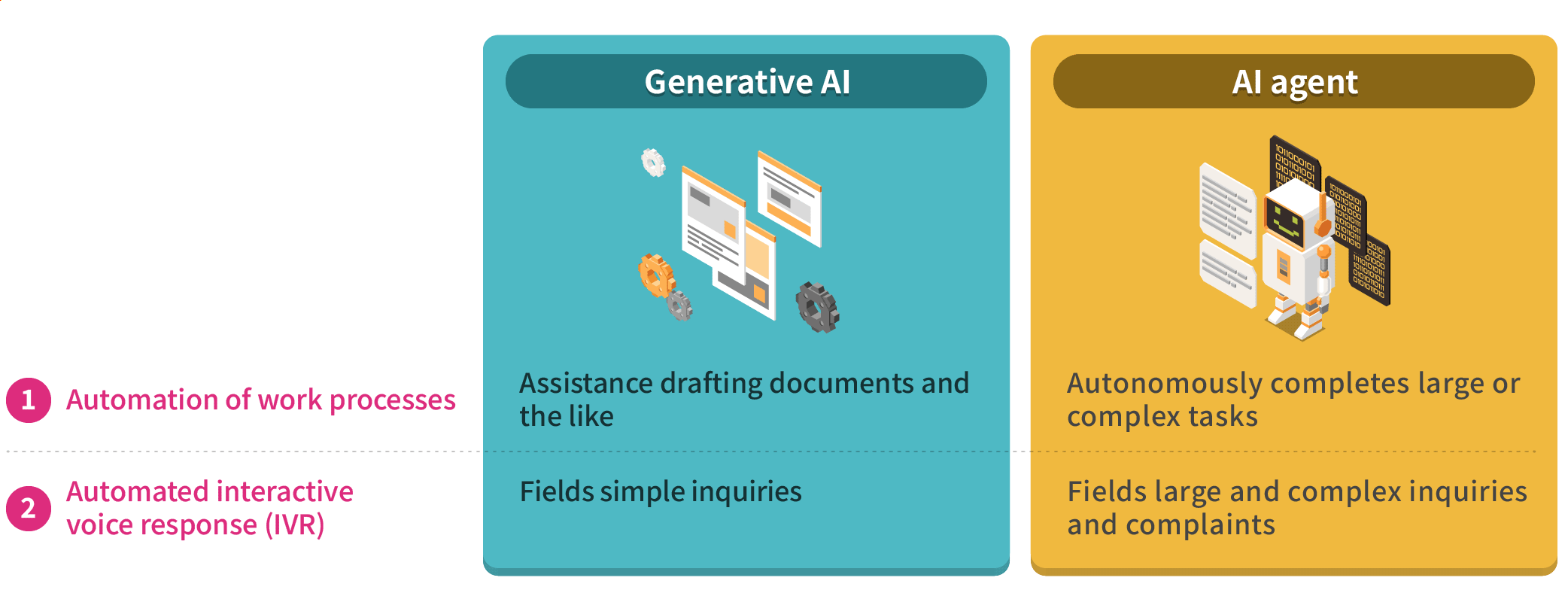
As with generative AIs like ChatGPT, AI agents too, acting as assistants, are a powerful ally of humans inasmuch as they can provide support and help people extend their capabilities. But at the same time, many people harbor expectations that AI will completely automate tasks, standing in for humans who previously performed them. In this area, automation of work processes and systems that can automatically field customer calls using natural language—interactive voice response (IVR) systems—are drawing the most interest.
1 Automation of work processes
SaaS and ERP system vendors like SAP and Salesforce have already begun offering platforms for developing AI agents that can automate—take over—whole work processes. On these platforms, companies’ ERP, CRM, and other mission-critical systems can be linked up to AI agents. This makes it possible to partially or fully automate workflows in areas like customer management, inventory management, finance, and accounting.
Take, as an example, the process involved when an employee files for reimbursement of out-of-pocket expenses. AI agents can automate everything from input of air-ticket receipts, linking to credit card statements, and categorizing individual expenses to generating expense reports. Among accounting tasks, they can even automate checks for compliance with travel regulations, correcting input mistakes, and detecting irregularities.
Take, as an example, the process involved when an employee files for reimbursement of out-of-pocket expenses. AI agents can automate everything from input of air-ticket receipts, linking to credit card statements, and categorizing individual expenses to generating expense reports. Among accounting tasks, they can even automate checks for compliance with travel regulations, correcting input mistakes, and detecting irregularities.
2 Automation of IVR systems
Development has progressed significantly for IVR systems that work automatically. For example, Google used OpenAI o1 to add interactive voice agents to its Duplex service, an IVR system already used for things like answering the phone at restaurants. It can adapt its conversation to general and novel contexts.
Take, for instance, an IVR armed with AI agents that fields calls from customers who want to know where their orders are. It autonomously queries the order-tracking system to check on order and shipping status and reports back to the customer. The system can even handle other processes, like taking care of returns and exchanges.
Automation like this alone promises huge back-office productivity gains and is just the beginning of what AI agents can do.
Figure 1: Automating work processes and IVR systems with AI agents
Source: Mitsubishi Research Institute, Inc.
AI assistants deliver productivity gains
Before AI agents came along, generative AI had already demonstrated its effectiveness by assisting people in performing their work. GMO Internet estimates that it helped the company reduce workloads by 1.5 million person-hours in 2024—30 hours per month for each employee.1
A rising number of corporations are getting a palpable taste of the productivity gains it offers. We survey large enterprises once a year to ascertain progress with their digital transformations. This year we found that during the 14 months between December 2023 and January 2025 they nearly doubled their use of generative AI services, from 25.5 percent to 45.7 percent. GMO has its own generative AI platform, and the proportion of user companies granting it access to their internal data rose from 9.3 percent to 16.2 percent.
A rising number of corporations are getting a palpable taste of the productivity gains it offers. We survey large enterprises once a year to ascertain progress with their digital transformations. This year we found that during the 14 months between December 2023 and January 2025 they nearly doubled their use of generative AI services, from 25.5 percent to 45.7 percent. GMO has its own generative AI platform, and the proportion of user companies granting it access to their internal data rose from 9.3 percent to 16.2 percent.
Figure 2: Generative AI utilization

Source: Mitsubishi Research Institute, Inc. original survey
In the creative professions, generative AI is already starting to work negatively on employment: According to one source,2 advertisements for freelance web writers are down 30 percent in the US. And its impact on other creatives, such as web designers and software engineers, is significant as well.
Meanwhile, even in fields oriented to generative AI, we forecast a mere four percent in person-hour reductions. This implies that further effort is needed to put in place integrated systems that facilitate use of generative AI to improve the level of utilization. That would lead to a rise in person-hour savings to about 22 percent, and as confidence in generative AI grows, so too will savings to about 32 percent.
Meanwhile, even in fields oriented to generative AI, we forecast a mere four percent in person-hour reductions. This implies that further effort is needed to put in place integrated systems that facilitate use of generative AI to improve the level of utilization. That would lead to a rise in person-hour savings to about 22 percent, and as confidence in generative AI grows, so too will savings to about 32 percent.
AI agents contribute significantly to enhancing reliability as well as flexibly automating entire workflows. That is because they can correct their own mistakes by assessing the results they generate through repeated proof-of-concept tests to raise the probability that they are reasoning correctly.
We classify AI usage on the path to artificial general intelligence (AGI) into four distinct levels.3 Generative AI is already being used in ways that span Level 1 and Level 2. In the former, it is primarily used for brainstorming and getting the gears turning; the latter makes use of generative AI output, but not without human review for accuracy. When AI agents go mainstream, they will work automatically, bringing AI usage up to Level 3, where humans will be monitoring and dealing with problems. When automation is complete for some tasks and human intervention is no longer needed, AI usage will have reached Level 4, and that is when AI will be able to substitute for even more employees.
We classify AI usage on the path to artificial general intelligence (AGI) into four distinct levels.3 Generative AI is already being used in ways that span Level 1 and Level 2. In the former, it is primarily used for brainstorming and getting the gears turning; the latter makes use of generative AI output, but not without human review for accuracy. When AI agents go mainstream, they will work automatically, bringing AI usage up to Level 3, where humans will be monitoring and dealing with problems. When automation is complete for some tasks and human intervention is no longer needed, AI usage will have reached Level 4, and that is when AI will be able to substitute for even more employees.
Glimpses of AGI emergence in automation by AI agents
A reason for confidence that automation by AI agents will continue to advance is that it is an early sign of the emergence of AGI. OpenAI o3 first achieved one of the benchmarks for AGI at the end of 2024, which implied that the day was near when AI would be able to learn how to learn, a requisite for its being able to solve previously unencountered problems.
Previously, corporate mission-critical systems needed to be carefully customized to adapt them to idiosyncratic rules and terminology. But AI agents that have learned how to train themselves can “read” manuals and acquire the ability to solve problems empirically.
Previously, corporate mission-critical systems needed to be carefully customized to adapt them to idiosyncratic rules and terminology. But AI agents that have learned how to train themselves can “read” manuals and acquire the ability to solve problems empirically.
Figure 3: AI agents learn how to learn

Source: Mitsubishi Research Institute, Inc.
Multi-agent AI systems are beginning to make use of several AI agents dividing tasks among themselves and collaborating to take on a company’s entire internal workflow.4 For example, sales agents and inventory management agents will be able to work together to handle everything at once, end-to-end from suggesting products to locking in inventory and issuing invoices.
Thus the next stage in AI agents’ evolution is on the horizon, and they are already well on the road to practical use.
DeepSeek’s emergence accelerates cheaper AI
DeepSeek-R1, a Chinese generative AI model, sent shockwaves through the AI community. Its reasoning capabilities were on par with those of OpenAI o1, but it was made available for several-tenths the price. And most of all, it showed the world that generative AI could be trained on the cheap without using high-performance AI processors.
Although DeepSeek-R1 looks like a victory for Chinese AI suffering under restrictions on the export of AI chips, there is more to it than that. If anything, that DeepSeek-R1, an open-source model, caught up with the closed-source commercial AI models is what is hugely significant. Rather than representing a technological leap, DeepSeek-R1 is the result of a combination of dogged trial-and-error and the latest research: It has spawned a whole open-source AI research ecosystem.
Immediately after DeepSeek-R1’s release, a global community of developers working on the open-source Open R1 project started replicating and improving on it.5 Examples of open source development accelerating IT research and breaking the monopoly of commercial software, as well as helping lower prices and freedom from vendor lock-in, are too numerous to count and include Linux in OSs and MySQL in database software. And now something should happen in the world of generative AI as open sourcing adds pressure to bring prices down.
This is forcing Big Tech to switch strategies for recovering its huge investments in AI. One reason is because along with open sourcing’s price-reducing effects, it is also making it almost impossible for any single winner to take all. That is also why Big Tech players are stepping up their game to monetize specialized “lite” models and especially business-oriented AI applications in addition to general-purpose foundation models.
The evolution of IT infrastructure is a history of tech revolutions—be it the internet, mobile communications, the cloud, or something else—that happened thanks to rapid market expansions driven by falling prices. In 1996, connecting a home to the internet cost about ¥40,000; by 2000 the price had plummeted to one tenth of that, ¥4,000. Meanwhile, connection speed rose by about 10-fold, from 128kpbs to 1.5Mbps. One impact was that online retailers went from doing ¥65 billion’s worth of business in 1998 to doing ¥5.6 trillion’s worth in 2004, a hundred-fold expansion.6
From email to the World Wide Web, undeniably enticing ways to use the internet entrenched the burgeoning infrastructure so deeply that eventually no one could imagine getting any work done without it. It even gave birth to a new way of working: remote working. Falling costs for AI should bring about a similar revolution—not only AI as an infrastructure, but the rapid birth of an entire market for AI applications and eventually even AI-based ways of working.
AI automation’s impact on white collar work
Most generative AI to date has come in the form of AI assistants intended to support people in doing their jobs; AI agents automate their work and do it for them. The difference in impacts is huge: With AI automation work gets done dramatically faster and upscaling costs—i.e., marginal costs—tumble.
The impact on employment of AI assistants has already been mentioned; but those of AI automation are going to be even bigger. The effects of automation are already starting to appear in the financial and internet sectors. According to Bloomberg, over the coming three to five years up to 200,000 people are at risk of losing their jobs in the banking industry.7 In examining human-resources supply and demand in 2035, we estimate that up to 4.6 million people doing tasks generative AI could stand in for could be affected, assuming a substitution rate of 50%.8
Even in sectors with automation-resistant workplaces like retailing and wholesaling, many sectors with battalions of back-office workers are going to feel the effects of job automation. And they will come from tasks prone to AI-agent automation: purchasing and order processing, contract negotiation and drafting, complaint handling, demand estimation, shift scheduling, ad placement, inventory control, and more.
A trend giving automation a boost in these sectors is business process outsourcing (BPO): it and AI agents are a perfect fit, given AI agents’ conduciveness to task consolidation and virtually unlimited scope for up-scaling. Operations like staffing agencies and IT support, which make their money by having huge numbers of employees at the ready, are likely to see rapid AI automation via BPO, too.
In other sectors as well, people with back-office white-collar jobs—accounting, human resources, general affairs, and legal—are particularly vulnerable to AI automation.
Figure 4: Impact of AI automation on white-collar jobs

Source: Mitsubishi Research Institute, Inc.
Get ready for AI agent-driven revolution
The tide of white-color job automation is on its way, with the first waves of work-process and IVR automation already lapping at the shores. Impacts will go far beyond simply making things more convenient and will revolutionize core aspects of business like marketing, sales, and procurement. In fact, offerings like 11x.ai,9 which automates marketing work, and Zip,10 which automates procurement processes, are already objects of intense interest.
The deployment of AI agents is also a great opportunity to create new businesses. Lower marginal costs will bring about a transition to business models predicated on AI. In particular, AI agents can automate jobs that previously only humans could do and were considered automation-resistant—like consulting and instruction roles. An example of this is Umi, an AI agent-powered and personalized wellness coach behind a service Japanese electronics major Panasonic has announced.11
DeepSeek’s appearance illustrates how rapidly low-cost and light-on-resources AI is evolving and consequently lowering barriers to development of expert AI agents that specialize in work tasks. Their uptake is likely to gain momentum, and do so more quickly than most anticipate.
AI automation will eventually spark explosive productivity improvements in most industries. This will bring about not only a widening productivity gap between companies that bravely venture on with AI and those that spurn its adoption, but also a widening of differences in the competitiveness of their product- and service-development. For example, harnessing AI has allowed apparel major Shein to develop the overwhelming competitive advantage of being able to churn out several thousands of new releases daily— demonstrating how AI has the potential to trigger restructuring or even total transformation of whole industries.
All this of course does not mean that companies can just plunge headfirst into adoption of AI agents without regard for any details. As the AI Guidelines for Business drawn up by Japan’s Ministry of Internal Affairs and Communications (MIAC) and Ministry of Economy, Trade and Industry (METI) indicate, deployment must be predicated on ensuring against misinformation, copyright infringement, data-security breaches, and other similarly negative effects.12 And on top of these considerations, automation amplifies numerous other risks. One stems from the speed at which AI agents can complete assignments: Things can proceed so quickly that mistakes and faults go unnoticed until they rack up volumes of downstream mistakes and faults. This hints at the need to reduce risk by AI-automating the verification of AI results and spotting faults early in a process. And then there’s no forgetting, once that’s done, the issue of how to involve humans.
At the individual level, disparities in what people can do also develop between those who use and those who eschew AI. And there will also be a ballooning of people who are used by AI at low wages—foremost among them, delivery personnel who work under the direction of AIs and AI monitors who check and correct AI-generated results. This brings us to concerns about AI deployment further exacerbating economic disparities in society.
As discussed above, the deployment of AI agents and rollout of AI automation entails both positive and negative implications; but the juggernaut is unstoppable. Those who dither to utilize AI will fall behind in the industrial restructuring and transformation that it brings. It therefore behooves companies to ready themselves for the industrial transformations and impacts AI automation will bring about: They need to get a move on, proactively utilizing generative AI and AI agents, raising AI literacy, and addressing productivity problems now.
Works Cited
1GMO Internet Group, Inc. “GMOインターネットグループ、生成AI業務活用率が88.6%に!自社提供の生成AI検索「天秤AI byGMO” (GMO Internet Group: 86% of group companies using GenAI in work. ‘Tenbin AI by GMO’ GenAI search engine usages second only to that of ChatGPT)
https://www.gmo.jp/
2Ozge Demirci, Jonas Hannane, Xinrong Zhu. “Who Is AI Replacing? The Impact of GenAI on Online Freelancing Platforms”
https://mimanizalesdelalma.com/
5“Open R1 is an open-source project seeking to replicate and extend the techniques behind DeepSeek-R1”: Open R1 Community “Open R1”
https://huggingface.co/open-r1 (accessed 12 February 2025)
6Ministry of Internal Affairs and Communications “平成18年版 情報通信白書” (Information and Communications in Japan: 2006 White Paper)
https://www.soumu.go.jp/
7Shaw (2025) “Wall Street Job Losses May Top 200,000 as AI Replaces Roles” Bloomberg
https://www.bloomberg.com/
911x.ai offers an AI agent system called Alice that does the job of sales development representatives: 11x AI Inc. 11x
https://www.11x.ai/ (accessed 12 February 2025)
10Zip is drawing interest for its AI-driven automation of procurement processes: Zip Zip
https://ziphq.com/ (accessed 12 February 2025)
11Panasonic Holdings Corporation Co., Ltd. (2025) “Panasonic HD announces launch of ‘Panasonic Go,’ a global corporate growth initiative promoting business transformation using AI, at CES 2025 opening keynote”
https://ces.na.panasonic.com/
Author profile

Kazuo Hiyane
Executive Officer and Research Fellow
Kazuo Hiyane has 50 years of experience in IT and 30 in AI. He has also been an open-source activist. Hiyane now serves as general manager of Mitsubishi Research Institute’s Generative AI Lab, where he advises enterprises on AI utilization and works in AI development. He has great hopes for AI despite harboring concerns about its trajectory.