
As worldwide momentum for decarbonization picks up, the Gulf states are under increasing pressure to pivot away from oil dependency. They are guiding their energy systems toward a green transformation (GX), aiming to become leaders in renewable energy and ultimately exporters of decarbonized energy. Yet these moves are beginning to lay bare weaknesses in the domestic energy infrastructure of each country. Here, Japan has potential to help the region overcome its challenges by digging deep into its experience addressing relevant grid-integration issues.
Gulf States’ Renewables Lay Bare Power-System Challenges
Japan offers insights as a front-runner in grid integration
22 October 2025
Gulf states advancing green transformation
The Gulf countries—Arab states in the Gulf region—have long sustained their economies by exporting oil and gas. But while the world works to decarbonize, they are now compelled to shift away from fossil fuel-dependent economic structures. As a new source of foreign revenue, they are increasingly turning to renewable energy.
The Arabian Peninsula, with over 3,000 hours of sunshine annually, is highly suitable for solar power generation. Saudi Arabia aims to supply 50% of its electricity from renewables by 2030. Qatar plans to raise its renewable share from the current 5% to 18% by the same year. Oman is also pursuing wind energy, including a 100 MW project under development in the Duqm Special Economic Zone. Furthermore, Oman and the UAE have launched national hydrogen strategies, in 2022 and 2023 respectively, signaling their intent to leverage renewables for green hydrogen and ammonia production as future exports.
Japanese companies have begun to take part in the greater regional shift and emerging green-transition market. In 2023, a consortium including Fuji Oil and Mitsui O.S.K. Lines (MOL) transported low-carbon ammonia produced in Saudi Arabia to Japan. JERA—an energy company with the largest generation capacity in Japan and one of the largest fuel-handling capacities in the world—signed agreements in both Saudi Arabia and the UAE to jointly explore hydrogen and ammonia development. In 2024, J-POWER—a Japanese developer of new power sources—announced participation in a hydrogen and ammonia project in Oman, while Mitsui & Co. made a similar move in the UAE.
Figure 1: Recent cases of Japanese companies in Gulf-state green-transformation projects
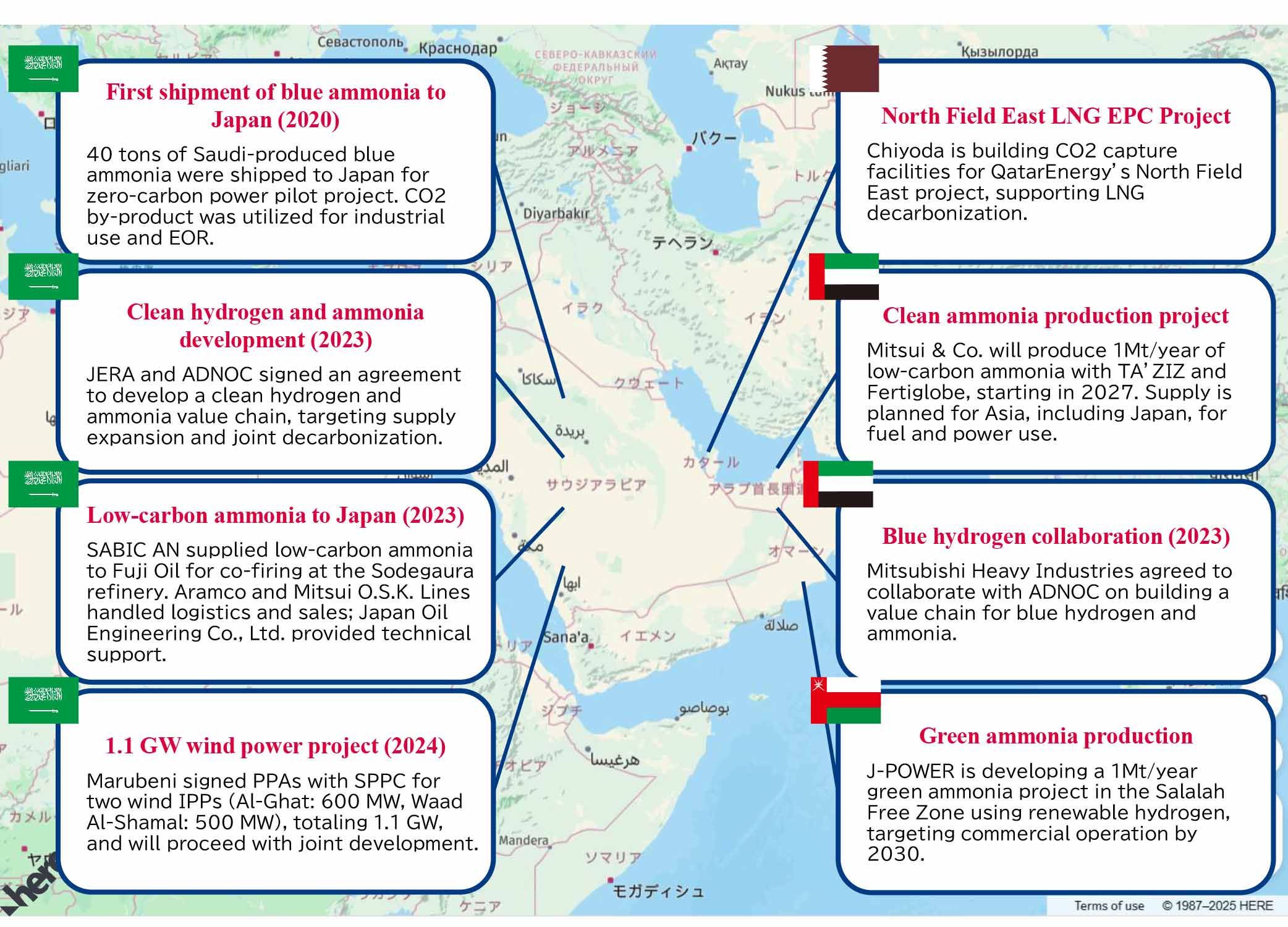
Source: Mitsubishi Research Institute, Inc.
Challenges facing green-transformation of power system
The Gulf states are striving to become major entities in renewables and the production of green hydrogen and ammonia. But they will be faced with the challenge of seamlessly integrating intermittent renewables and unconventional infrastructure into legacy power systems.
The region is characterized by its low population density and lengthy distances among its cities and industrial zones. In Saudi Arabia, the vast land area and historically fragmented power grid—only later interconnected—have resulted in limited capacity for long-distance transmission between regions. Even in areas with strong solar or wind potential, such constraints mean the generated electricity cannot always be transmitted freely across the country.
One potential solution is to collocate independent green hydrogen and ammonia plants near renewable generation sites without relying on the power grid. However, such off-grid systems are significantly less cost-competitive than plants that receive grid backup 24/7. Moreover, costly infrastructure would be required to get the hydrogen and ammonia produced to demand centers and ports. Thus, in many cases, it is more economically feasible to place production facilities near demand or logistical centers and supply them with renewable electricity via the grid, even if that were to involve grid reinforcement.
To achieve their ambitions, the Gulf states will need to design grand strategy that encompasses not only power systems but also energy supply–demand optimization and infrastructure integration.
Enhancing grid flexibility with demand-side solutions
Reinforcing core transmission lines between regions is critical for renewable integration and has been under planning for years. However, given the Gulf’s low demand density, even if transmission investment is more economical than carrying hydrogen and ammonia overland, ultra-long-distance lines remain cost-prohibitive. Moreover, planned projects often face long lead times and cannot address short-term needs. While international interconnections (e.g., with Europe) are being considered, geopolitical risks and enormous construction costs make near-term prospects unlikely.
Compared to transmission projects, renewable installations can be developed rapidly. Many countries—including Japan—have already experienced surges in renewable deployment triggered by policy incentives. If the Gulf states pursue their ambitious green-transformation targets in earnest, grid integration will soon become an urgent issue.
Thus, while the reinforcement of inter-regional transmission must continue, it is equally critical to develop balanced energy systems on the local level, thereby making it possible to absorb fluctuations from decarbonized assets.
Specifically, demand response (DR) and battery storage can increase demand-side flexibility and enable effective supply–demand balancing. In the future, hydrogen and ammonia power generation may also replace conventional thermal power plants as balancing resources, further strengthening system stability and energy optimization.
Japan’s role as a front-runner and partner in green transformation
Japan, having experienced rapid renewable-energy expansion since the 2010s, has already dealt with challenges such as the duck curve —large differences in residual demand between day and night caused by the increase and drop in solar generation output. As a front-runner in managing renewable integration, Japan has conducted various demonstrations and developed multifaceted solutions. These include demand response, grid-scale batteries, advanced solar forecasting, and market reforms to address new challenges—all of which could offer valuable insights for the Gulf states.
Japan’s cooperation in enhancing power system resilience in the Gulf extends beyond mere technology transfer; it aligns with Japan’s strategic interest in securing future supplies of hydrogen and ammonia, as the Gulf transitions from oil and gas to low-carbon energy exports.
Furthermore, Southeast Asian countries—facing rapid economic growth—are also expected to increase energy imports from the Gulf. By promoting trilateral cooperation between the Gulf, Japan, and Southeast Asia, Japan can support regional energy transition and ensure long-term energy security.
Here, as a think tank and consulting firm with deep experience in energy policy, technology, and strategy, Mitsubishi Research Institute has much to offer. The firm is committed to tackling global energy challenges and co-creating a sustainable energy future in collaboration with diverse stakeholders both in Japan and around the world.
Figure 2: Selection of work by Mitsubishi Research Institute, Inc. in the Gulf region’s energy and sustainability sector
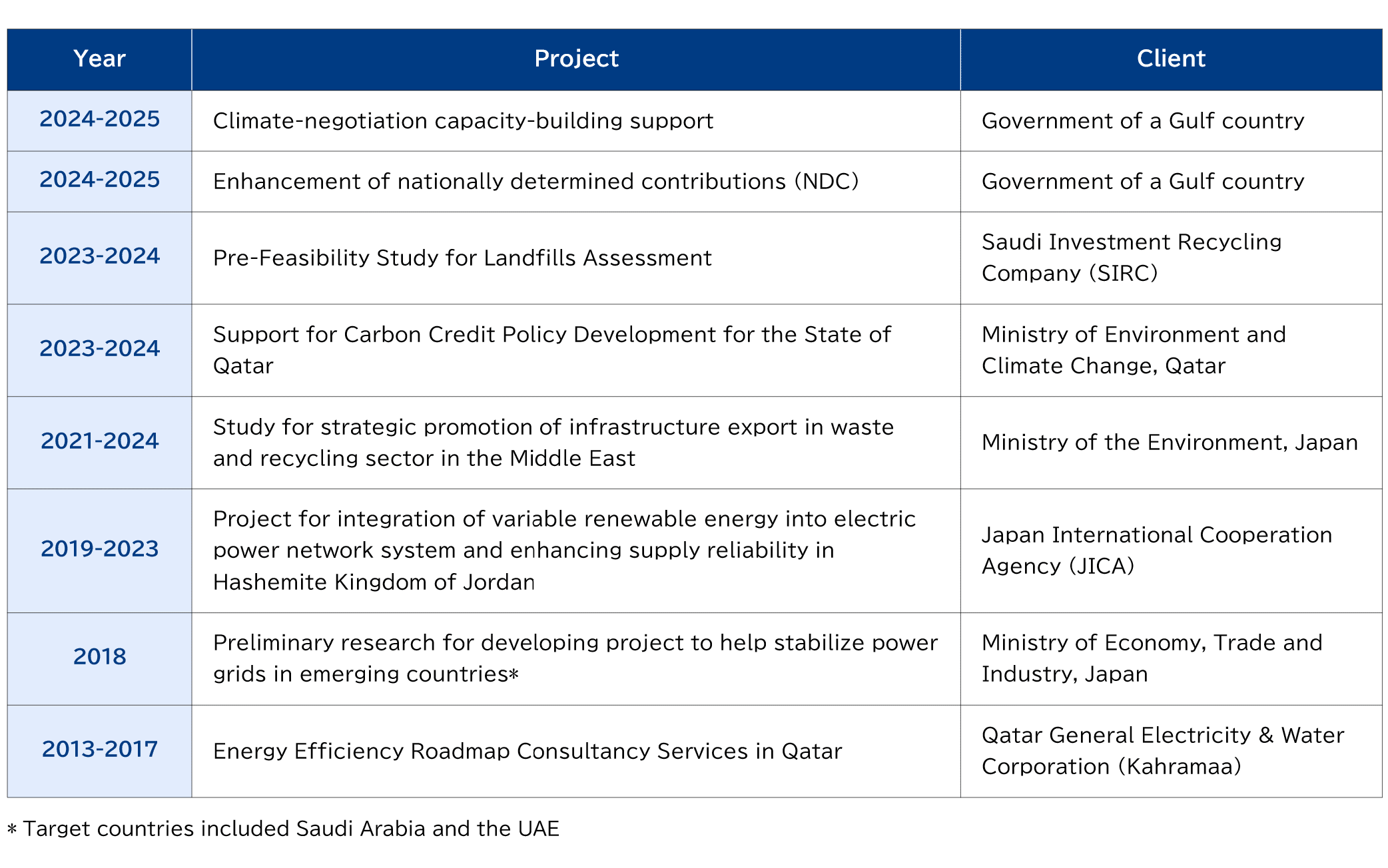
Source: Mitsubishi Research Institute, Inc.
Author profile
Keiko Ukai
Green Transformation Division
Keiko Ukai is engaged in the design of decarbonization policy and the promotion of green-transformation projects in the Gulf countries of the Middle East, particularly Saudi Arabia and Qatar. She leverages Japan’s institutional expertise and advanced technologies to strengthen economic partnerships and regional cooperation. Her work connects governments and industries in Japan with their counterparts in the Middle East through energy transition initiatives.