
While the world must achieve carbon neutrality by mid-century to minimize the impacts of climate change, complete elimination of greenhouse gas emissions would not be feasible. Carbon neutrality is expected to be attained by balancing emissions and removals—a state of net-zero emissions. Achieving this will require offsetting emissions with removals. Carbon dioxide removal (CDR) projects at present have yet to fulfill this purpose due in part to their long lead times. Moving forward, policymakers must move quickly to foster an environment conducive to the creation of these crucial projects.
CDR Holds the Key to Achieving Carbon Neutrality
Policymakers must urgently create an enabling environment
7 November 2025
Defining carbon neutrality
Around 2020, Japan and other major countries began proposing carbon-neutral targets. Many developed countries have set 2050 as the target year, while many developing countries have set later dates, like China’s 2060 target and 2070 for India. Carbon neutrality by complete elimination of greenhouse gases like CO2 is unrealistic, and the world is examining ways to achieve net zero by balancing emissions and removals (Figure 1).
Figure 1: The concept net-zero carbon neutrality

Source: Mitsubishi Research Institute, Inc.
Both the concepts of carbon neutrality and net-zero are already a part of worldwide discourse on the topic. According to the Intergovernmental Panel on Climate Change (IPCC) Synthesis Report, greenhouse gas emissions must be brought down close to zero by mid-century in order to limit the temperature increase to 1.5°C. The Paris Agreement calls for “a balance between anthropogenic emissions by sources and removals by sinks of greenhouse gases in the second half of this century”. In this sense, “carbon neutral” and “net zero” are almost synonymous with “limiting temperature increase to 1.5°C” and “aligning with the Paris Agreement”.
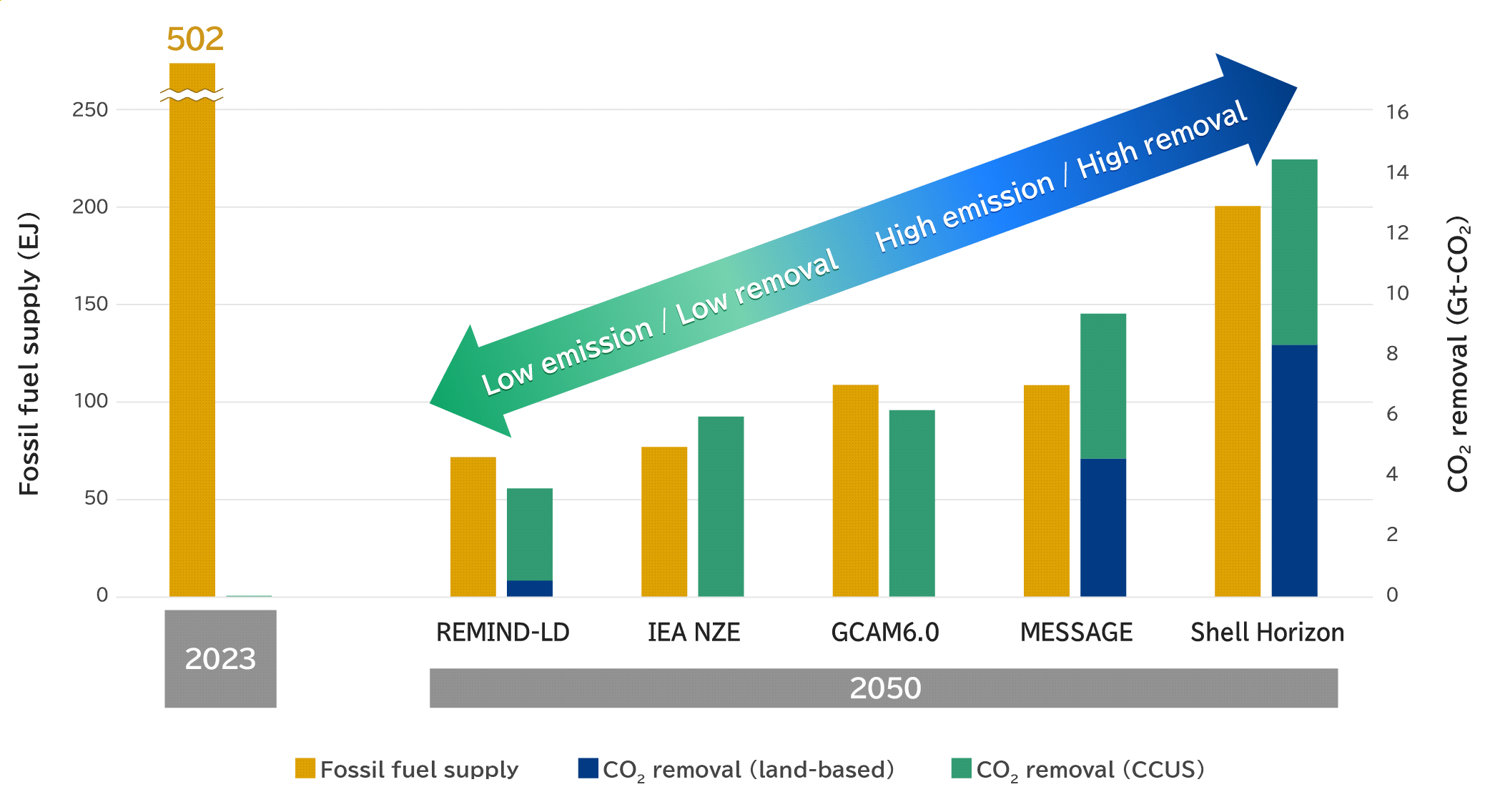
The world has yet to come to consensus on the level of emissions and removals needed to achieve the balance. Most scenarios do however share a similar conceptual base: the idea of drastically reducing emissions through measures such as zero-emission electricity, the electrification of energy, and the promotion of energy conservation, while balancing the removal of emissions through measures such as afforestation and CCUS (carbon capture, utilization, and storage). However, the way that each looks to achieve these differs significantly (Figure 2).
The world has yet to come to consensus on the level of emissions and removals needed to achieve the balance. Most scenarios do however share a similar conceptual base: the idea of drastically reducing emissions through measures such as zero-emission electricity, the electrification of energy, and the promotion of energy conservation, while balancing the removal of emissions through measures such as afforestation and CCUS (carbon capture, utilization, and storage). However, the way that each looks to achieve these differs significantly (Figure 2).
Figure 2: Fossil fuel supply and CO2 removals according to carbon-neutral scenario
Source: Mitsubishi Research Institute, Inc. from the NGFS Climate Scenarios (phase V) data set, the IEA World Energy Outlook 2024, and Shell’s The 2025 Energy Security Scenarios
As mentioned above, carbon neutrality refers to a state in which CO2 emissions and removals are balanced. To achieve this, it would be essential to establish a carbon crediting system through which emissions and removals are monetized and traded on the market, to enable the offsetting of emissions with removals.
Furthermore, such offsets can ultimately be achieved only through removal projects. Currently, renewable energy and energy conservation account for a large portion of carbon credits. While they are indispensable for reducing emissions, they cannot cancel out emissions themselves. Therefore, in the not-so-distant future, the world should not go on considering emission reduction projects as a source of carbon credits.
Furthermore, such offsets can ultimately be achieved only through removal projects. Currently, renewable energy and energy conservation account for a large portion of carbon credits. While they are indispensable for reducing emissions, they cannot cancel out emissions themselves. Therefore, in the not-so-distant future, the world should not go on considering emission reduction projects as a source of carbon credits.
Three main challenges associated with removal projects
From the above, it can be hypothesized that removal projects, typically CDR, should be promoted as a major component of carbon credits. However, CDR currently faces the following major obstacles.
Business viability
Unlike renewables or energy conservation, few CDR projects have revenue-generating potential other than carbon credits. An exception is biomass CCS (BECCS), a technology combining CCS, which does not generate revenue, with biomass power generation, which does.
Calculation methodology
In CDR projects, there is a chance that CO2 that has been removed once ends up being emitted again—or reversal. Reversal risk varies greatly from project to project: in the case of mineral fixation of CO2, it can be considered to be negligible, whereas in the case of afforestation and forest protection, it could be re-emitted in a short period of time due to forest fire, etc. Therefore, it becomes necessary to establish a way to address the risk of reversal and incorporate it into the method to calculate emission reductions. One such approach is a buffer pool, or contributing a certain percentage of emission reductions as an insurance policy to cover the risk of reversal in the event that it occurs. However, at present the details of this have not been universally agreed upon.
Knowledge
Much of the knowledge on carbon credits to date has been developed through the Clean Development Mechanism (CDM) of the Kyoto Protocol era and the voluntary credits that followed it. Neither of these were based on the assumption that emissions need to be reduced significantly, and for this reason, accumulation of knowledge on CDR projects is generally insufficient. Afforestation and forest protection (REDD+) have long been a part of carbon crediting schemes, but they are under scrutiny in light of recent claims of greenwashing and the loss of buffer pools due to large-scale wildfires.
Currently, development of methodologies applicable to CDR projects is being undertaken in the framework of the Paris Agreement Crediting Mechanism, in addition to several voluntary carbon credit programs. However, differences in viewpoints are still evident, an example being the draft standards for development of methodologies prepared by the Article 6.4 Methodological Expert Panel in July 2025, where the panel produced two very different proposals.
It should be noted that even the REMIND-LD scenario, which is most aggressive in terms of energy consumption reductions (Figure 2) at half of the current levels, anticipates removal of about twice as much as Japan’s total emissions. This is a much larger amount than the amount of removal that is currently being undertaken. Despite such obvious importance of removal, there is currently no universally agreed calculation method.
Swift international collaboration for CDR essential
Although addressing CDR is essential for long-term emission-reduction measures, there are several major barriers in the short- and medium-term. Many projects are expected to have long lead times, including securing of sites, establishing calculation methods, and arranging international cooperation. Many CDR projects are also not financially viable alone. This makes policy guidance and support crucial. In order to realize large-scale implementation by mid-century, discussion on how to achieve them needs to start in earnest.
As one step in this direction, Mitsubishi Research Institute, together with Mitsubishi Corporation, became a founding sponsor and established the Japan Carbon Dioxide Removal Coalition in September 2025. The initiative serves as a platform for collaboration and co-creation activities among a wide range of parties involved in CDR and aims to contribute to the acceleration of CDR initiatives through various activities. For CDR projects, a requirement in the long-term, the Coalition will examine how to overcome barriers—business viability, calculation methodology, and knowledge—and how to address them from the standpoint of the private sector. It also intends to make policy proposals regarding the institutional aspects of and support structures for CDR.
As one step in this direction, Mitsubishi Research Institute, together with Mitsubishi Corporation, became a founding sponsor and established the Japan Carbon Dioxide Removal Coalition in September 2025. The initiative serves as a platform for collaboration and co-creation activities among a wide range of parties involved in CDR and aims to contribute to the acceleration of CDR initiatives through various activities. For CDR projects, a requirement in the long-term, the Coalition will examine how to overcome barriers—business viability, calculation methodology, and knowledge—and how to address them from the standpoint of the private sector. It also intends to make policy proposals regarding the institutional aspects of and support structures for CDR.
Author profile

Kenichiro Yamaguchi
Green Transformation Division
Kenichiro Yamaguchi is a member of the Paris Agreement Article 6.4 Methodology Expert Panel, a member of the CDM Methodology Panel, and a prominent expert on the methodological aspects of carbon credits. He has broad knowledge of and a wide network spanning all aspects of climate change measures. He also has extensive experience in corporate carbon-neutrality strategies and addressing TCFD recommendations.