
In the burgeoning AI robotics field, Japan is poised for a competitive advantage: It can strategically apply to service robots, its component technologies for industrial robotics. Just how much promise this tech holds, and the challenges that could come up, is evident in examination of data on patent filings. Here, Japan shines in manipulation technology—i.e., that for grasping, moving, and handling—which gives the country a footing for breaking into the worldwide service-robot market. Essential will be coordinating its manufacturers and service providers. The key to success will be technical development fully conscious of market needs, and repeated verification in the field. These approaches will enable Japanese service-robot players to pioneer and grow new markets.
Japanese Service-Robot Components to Fuel Industry Growth
Competitive in tech for fine-motor manipulation
5 March 2026
Japan’s position in AI robotics patent applications
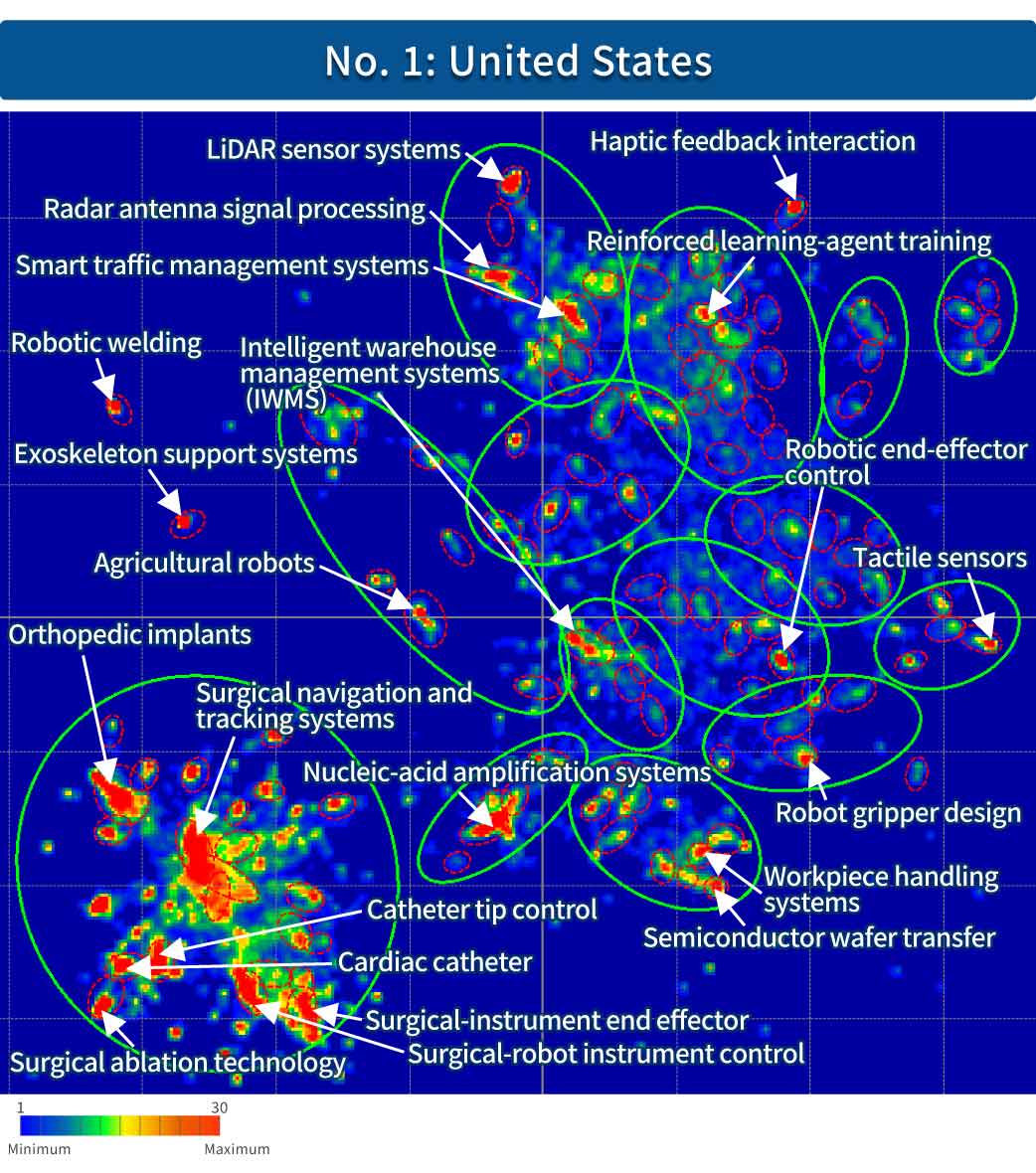
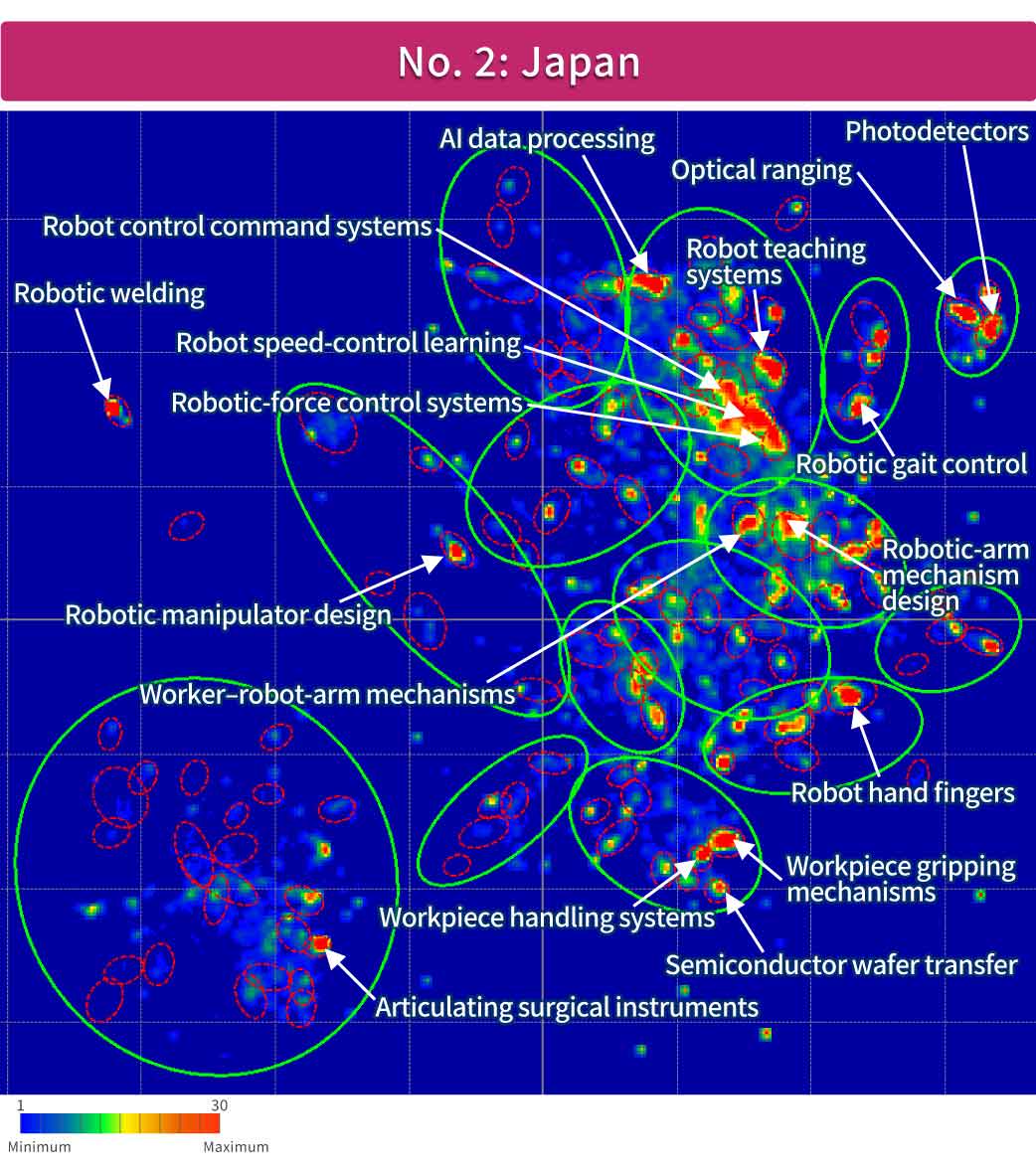
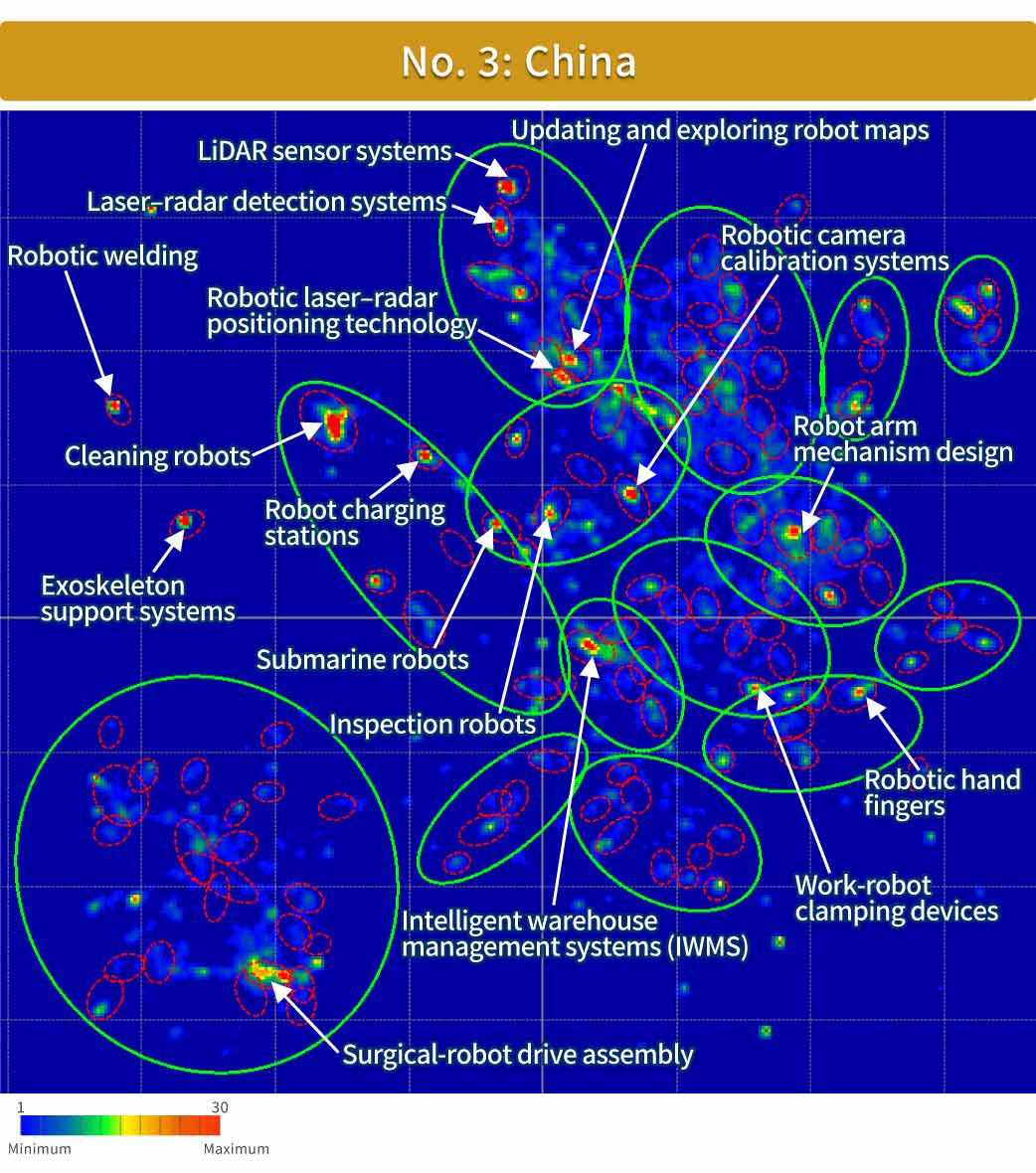
Different countries distinguish themselves in different areas in the development of technologies significant to AI robotics—i.e., their distinctive component technologies. To pin down their strengths, we did an international comparison of relevant patents filed from 2000 onward (Figure 1).* A simple by-country ranking shows that the US and Japan are the top two in numbers of patents filed by a large margin, but breakdowns zooming in on trends over time and specific underlying technologies by country show where Japan stands relative to others’ strengths (Figure 2).†
Since about 2017, China began to stand out in cleaning robots as relevant filings ballooned. We note that Chinese patents for technologies related to laser radar detection (path optimization) and lidar optical detection systems (spatial information detection) have been growing at a noticeably quick pace. Since 2017 US patent filings have risen similarly in surgical robot-related and radar-antenna—i.e., biological monitoring—technologies, and a broadening of technical fields is observable. Meanwhile, the bulk of Japanese filings appear to be in areas related to industrial robots, where it has a competitive edge in a wide range of component technologies—robot arms, data processing and control, and walking mechanisms, to name a few. Unfortunately, we observed no shifts in patent application trends, indicating that since 2017 Japan has created few if any new-tech patent fields.
These results are consistent with both government policies and industrial trends. China’s “Made in China 2025” strategy, adopted in May 2015, has had a huge influence on the situation in China. And in the US, expansion of the market for service robots, especially in its surgical and cleaning segments, and Department of Defense investments are behind the filing trends observable in the US. As for Japan, growth in markets for industrial robots, mainly for the manufacturing sector, continues; but as the technologies mature, some companies are shifting emphasis from the quantity to the quality of their patent filings, and this seems to be affecting numbers.‡
*Patents were selected using keywords in their IPC classifications and texts. To limit the scope to high-relevance patents, selection was limited to international applications and those filed in more than one country, yielding 83,077 patents. Figure 1 shows the number of filings by country and the countries with the most filings in both cases since 2001
†We did a cluster analysis of applications filed by the three patent-filing leaders (US, Japan, and China). The closer to the maximum (red), the more patents in each cluster were filed from that country
‡Industrial robot manufacturer FANUC is shifting the focus of its patent applications from quantity to quality as a part of its intellectual property strategy; for example, by filing applications for patents that have practical applications1
Figure 1: Cumulative patent filings by country and annual trends among major countries
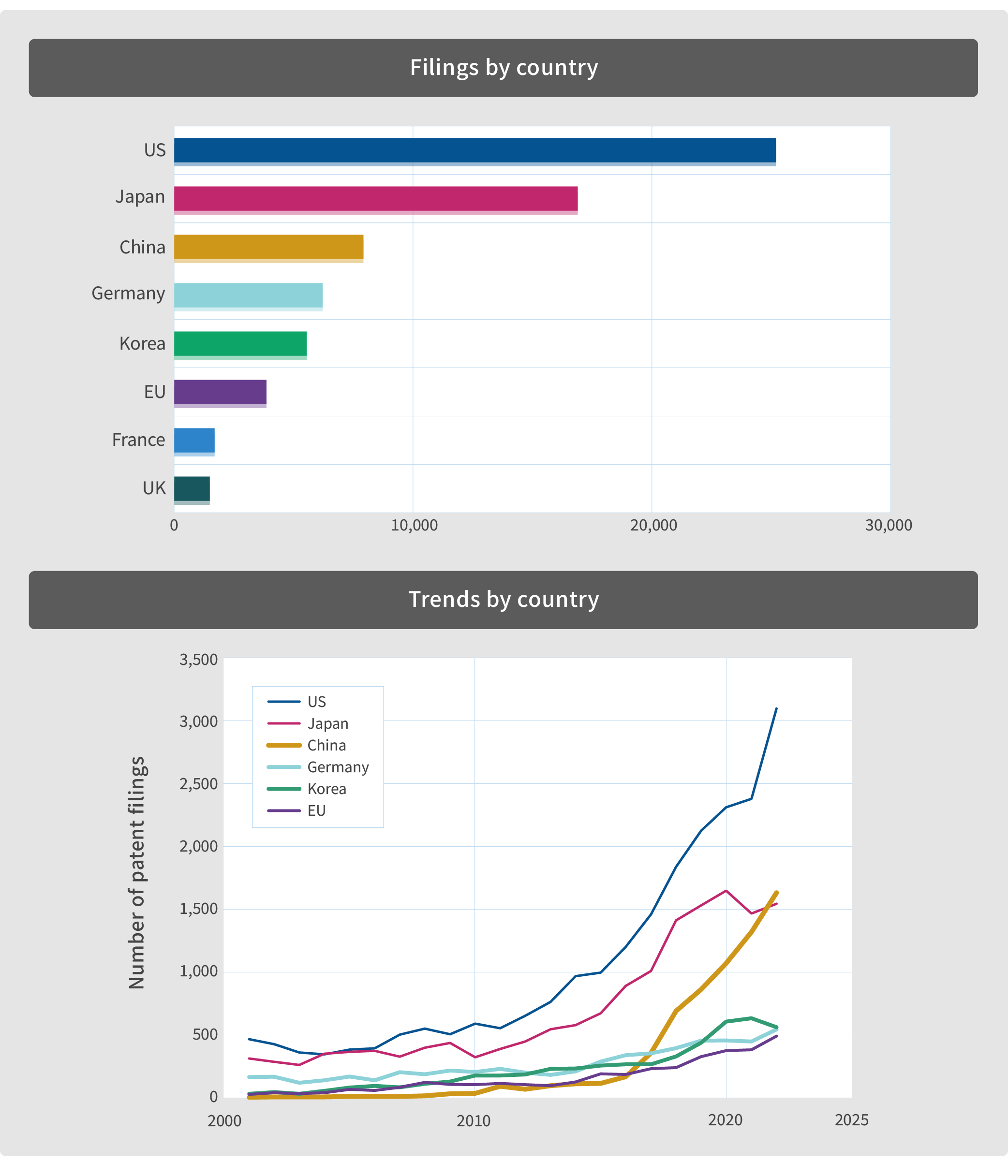
Note: Applications for patents filed internationally or in more than one country
Source: Mitsubishi Research Institute, Inc. and Valuenex Co., Ltd.
Source: Mitsubishi Research Institute, Inc. and Valuenex Co., Ltd.
Figure 2: Cluster analysis of the world’s top three patent filers
Source: Mitsubishi Research Institute, Inc. and Valuenex Co., Ltd.
Japan’s industrial robot technology positions it well for entry into the service-robot market
As society seeks to deal with aging and improve work efficiency, service robots are likely to see massive growth.2
Unfortunately, this is an area where Japan trails the US and China. The US having established itself as leader in surgical* and delivery robots,† and China having done the same in cleaning robots,‡ the pair are fueling growth in service-robot markets while Japan, lacking strengths in specific fields, has been slow to respond to market needs and apply its competitive technologies. This gives rise to concerns that Japan will further lose competitiveness and market share as the US and China continue to broaden the span of fields in which their component technologies find use. Japan needs strategic initiatives that put its established industrial-robot technologies to work in service robots.
There are a few things Japan could do.
The country has long been involved in industrial robot R&D, and it has built supply chains geared for mass production. Japanese manufacturers have rolled out product at home and abroad, maintaining competitiveness worldwide with excellence in quality and reliability. And therein lies a foundation of component technologies it now needs to apply strategically in the service-robot space.
The country has long been involved in industrial robot R&D, and it has built supply chains geared for mass production. Japanese manufacturers have rolled out product at home and abroad, maintaining competitiveness worldwide with excellence in quality and reliability. And therein lies a foundation of component technologies it now needs to apply strategically in the service-robot space.
Japan is competitive in industrial-robot technologies like robot arms, precision information processing, and manipulation. Optimizing these technologies for the diverse applications of service robots would enable their deployment in fields like medical, nursing, and other care services; cleaning; and autonomous delivery. And Japan’s excellence in quality assurance and reliability will be a powerful strength too. Using these advantages as a launchpad, Japan should step up the pace of putting service robots to practical work in the real world. Key to success will be identifying areas among the component technologies where Japan has a strong competitive edge and putting them to work strategically. Specifically, manipulation technology shows promise. The core of industrial robot technology, it can be adapted for use in countless applications.
*North America’s share of worldwide surgical-robot revenue was 50.9% in 20243
†The US accounted for some 78% of the North American market for delivery robots in 20244
‡In the second quarter of 2025, all five of the world’s top-five cleaning robot manufacturers were Chinese, with Roborock, Ecovacs, Dreametech, Xiaomi, and Narwal Robotics accounting for about 70% of the market5
Service providers and manipulation technology underpin future success
Manipulation technology is what enables robots to imitate the movements of human arms, hands, and fingers to manipulate objects in a series of operations: grasping, moving, and handling. Deployment of high-quality manipulation technology—built on achievements in industrial robots—will underpin future market growth in service robots.
Robot-hand technology has become a critical factor affecting the convenience robots offer and their market competitiveness, as evident in the growing flurry of robot-hand R&D taking place in Europe, the US, and China over the past several years.*
Here, Japan already has an advantage: the high-quality manipulation technology its manufacturers have nurtured in the process of developing and commercializing industrial robots. In service robots, though, Japan still has some challenges to take on; namely, figuring out which service-robot segments to home in on.
Most service robots on the market today are designed and have functions with such specific applications in mind. They tend to be self-contained, standalone products, such as cleaning robots.
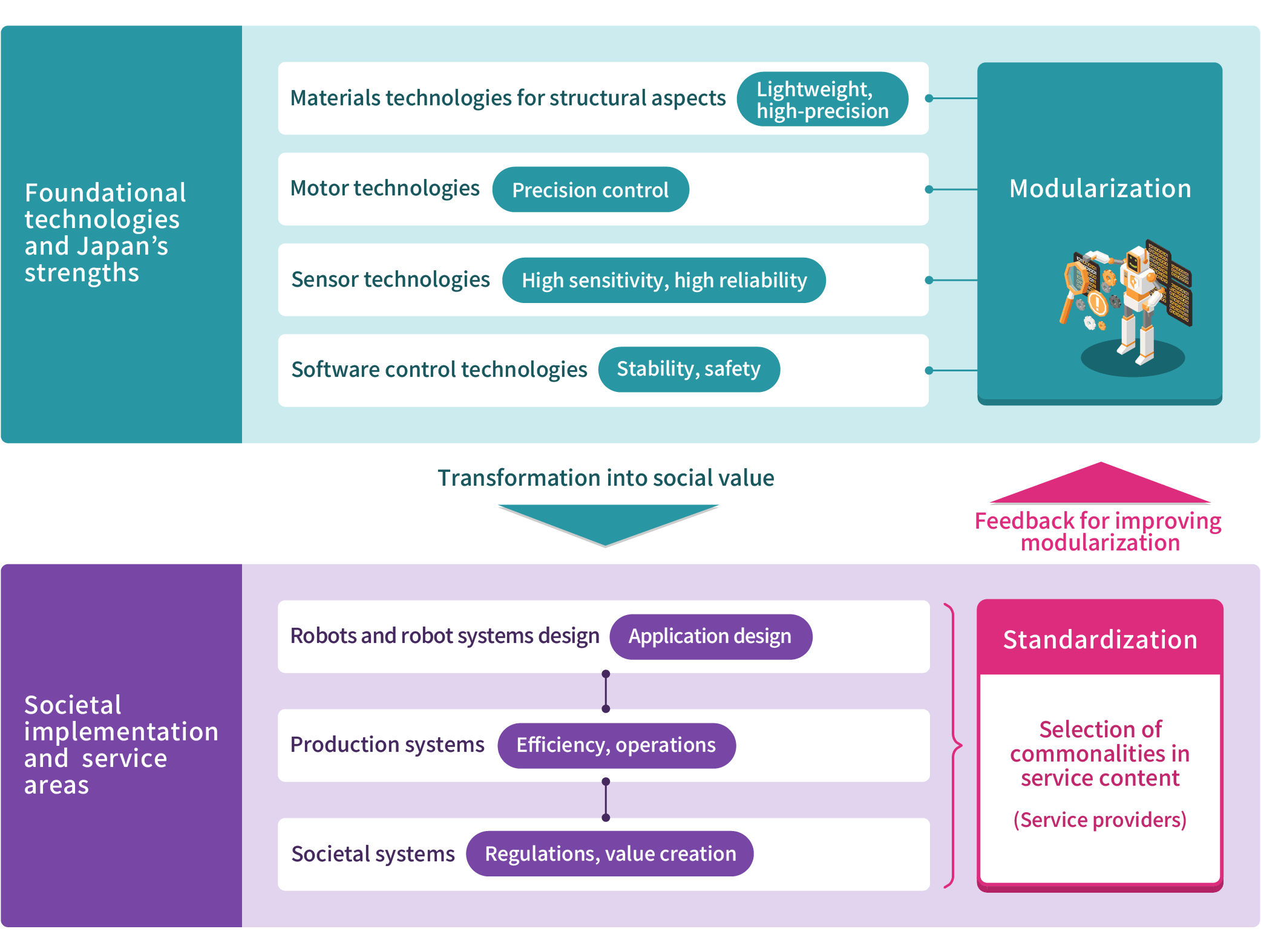
To be globally competitive, Japan needs a strategy that takes in the full scope of service applications it wants to cover. Identifying their form and how they will see widespread uptake, and devising mechanisms for deploying technologies refined in industrial robots (Figure 3), will be essential.
*See Figure 3-5 in the PDF of our Policy proposal: AI robotics for pioneering the future.6 Europe and the US have numerous government-led robotic hand projects running. In China, startups are pouring effort into developing high-function general-use robot hands
Figure 3: Schematic for developing and deploying manipulation technology
Source: Mitsubishi Research Institute
Service providers hold the key to success in the service robot market. They have access to, and a deep understanding of, a wide range of customers; they know the context in which their services are consumed; they can see where and how to use robots in situations where the robots and people interact. In addition, they are in a position to function as intermediaries between end users and manufacturers, giving the latter insights into the products users need or want, across their lifetime from the development stage onward.
Since industrial robots are used mainly on production lines, system integrators, thoroughly versed in these production lines, play the service-provider role described above. In contrast, service robots have a scope of application that spans the full spectrum of non-manufacturing applications, which means that involving service providers who are familiar with how they will be used in each particular segment will be essential to the endeavor: They will fulfill the role of uncovering the features service robots will need to satisfy customers with the added value they want.
It will then be manufacturers’ job to draw from among the advanced technologies at their disposal and integrate them into robots with the features and functions service providers ask for. In the process, they should turn to modularization and using shared components to effectively reduce development costs.
Bathing assistance robots are one use of manipulation technology. In bathing assistance, reducing the physical load on caregivers is a major issue, and key to this is the collection of detailed data on bathers’ physical condition (how they feel), functional abilities (whether and how well they can control their own body movements), and what motions they make during the bathing process. In this field, the optimal candidate sources of the relevant data would be long-term care facilities and welfare-service providers. They are best positioned to accurately apprehend real, specific needs and feed them back to manufacturers. Applying their flexible-arm design and precision handling technologies, they in turn can develop service robots that fulfill those needs, and do so with less resources. For example, while adopting flexible arms that reduce the load on caregivers’ joints, costs can be reduced by using components that are already used in industrial robots.
The role of service providers is broad. It is they who will have to distill and share insights from the issues confronting the people providing and receiving services. And it is essential that they are nimble in redesigning work tasks so that they can tackled through human–robot teamwork.
To ensure its competitiveness in the service-robot market, Japan must develop technology rooted in full appreciation of true needs on the ground and on-going verification of their utility and customer satisfaction. This is why leveraging Japan's high-quality manipulation technology and pioneering new markets based on strong partnerships with service providers will be key to maintaining Japan's competitiveness in, and the greater growth of, service robots.
Works Cited
1Saito (2025)
https://xtech.nikkei.com/atcl/nxt/column/18/00001/10788/ (accessed 8 October 2025)
3Grand View Markets Surgical Robots Market (2025 - 2033)
https://www.grandviewresearch
4MarketsandMarkets (2025)
https://www.prnewswire.com/
5Huifeng (2025)
https://www.scmp.com/economy
Author profile

Tomoaki Ujimaru
Center for Advanced Technology
Prior to his joining Mitsubishi Research Institute, Tomoaki Ujimaru’s work spanned research and mass production in automotive infotainment devices and power electronics devices. Drawing on that experience, he now conducts investigative research and develops policy proposals related to advanced technologies. His current focus is on fields related to AI robotics and human digital twins.