
COP30, held in Belém, Brazil, did not include many new decisions, but there was some progress, including an end to the clean development mechanism (CDM), a relic of the Kyoto Protocol era. The Paris Agreement can be said to have entered the operational phase, but the road to achieving its goals is arduous amid new geopolitical challenges, including the withdrawal of the US. At the upcoming COP31, the Presidency will be shared between two Parties, and smooth operation of the proceedings will be an issue to be tackled.
A Decade Under the Paris Agreement: What can be observed from “The COP in the Amazon”
Achievements of international climate change negotiations and issues we face after 2026
29 January 2026
Significance and background of COP30 in the operational phase of the Paris Agreement
The 30th Conference of the Parties (COP30) to the United Nations Framework Convention on Climate Change (UNFCCC) was held in Belém, a city at the mouth of the Amazon River in Brazil, on 10–21 November 2025, with its formal conclusion in the evening of 22 November.
It can be said that the Paris Agreement has entered the operational phase with the rulemaking phase of Article 6 of the Paris Agreement having reached completion with COP29 (Baku) in 2024. The key issues to be decided at COP30 were largely limited to the indicators to assess the achievement of the Global Goal on Adaptation. In this sense, it was clear from the outset that this COP would not be a landmark event on climate negotiation. However, with the US under the Trump administration not sending a single delegate, and with geopolitical challenges surfacing in various parts of the world, it was a noteworthy occasion for the purpose of predicting how multilateral negotiations to address climate change issues will be conducted in the coming years.
Prior to COP30, the Brazilian Presidency positioned the event as a “Forest COP” and launched the Tropical Forests Forever Facility (TFFF), which allocates the profits from its investments to forest conservation. Furthermore, ten letters from the Presidency were issued prior to COP30, which emphasized multilateralism, people-orientedness and a focus on implementation. These initiatives were aimed at raising the inherently low profile of COP30, but they also offer a glimpse into the intentions of President Lula, who is taking an increasingly adversarial position against the Trump administration.
Negotiation process and key outcomes: An end to Kyoto Protocol’s CDM
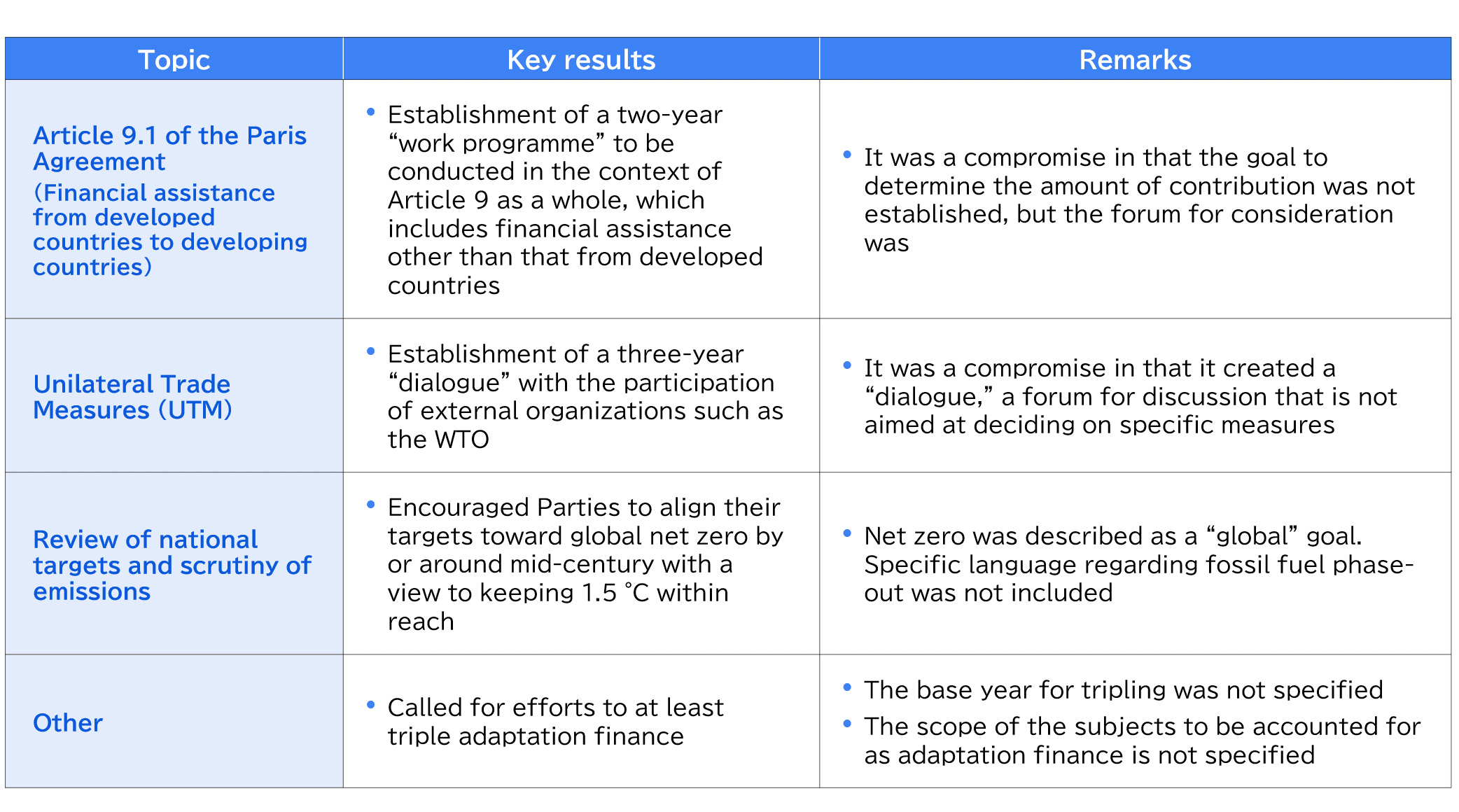
The central discussion at COP30 was the agenda for consideration at future COPs. The EU and the Alliance of Small Island States (AOSIS), who advocate climate change measures undertaken globally, expressed their desire to strengthen the establishment of a mechanism to continuously encourage scrutiny of national targets and implementation of measures based on the Paris Agreement. However, many developing countries opposed this, and in response argued for discussion on financial support from developed countries to developing countries as well as on the justifiability of unilateral trade measures including the Carbon Border Adjustment Mechanism (CBAM), which the EU will fully introduce from 2026. As a result, the Brazilian Presidency decided to withhold from putting these contentious items on the agenda, and instead opted to discuss them in a separate consultation organized by the Presidency. This avoided delays in the adoption of the agenda, and the negotiations appeared to have a smooth start. However, the gap between the countries remained unresolved; on 21 November, the live webcast was suddenly stopped mid-meeting, and informal negotiations continued thereafter. The result was summarized in a cover decision titled Global Mutirão: Uniting humanity in a global mobilization against climate change. The contents are as follows.
Figure 1: Summary of COP30 Global Mutirão resolution
Source: Mitsubishi Research Institute, Inc.
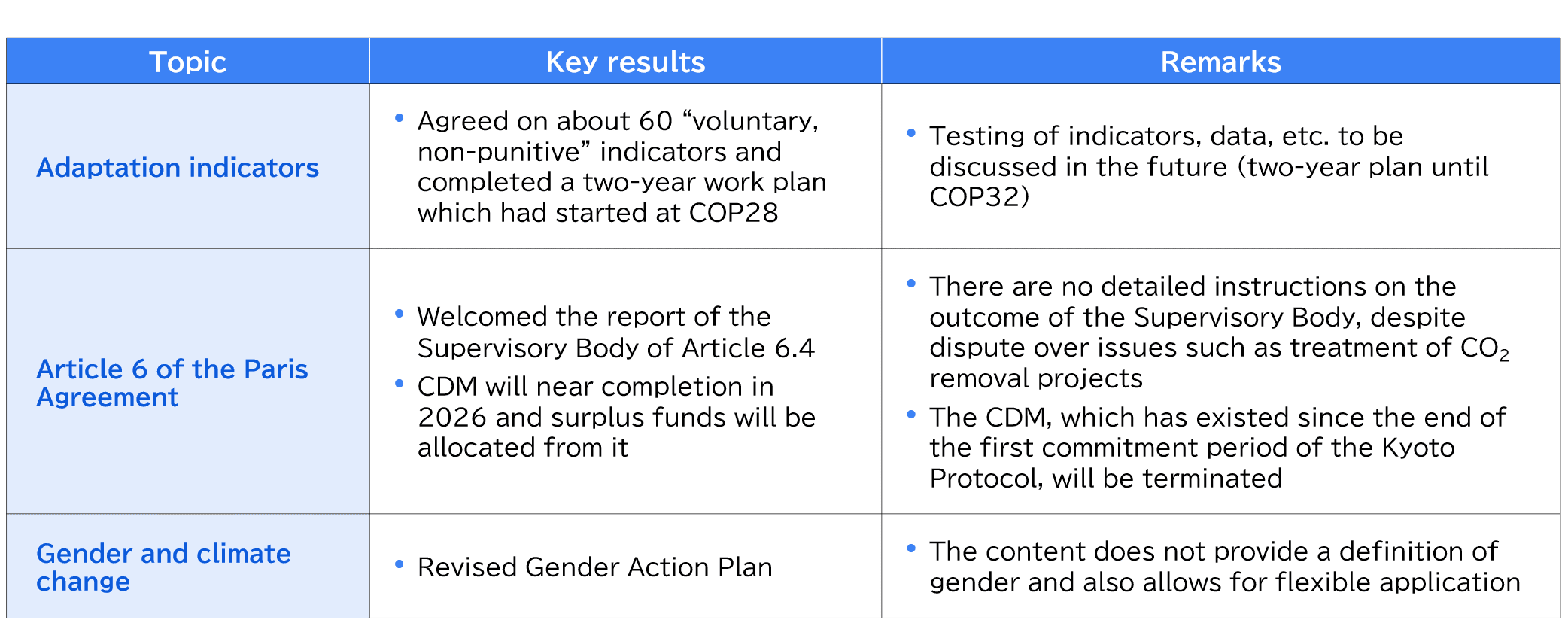
Other major decisions of COP30 are also listed below. As mentioned above, COP30 was not expected to produce landmark results in the first place, and there were no decisions that can be deemed historic. However, some decisions can be deemed as operational achievements, the most notable being the decision to put an end to the clean development mechanism (CDM), which had been in existence for more than ten years since the de facto end of the Kyoto Protocol, and the decision to allocate surplus funds to Article 6.4, CDM’s successor mechanism.
Figure 2: Other key resolutions of COP30
Source: Mitsubishi Research Institute, Inc.
Achievements of Paris Agreement after its tenth year and prospect of future COPs
As mentioned above, the rule-making phase of the Paris Agreement has run its course for the time being. Further, the momentum for implementing climate change measures has declined due to factors such as US withdrawal from Paris Agreement. Therefore, it is unlikely that significant progress will be made on climate change measures at COP for the foreseeable future. COP31 will be held in Turkey in 2026, but it will be co-hosted with Australia, which competed to host COP until the very end of COP30. The unusual arrangement raises the question of how the two countries will work together. This is to be followed by COP32 in 2027, which is slated to be held in Ethiopia. Here, Parties are expected to decide on the details of the adaptation indicators carried over from COP30.
In January 2026, the Trump administration announced its intention to withdraw from the UNFCCC. At the time of writing, the notification of withdrawal has not been submitted; if the US was to withdraw, reaching an agreement that ignores the US, the world’s second largest emitter, could prevent it from rejoining in the future. Therefore, negotiations will have to proceed on the assumption that the US will eventually rejoin.* This means that negotiations will have to remain sluggish for the time being.
The next milestone is likely to be COP 33 in 2028. Expected to be held in India, it will include the second Global Stocktake—a process to confirm progress toward the Paris Agreement goals—and the Article 6 review. It is likely that this COP will be held after the next US elections. Therefore, even without the participation of the US, negotiations will likely take place in anticipation of the administration in the following year and will be strongly influenced by the election results.
The World Energy Outlook (WEO), published by the International Energy Agency (IEA), is a must-read publication for all those involved in energy. Its 2025 edition (WEO2025) included the Current Policy Scenario (CPS) for the first time in six years since 2019, and the 2025 version of CPS incorporates the policies of the current Trump administration. Comparison of the two CPS projections provides interesting insights into developments over the past six years.
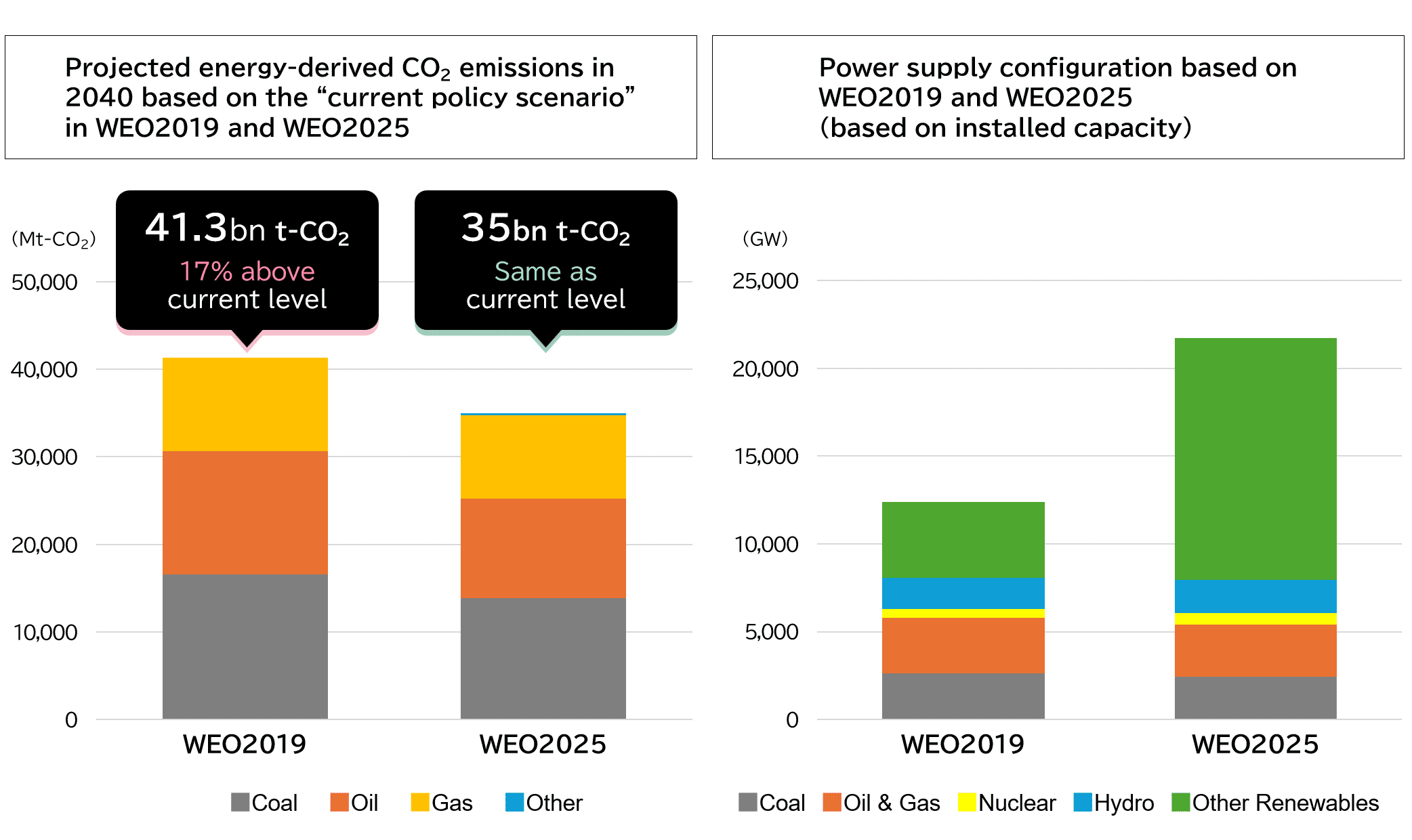
Specifically, in WEO2025’s CPS, global CO2 emissions from energy combustion for the year 2040 are projected to be 35.2 billion t-CO2, almost the same as the current level; in WEO2019’s CPS, the same figure is forecast at 41.3 billion t-CO2 (17% above the current level) (Figure 3, left). This is due to the fact that the projection for the introduction of renewable energy has been revised significantly upward. Another factor is that the majority of capacity of power sources to be installed is expected to be renewable energy according to WEO2025 (Figure 3, right). This owes significantly to not only technological advances in renewable energy and energy storage, but also to the support and incentives provided by policies around the world, including Japan’s GX policy, that have made this possible. In this sense, the Paris Agreement, a decade from its adoption, has achieved a certain degree of success.
*There is room for debate as to whether the US’s rejoining to the treaty would require congressional approval, which is currently difficult, or whether it would be unnecessary as was the case with the Paris Agreement
Figure 3: WEO2019–WEO2025 comparison
Source: Mitsubishi Research Institute, Based on World Energy Outlook 2019 and World Energy Outlook 2025.
However, although such a large-scale introduction of renewable energy is anticipated under current policy, CO2 emissions will remain flat compared to the current level, and it will be difficult to achieve the 2°C target (roughly half the current level by 2050), let alone the 1.5°C target (carbon neutral by 2050). With the observed increase in global temperatures and sea-level rise accelerating since 2010, climate change measures need to overcome the current stagnation.
Author profile

Kenichiro Yamaguchi
Green Transformation Division
Kenichiro Yamaguchi is a member of the Paris Agreement Article 6.4 Methodology Expert Panel, a member of the CDM Methodology Panel, and a prominent expert on the methodological aspects of carbon credits. He has broad knowledge of and a wide network spanning all aspects of climate change measures.

Kikuko Shinchi
Green Transformation Division
Kikuko Shinchi joined Mitsubishi Research Institute after working in methodology development and project formation at Mitsubishi Securities Co., Ltd. (now Mitsubishi UFJ Morgan Stanley Securities Co., Ltd.), one of the pioneers in carbon credit consulting since immediately after the CDM operation started in 2004. She has extensive knowledge and networks in all aspects of climate change measures in Japan and abroad.