
Breakdown of the global order, technological innovation, and increasing competition for energy and resources are three tectonic changes upending international relations. With confidence in rules-based order—premised on concepts like liberalism, multilateralism, and reciprocity—shaken, the world is heading into an era of protectionism and nationalism. For Japan, coping with the shockwaves will be unprecedently urgent, and many wonder whether policies worked out by the Takaichi administration can build the “robust economy” as envisioned. Here, we analyze the issues Japan needs to address, and how it can overcome them, in order to put the economy on a sustainable growth footing amid the global turmoil.
The Japanese Economy Amid Big Worldwide Change
Sustainable growth for a robust economy and the challenges ahead
11 May 2026
A period of historical transition
The world is entering a transitional era of historical significance. The global order based on liberalism, multilateralism, and reciprocity, commonly called the rules-based international order, is shifting toward one shaped by protectionism and priority for narrow national interests. Three ground-shifting structural changes are behind the breakdown (Figure 1).
Figure 1: Tectonic changes upending international relations

Source: Mitsubishi Research Institute, Inc.
The first is breakdown of the global order. The US led the formation of the international order as the leading power post-World War II, but its position is now precarious. The rise of China and other emerging economies is eroding the unipolar order. Meanwhile, rising numbers of illegal immigrants and the retreat of the US’s manufacturing sector are making it harder for Americans to see the benefits of open borders. The Trump Administration, born of Americans’ dissatisfaction with this, is rolling out blatantly protectionist and nationalist America-first policies. Moves that effectively reject the existing international order have also led to a drop in trust toward the US and signs of countries turning away from it.*
With the current leading power increasingly disinclined to provide global public goods—a trading system, financial stability, confidence in the reserve currency, etc.—and no new power ready or willing to assume the mantle of leadership, the world seems to be in danger of falling into the Kindleberger Trap.† This situation, in which global order is unusually vulnerable to destabilization, seems to be the direction the world is headed.
With the current leading power increasingly disinclined to provide global public goods—a trading system, financial stability, confidence in the reserve currency, etc.—and no new power ready or willing to assume the mantle of leadership, the world seems to be in danger of falling into the Kindleberger Trap.† This situation, in which global order is unusually vulnerable to destabilization, seems to be the direction the world is headed.
The second tectonic change is technological innovation. Rapid advances in AI could significantly ease labor-shortage constraints on economic growth. AI could also be an effective tool for China, where the population is shrinking, and the US, which wants to limit illegal immigration.
Though countries around the world are working to develop cutting-edge technology, the US and China still dominate due to its capital-intensive nature. Right now, American companies are in the lead, partly due to restrictions on high-performance semiconductor exports to China; but their Chinese rivals are catching up.
On top of that, AI is gradually finding ever-broader deployment in everyday life and business around the world. While it’s widely believed to be a productivity booster, new risks for social stability are also emerging, such as that of rising unemployment due to task automation and the danger of AI’s spreading misinformation.
The third change is intensifying competition over resources and energy. One factor that could limit AI development and use is power constraints. The International Energy Agency (IEA) says global data center electricity consumption is set to more than double between 2024 and 2030,‡ to a level on par with Japan’s total annual consumption.1 China is reputed to have plenty of electricity to spare, but in the US the power infrastructure is in urgent need of overhaul, and investment in US power infrastructure was a key issue of the October 2025 Japan–U.S. trade agreement.2
Resources essential for manufacturing semiconductors and electric vehicles are also gaining attention for their economic-security implications. Resource-rich countries are increasingly weaponizing access to resources by imposing export restrictions, while resource-consuming ones are moving to secure stable supplies and develop alternatives to boost self-reliance. The era when countries could just buy the resources and energy they needed, is quickly fading into the review mirror.
Resources essential for manufacturing semiconductors and electric vehicles are also gaining attention for their economic-security implications. Resource-rich countries are increasingly weaponizing access to resources by imposing export restrictions, while resource-consuming ones are moving to secure stable supplies and develop alternatives to boost self-reliance. The era when countries could just buy the resources and energy they needed, is quickly fading into the review mirror.
Countries caught in the middle are responding to these tectonic shifts by reassessing their relationships with other countries and moving to shore up their competitiveness and reduce their industries’ vulnerable supply-chain dependencies. The US and China are already taking actions in this area that will have significant implications for the global economy, and Japan is readying itself to deal with changes.
*According to a January–April 2025 Pew Research Center survey,3 in Indonesia, Mexico, and several other countries, people who have confidence in China’s Xi Jinping to do the right thing in world affairs outnumber those who have confidence in Donald Trump. Further, according to the IMF,4 the US dollar’s share of reserve currencies has dropped from 66% in 2015 to 56% in the second quarter of 2025
†The Kindleberger Trap is a situation in which the stability of the global economy comes under threat because neither the leading power nor an emerging one is willing to take on the role of providing global public goods such as free trade and security
‡This is an estimate from a base case, so technological innovations (e.g., in power efficiency) could bring this down to less than double
Need to brace for aftershocks
These three tectonic shifts could fuel protectionism’s spread and geopolitical risk to the point that they threaten Japan’s economy, making getting ready to deal with them all the more urgent. Such efforts might include: ensuring that supply chains can withstand the shocks of protectionist moves, economic pressure like embargoes, and geopolitical risk; avoiding overdependency on foreign AI tech; and securing reliable access to resources and energy.
Addressing upheaval with crisis-management and growth-oriented investment
The Takaichi administration, which launched in October 2025, set up the Council for Japan’s Growth Strategy to act as a command center for economic policy. It positioned crisis-management investment and growth-oriented investment via public–private cooperation as the keystone of Japan’s growth strategy. The expectation is that this will result in policies that will prepare Japan for dealing with the threats—the aftershocks—likely to reverberate around the world from these tectonic shifts.
The council designated 17 domains for strategic priority investment but left for others the twin task of identifying which fields are of true importance and encouraging investment in them. To do that ef-fectively, policymakers should apply a clear frame-work centered on three criteria: alignment with na-tional security objectives, technological leadership, and cross-industry impact. Under that lens, the de-fense industry as well as fields like resources, energy security, and green transformation deserve invest-ment for how they enhance the country’s ability to continue functioning economically and fend for it-self in a crisis. Sectors demonstrating the ability to innovate domestically and compete globally, such as quantum computing and synthetic biology and bio-tech, merit shoring up to maintain technological leadership. And sectors like AI and semiconductors not only drive productivity within themselves, but also deliver substantial spillover benefits to the rest of the economy by enabling higher productivity and the ability to provide new value throughout industry.
The challenges to achieving sustainable growth
1. Solidifying real wage growth
The first challenge for Japan is making rising real wages the norm. Once the current round of food-price hikes comes full circle, consumer-price inflation looks set to settle back to about 2% during the first half of 2026. Nominal wages will probably continue to trend upward amid ongoing labor-shortage concerns, and compromises coming out of the 2026 Spring Labor Offensive wage negotiations look set to line up with last year’s 5% wage hikes (around 3½% for non-regular base-pay hikes). That would once again pace year-on-year real wage increases ahead of inflation at the beginning of 2026.
But if real-wage increases are to remain the norm, productivity gains are indispensable. Because labor share is particularly high at small and medium-sized businesses (SMEs) (Figure 2), more is needed than just proclamations designed to discourage abusive practices like forcing suppliers to absorb higher costs themselves. To be able to cover steady wage increases, SMEs need to boost productivity as well. Businesses need to strengthen their earnings capacity domestically and overseas by leveraging digital technologies discussed below and enhancing technological capabilities through stronger R&D, thereby increasing the value added of their products and services.
Figure 2: Labor share at SMEs and LEs

Source: Mitsubishi Research Institute, Inc. from Ministry of Finance Financial Statement Statistics of Corporations by Industry
2. Bolstering supply capacity
The second issue Japan needs to deal with is strengthening Japan’s supply capacity. As of 2025, demand and supply across Japan’s economy are just about in balance, so the challenge for economic growth is shifting to supply constraints rather than lack of demand.
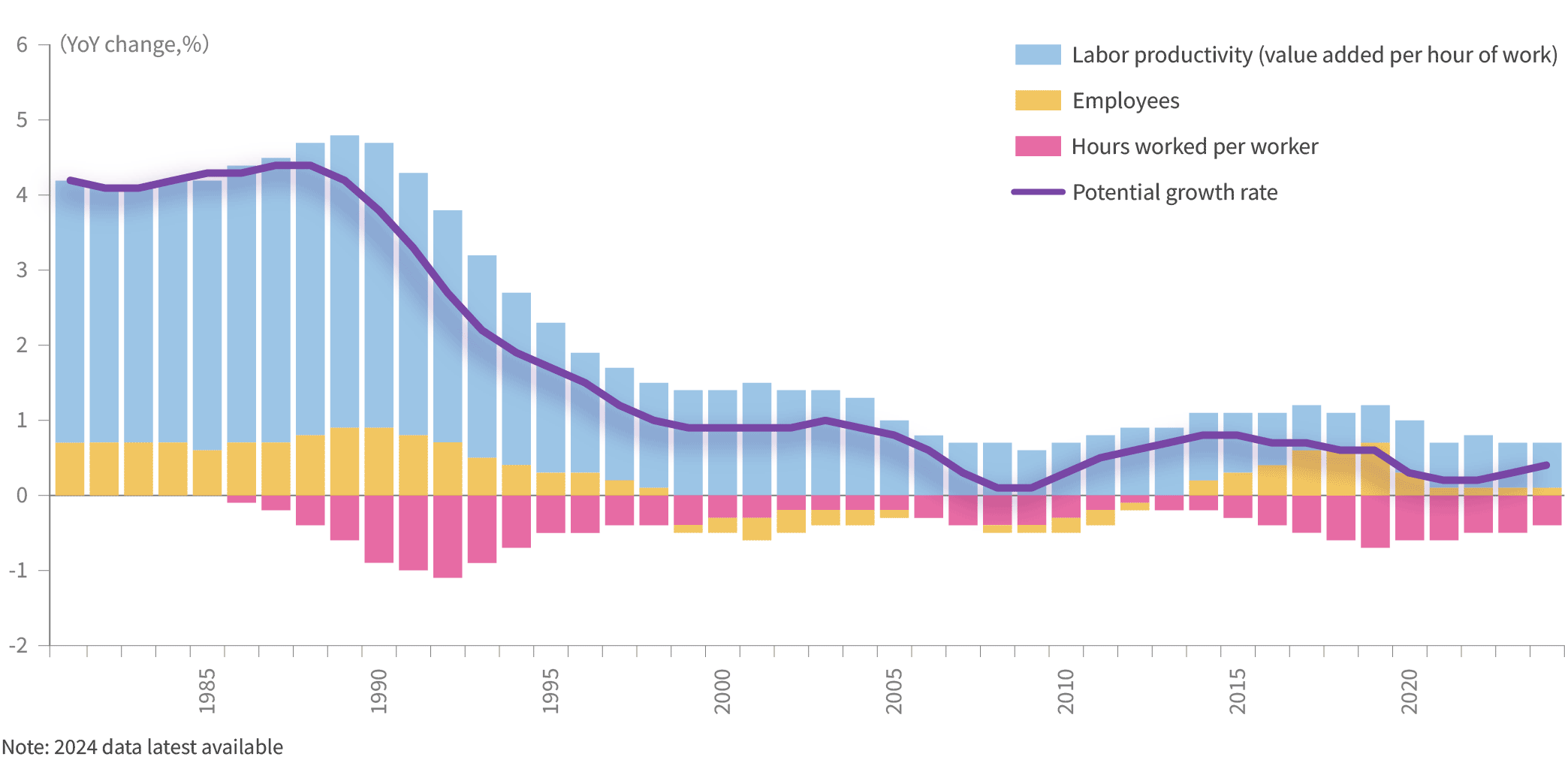
The two main approaches for boosting supply capacity are increasing total labor hours (hours worked per employee × total workforce) and boosting productivity. Societal aging and shrinking population mean that productivity gains are vital to making up for labor shortages. And weakening labor productivity has been the main factor behind the drop in Japan’s potential growth rate—an indicator of its ability to supply goods and services—since the 1990s (Figure 3). To boost it, Japan must encourage business churn—businesses exiting and entering the market—and leverage technology.
1) Encouraging business churn
The numbers of business births and deaths, or churn, in Japan are low compared to other major economies. Encouraging low-productivity companies to leave the market and new, high-productivity ones to get into it would bring higher productivity to the whole economy. Even at the individual business level, abandoning low-productivity undertakings for new, high-productivity ones promises productivity gains.To pull off such restructuring, smoothly functioning labor mobility will be vital. Getting labor mobile—making it easier for workers to transition out of old jobs and into new ones—could make it easier for existing companies to find entrepreneurial types and startups to acquire the human resources they need. This is especially true if the Japanese labor market would start fairly assessing the value of hiring people with previous experience working for multiple employers. Inside individual businesses as well, the practical knowledge, expertise, and personal networks accumulated by human capital from different industrial sectors promise to spark business transition to other new fields of endeavor by broadening opportunities for cross-business collaboration and M&A deals.
To smooth the road to greater labor mobility, Japan needs to overhaul its employment practices premised on long-term employment, such as severance determined by length of continuous service and seniority-based wages.* Policymakers need to rethink how severance pay is taxed,† and businesses need to rethink what they pay workers for and what they link severance payments to.
*When the Ministry of Health, Labour and Welfare (MHLW) asked job changers in 2020 how the government could best support them in making career changes, nearly a third (29.3%) chose “systemic improvements to prevent disadvantages in corporate pensions and severance pay” as one of the two responses they could check from a list of multiple choices5
†The formula for calculating the income-tax deduction on severance (retirement) pay is ¥400,000 × years of service for persons with 20 years or less of service, but the deduction increases discontinuously for over 20 of service according to the formula ¥8,000,000 + (¥700,000 × (years of service – 20 years))6
2) Leveraging technology
A broad range of industries could look forward to higher productivity if they put digital technologies to good use. A problem is that SMEs are behind the curve in digital-technology adoption. It is essential to introduce digital solutions in conjunction with a standardization and streamlining of business processes, as well as to encourage acquisition of digital skills among the workforce*. But SMEs often struggle to do these things on their own: A shortage of digital talent and implementation costs stand in the way. In addition to help from the government to encourage investment, interventions are needed to encourage collaboration among businesses to share digital talent and reduce deployment costs. Companies should also make wages reflect productivity to motivate workers to reskill in ways that contribute to productivity improvements.*Drawing on Japanese corporate data, Takizawa and Miyagawa conclude that additional investment to enhance ICT literacy is requisite for ICT investment to improve productivity7
Figure 3: Potential growth rate
Source: Mitsubishi Research Institute, Inc. from Cabinet Office, Government of Japan GDP Gap and Potential Output Growth Rate
3. Ensuring fiscal sustainability
The third challenge for ensuring sustainable growth of Japan’s economy is ensuring fiscal sustainability. Projections foresee government debt trending above 200% relative to GDP through 2040 (Figure 4). And Japan's finances are vulnerable to shocks: estimates suggest that a major earthquake or interest rate spikes could push the government debt GDP ratio into the upper half of the 200% range. As 2025 got underway, long-term interest rates (10-year government bond yields) started to rise, reaching 1.9% in early December. As if that were not enough, the yen has weakened despite a narrowing US–Japan interest rate differential, suggesting that the markets are concerned about fiscal sustainability.
Deteriorating public finances could also affect businesses and households adversely. A downgrade of Japanese government bonds could trigger downgrades for businesses and financial institutions, increasing funding costs and potentially dampening investment and wage growth. Meanwhile heightened anxiety over future tax hikes or government service cuts could lead to reduced consumption as households set money aside to prepare for the uncertainty. If the yen were to soften further on fiscal deterioration concerns, rising import prices could put upward pressure on consumer prices. This could result in real wages stagnating despite nominal wage increases.
The key to ensuring fiscal sustainability lies in reform of the social safety net. Social security expenditure increases, mostly to cover the costs of an aging society, have been a major driver of rising government spending since 1990. Improving the efficiency of the systems for delivering medical and long-term care, and rethinking benefit structures and burden-sharing mechanisms are urgent priorities. Specific measures include promoting regional healthcare reform, higher copays for over-the-counter (OTC) drugs, and adjusting medical and long-term care copay rates to reflect elderly users’ ability to pay, including their financial assets. Reform of the social net will hinge on public acceptance of benefits levels and who pays how much for them. We hope the National Council on Social Security, launched by Prime Minister Takaichi, will be successful in building a broad consensus.
Figure 4. Forecasts of Japan’s fiscal situation by scenario (Mitsubishi Research Institute estimates)

Source: Mitsubishi Research Institute, Inc. from Cabinet Office, Government of Japan Economic and Fiscal Projections for Medium to Long-Term Analysis (August 2025); Cabinet Secretariat, Cabinet Office, Ministry of Finance, and Ministry of Health, Labour and Welfare 2040年を見据えた社会保障の将来見通し(議論の素材) [Outlook for social security looking ahead to 2040 (discussion materials)]; IMF data; and Mitsubishi Research Institute’s own simulations on healthy lifespan
The above three challenges are complementary and thus require an integrated approach. Japan needs to simultaneously pursue sustainable real wage growth and build up its capacity to keep its industry supplied while ensuring fiscal sustainability. The growth strategy the Takaichi administration is considering includes policies that contribute to sustained real wage growth and strengthening supply capacity. These encompass creating an environment where wage increases consistently outpace inflation and labor market reforms, including facilitating smooth labor migration to high-productivity sectors and work-style reforms. These policies should not be driven solely by budget size; rather, they should be evidence-based, leveraging existing research findings on the effectiveness of policies implemented in the past, whether in Japan or elsewhere, and implementing cost-effective measures with a clear focus on prioritization.
In the end, it is businesses themselves that will have to actually pay inflation-beating wages, achieve productivity gains, and bolster Japan’s ability to supply enough product. They need to be aware that it is ultimately up to them to step up to the mound, build on the platform the Takaichi government’s growth strategy gives them, and pursue sustained economic growth.
Works Cited
1IEA (2025) “Energy and AI”
https://www.iea.org
2Ministry of Foreign Affairs (2025) “Japan-U.S. Summit Meeting, Signing Ceremony, and Japan-U.S. Working Lunch”
https://www.mofa.go.jp/na/na1
3Wike et al. (2025) “U.S. Image Declines in Many Nations Amid Low Confidence in Trump” Pew Research Center
https://www.pewresearch.org/global
4IMF “Currency Composition of Official Foreign Exchange Reserves (COFER)”
https://data.imf.org/en
5MHLW (2021) “2020 Survey of job changers”
https://www.mhlw.go.jp/toukei
6National Tax Agency
https://www.nta.go.jp
7Takizawa, Miho and Miyakawa, Daisuke (2024) “ICT Investments and Firm Productivity: An Analysis Using Micro Data,” Keizai Bunseki, No. 209
https://www.esri.cao.go.jp/jp