Marketing Eco-Friendly Products in Japan

Behavior change can ensure both food supply and business sustainability
18 August 2026

Japanese: 1 June 2026

Nanae Yamamoto
Center for Policy and the Economy

A few typical thoughts run through the mind of a Japanese consumer when they pick up a food product at the store. They tend to judge based on taste, price, and health, but eco-friendliness is not usually on their minds. For makers of such merchandise, they must home in on the process in which a consumer picks a product and help the country maintain a sustainable food supply.
We conducted research on food-purchasing behavior with Strategic Research Institute, Corporate Planning Division, Mitsubishi Shokuhin Co., Ltd. in 2025. In line with our goal, we were able to gain insight into how to ensure the sustainability of the food supply.

Sustainability still seen as a cost

Extreme weather and ecosystem deterioration caused by climate change are beginning to directly affect the stability of food supply. Impacts are increasingly evident for major food groups like leafy vegetables, seafood, and rice. Given their potential as risks to business continuity, companies cannot ignore the effects.
In light of this, Japan is working to build sustainable supply chains. It has set up the MIDORI Strategy for Sustainable Food Systems, the MIDORI Act (2022),1 and a producer-certification system.2
However, most food businesses still position environmental initiatives—to, e.g., reduce CO₂ emissions, recycle, reduce food loss, and foster biodiversity—as a cost center or a form of corporate social responsibility. This positioning thwarts their potential to contribute directly to sales and profits.
To change this situation, a shift in market structure, to one in which greater sustainability efforts lead to greater consumer choice, is essential.

A reality of retail: Consumers make the decisions

Unclouded understanding of consumer purchasing behavior is key. No matter how significant the environmental initiative, it will not be commercially viable unless consumers choose to buy the products on offer.
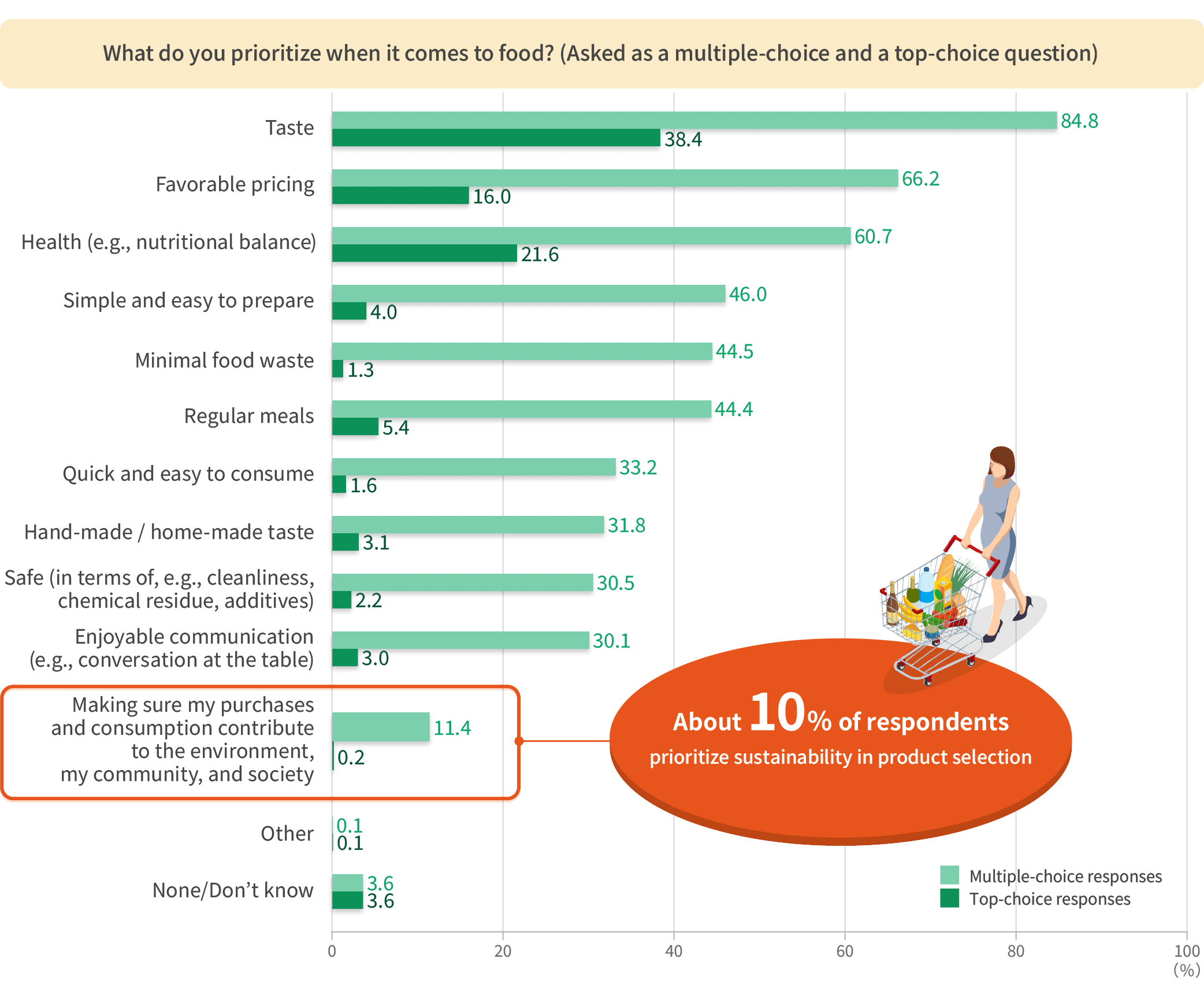
A Mitsubishi Shokuhin consumer survey showed that shoppers still purchase food based on taste, price, and health. Only about 10 percent prioritized sustainability (Figure 1). Consumer behavior that supports sustainability is also limited in scope, confined to actions like food-loss reduction. Even audacious communication of environmental value is not enough right now to move most consumers to buy eco-friendly products. We still have a long way to go before consumers completely shift to sustainability-centric purchasing behavior.
Figure 1: Consumer survey on food-purchasing behavior
Consumer survey on food-purchasing behavior
Source: Mitsubishi Research Institute, Inc. from consumer survey (sample size: 2,000) conducted in May 2023 by the Strategic Research Institute, Corporate Planning Division, Mitsubishi Shokuhin Co., Ltd.

Case studies: Reframing eco-friendliness translates into sales

There are multiple instances where measures have actually changed consumers’ purchasing behavior, and these case studies offer interesting insights.
European discount-supermarket major LiDL has been trialing an eco-score (products ranked from A to E) labeling initiative for food products (Figure 2). Providing visualization of information on eco-friendliness seems to have helped the firm increase its sales of eco-friendly products by a few percentage points. The impact was greater in certain consumer segments, such as those aged under 40, those without children, and those oriented toward sustainability.3 However, the program is still young, leaving it with room to evolve.
Another trial, this one in Kanagawa Prefecture, Japan, confirmed that applying nudge theory* led to the percentage of customers who purchased target products increasing about 15 percentage points. This program included labeling eco-friendliness with more visible and artful displays. Other significant effects were also noted: Combining these tactics with incentives such as competitive pricing and loyalty points resulted in a 27 percent increase in sales of target items.4,5
A third trial, Cuoncrop’s “My Eco-Ruler Food AI Ideator”, makes explicit the environmental impact of food through indicators for decarbonization, biodiversity, and resource-savings, even for fresh produce like vegetables. The generative AI tool quantifies environmental impacts at the product and process level and presents producers’ innovations and value created as data. It is an example where clearly displaying eco-indicators serves as a means of differentiating products, helps them win supermarket shelf space, and helps them sell more.6
These trials share a common theme: Simply stating that a product is eco-friendly is not enough to get people to modify their behavior. Messaging has to be combined with other purchase motivators like ease of choice, good value, experience, and emotional connection. The LiDL example shows that the effects of motivational tactics’ on purchase behavior varies between age groups. This means it is essential to design target-group–aware strategies.

*Nudge theory applies concepts from behavioral science premised on allowing people to maintain their freedom of choice, but also encouraging them to make better decisions. It posits that the selection environment can be designed to encourage people to adopt desirable behaviors on their own. Changing product display layouts on the sales floor, eye-catching labels, and recommendation messages are examples of this approach7

Figure 2: Behavior change elicited by explicating environmental value in case studies
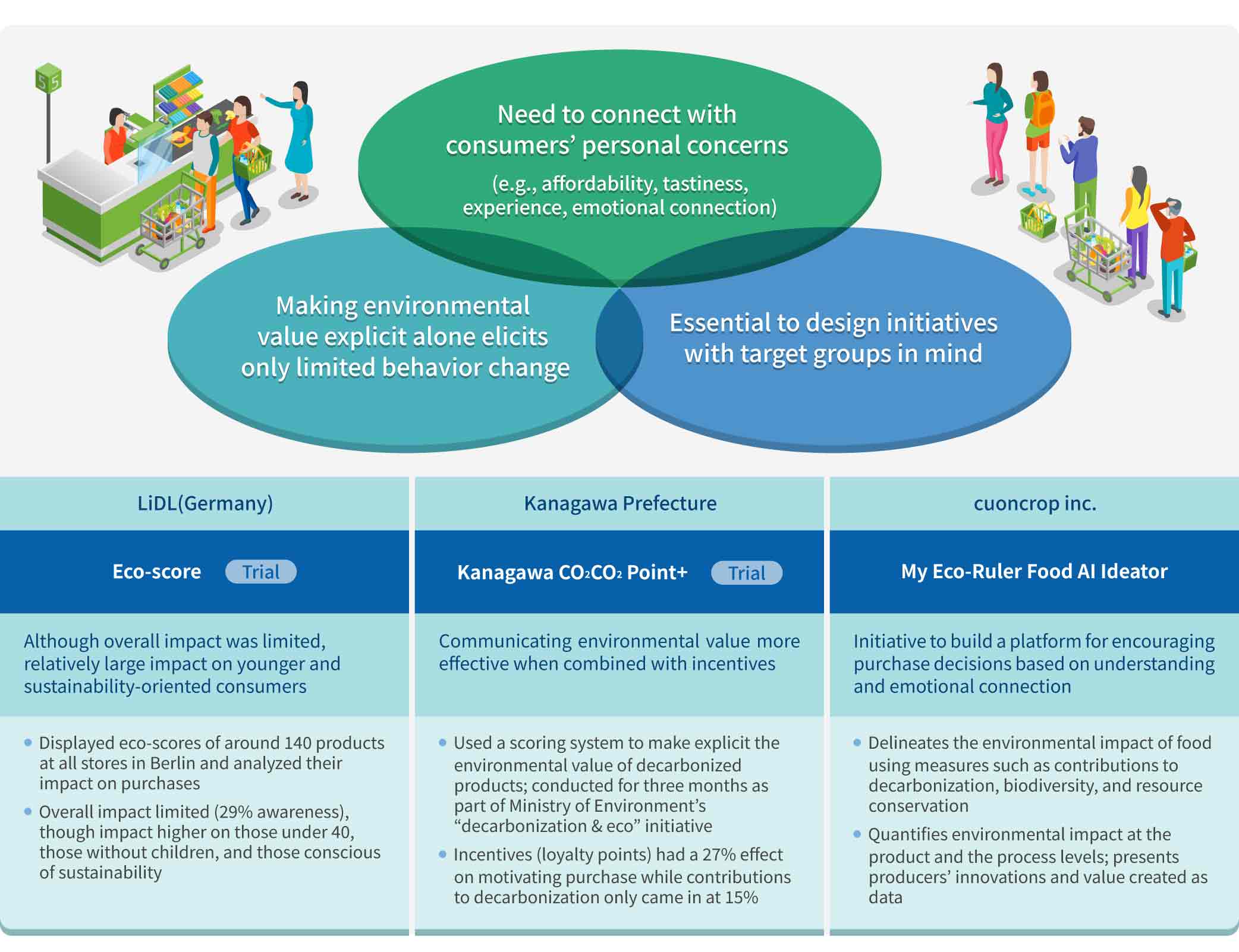
Behavior change elicited by explicating environmental value in case studies
Source: Mitsubishi Research Institute, Inc.

From conscious decision to natural choice

These trials offer insights into not only how we should message about eco-friendly products to consumers, but also how we can create situations that make them consumers’ natural choice.
There are three challenges to overcome that are specific to food purchases. First, the market for eco-friendly food is limited since only a fraction of consumers will adopt eco-friendly behaviors on their own. Second, providing environmental information (via labeling) on its own has minimal impact on sales. Third, a divide between producer and consumer makes it difficult to convey value.
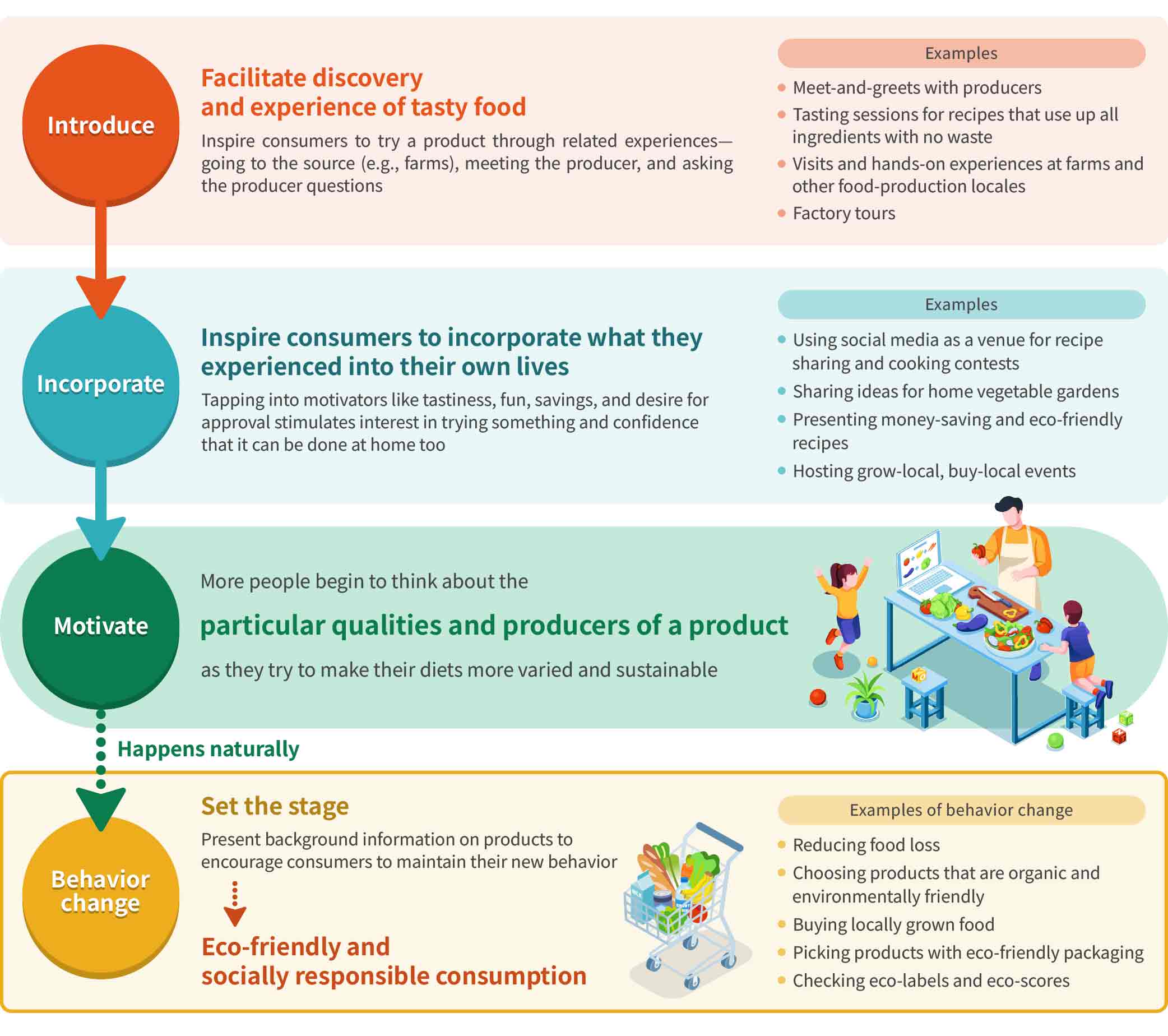
Tackling these challenges requires working environmental value into existing purchase criteria rather than simply communicating environmental value. Some effective initiatives might include integrating environmental value with tastiness and health value, designing salesfloor flow lines so that consumers know where to go, and building emotional connections by featuring the stories and experiences of producer’s (Figure 3).
Figure 3: Taking products from a conscious decision to the natural choice
Taking products from a conscious decision to the natural choice
Source: Mitsubishi Research Institute, Inc. from joint research report with Mitsubishi Shokuhin Co., Ltd. titled 『持続可能な食』に向けた生活者行動変容の共同研究を開始 生活者(消費)とサプライヤー(供給)の共創実現に向けて [“Joint research on consumer behavior change toward sustainable food: Making co-creation between consumers and suppliers a reality”]
The natural choice concept has seen real-world application by Colruyt, a Belgian retailing major. The company runs a program that awards points to customers when they buy products with high eco-scores. Customers can then exchange the points for products. The program effected behavior change by tapping into the motivation to buy something because it was good deal rather than by relying solely on environmental awareness.
The points can also be used for donations and tickets to expert webinars, creating a cycle that uses purchases as a starting point for deepening understanding of the environment and agriculture. This has brought an increase in consumer segments that choose products with high eco-scores on a regular basis, differentiating these products and improving customer loyalty. The company aims to achieve a sales share of over 30 percent for high eco-score products in the longer term.8,9,10
Note: See below for details of our joint research with Strategic Research Institute, Corporate Planning Division, Mitsubishi Shokuhin Co., Ltd., including analysis of the consumer survey, policies, and case studies of trials in Japan and overseas

Works Cited

1Ministry of Agriculture, Forestry, and Fisheries “MIDORI Strategy for Sustainable Food Systems”
https://www.maff.go.jp/e/policies/env/env_policy/midori.html (accessed April 17, 2026)

2Ministry of Agriculture, Forestry, and Fisheries “MIDORI Act (2022) (MIDORI certification, technology certification)
https://www.maff.go.jp/e/policies/env/env_policy/attach/pdf/midori-2.pdf (accessed April 17, 2026)

3LiDL Ergebnisse der Eco-Scorepilotierung bei Lidl in Deutschland [“Findings of the Ecoscore Pilot Program at Lidl in Germany”]
https://unternehmen.lidl.de/pdf/show/51552 (accessed 17 April 2026)

4Decarbonization Strategy Office, Environment and Agriculture Department, Kanagawa Prefecture (2025) 脱炭素に資する商品・サービスへのポイント付与ガイドライン(令和6年度版) [“Guidelines for reward points awarded for products that contribute to decarbonization (fiscal 2024 edition)”]
https://www.pref.kanagawa.jp/documents/118954/assyuku.pdf (accessed April 17, 2026)

5Earth hacks & Co. (2025) “PR Times, Earth hacksと神奈川県、『かながわCO₂CO₂ポイント+』実施結果を元にした事業者向け『脱炭素に資する商品・サービスへのポイント付与ガイドライン』を公開” [Earth hacks and Kanagawa Prefecture release “Guidelines for reward points awarded for products that contribute to decarbonization based on Kanagawa CO₂CO₂ Point+ program]
https://prtimes.jp/main/html/rd/p/000000073.000122970.html (accessed April 17, 2026)

6cuoncrop inc.
https://cuoncrop.com/en/ (accessed April 17, 2026)

7Cabinet Office and Ministry of the Environment, 第311回消費者委員会本会議 2.行動経済学『ナッジ』活用に向けた取組状況について [“2. Status of initiatives to utilize nudge behavioral economics theory, 311th Consumer Council meeting”]
https://www.cao.go.jp/consumer/iinkai/2019/311/shiryou/index.html (accessed May 7, 2026)

8Colruyt Group (2026) Annual report with sustainability reporting 2023/2024
https://www.colruytgroup.com/en/investor-relations/annual-report-with-sustainability-reporting (accessed April 17, 2026)

9Colruyt Group (2026) “Danone joins forces with Colruyt Group to further expand Eco-score in Belgium”
https://press.colruytgroup.com/danone-joins-forces-with-colruyt-group-to-further-expand-eco-score-in-belgium (accessed April 17, 2026)

10Collect & Go
https://www.collectandgo.be/colruyt/nl/home (accessed April 17, 2026)

Author profile

Author

Nanae Yamamoto

Center for Policy and the Economy

Since joining MRI in 2012, Yamamoto’s research areas have been food, agriculture, and regional industries in Japan. Focusing on sustainability of the environment and communities, she conducts independent research and crafts proposals on sustainability in food and agriculture, implementation of techniques and technologies, and consulting themes such as the creation of new businesses utilizing local resources.