
Japan is working out how to boost its capabilities in drug discovery and development and avert loss of access to new drugs, or drug loss—the phenomenon, and wider fallout, of patients going without the newest global medications. Global clinical trials provide one way to address the issue. Participation in them staves off drug loss while fortifying a country’s developmental prowess and putting promising domestic research to practical use. With competition for a spot in the global clinical trial race growing, Japan should focus on how it can improve the recruitment of trial participants and secure a workforce with the specialisms it needs.
Keeping Japan relevant for international clinical trials
Improving patient recruitment and securing specialized personnel are key to a competitive clinical trial environment
18 November 2026
The future of Japan’s position in global clinical trials
Drug development and sales strategy have traditionally followed a more-or-less standard path. Clinical trials were conducted in the US, then Europe, and finally Japan, as drugs made their way to approval. But more recently there has been a change of course. With startups that lack marketing arms now taking over the bulk of development, and with drug markets growing outside the US–EU–Japan triangle—China’s above all—global clinical trials are displacing the old country-by-country model. This new norm1 means a country’s timely access to new drugs now hinges on whether it can join those trials.
For years, Japan took part in drug trials as one slice of a broader Asian sample population. But more recently China and South Korea have courted drug companies for trial work, raising their profiles as places where trials get done.2 That shift means pharmaceutical companies can increasingly bring new drugs to the global market without ever testing them on Japanese patients—and Japan becomes a less compelling place to run a trial.
If Japan misses out on global clinical trial opportunities, the impact will be twofold. Japanese patients’ access to new drugs will be delayed. And the country’s medical institutions, healthcare support personnel, and companies will have fewer chances to build and share the practical knowhow that comes from drug development and trials. This could even erode Japan’s own ability to carry homegrown drug-discovery seeds through to market.
For Japan to continue participating in pharmaceutical development at the global level, it must be a country developers choose to run their trials in. Key to that is making the choice an easy one for developers: trial quality, of course, but also ready access to plentiful patient data, speed of trial launches, low administrative burden, and cost forecastability.
First fix: Improve patient recruitment
Japan’s environment for conducting clinical trials has both strengths and weaknesses. On the one hand, Japanese trials have a reputation for high-quality data; on the other, their speed and cost are a competitive weakness.3 Much of that traces to a feature of Japan’s healthcare system: the sheer number of hospitals4 and the geographical spread of mostly small clinics across the country. Because the patient pool is so dispersed, a single trial needs the cooperation of multiple hospitals and clinics, each contributing only a limited number of participants. That low patient density piles on administrative work—applications to process, progress to track across many sites—slowing trials down and driving up costs.5 The fix starts with knowing where the patients are. An efficient way to track them, coupled with cooperation among medical institutions to improve patient recruitment at hub facilities, would make Japan a more attractive place for drug makers to run trials.
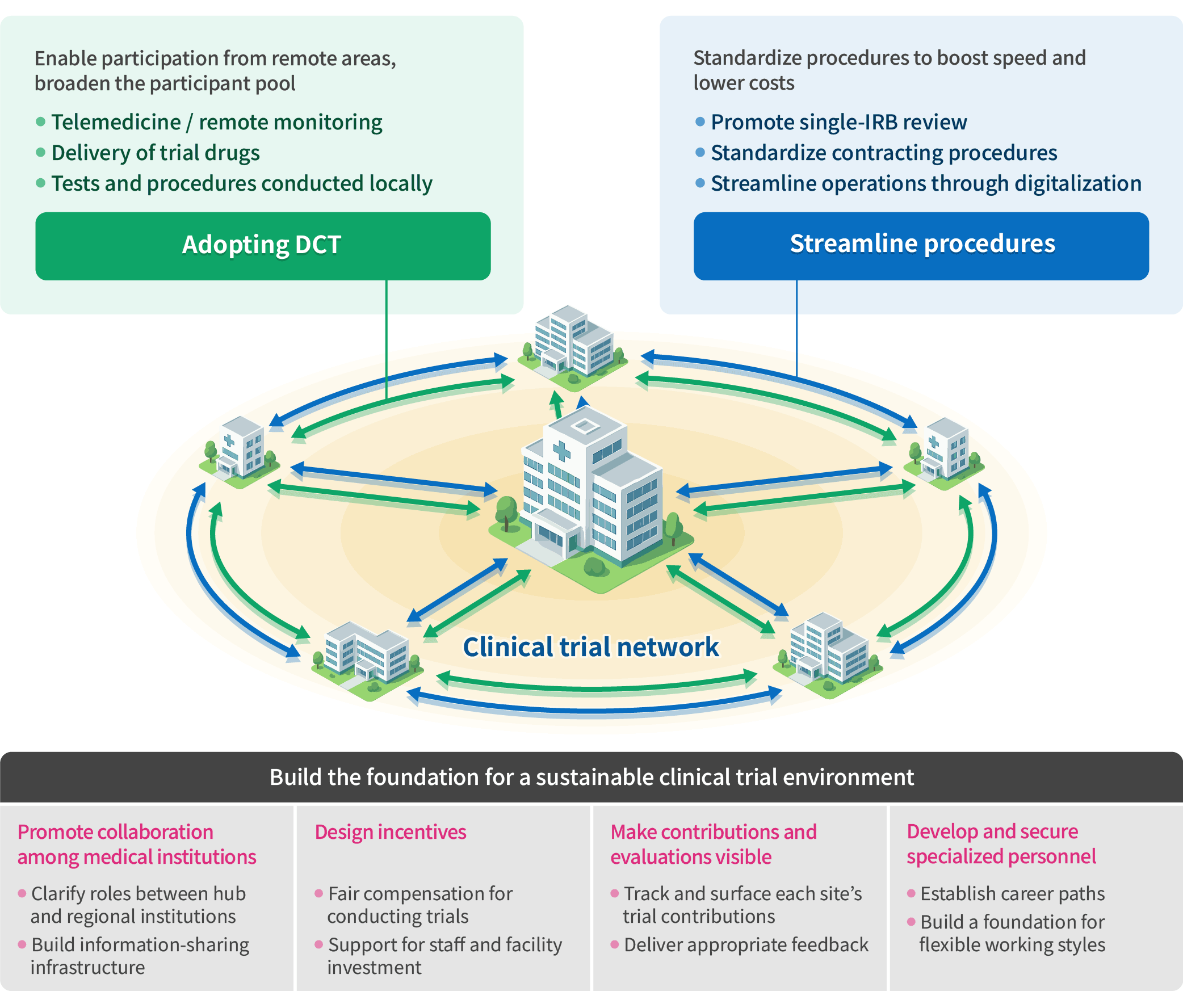
The pandemic accelerated adoption of decentralized clinical trials (DCTs),* which make use of telemedicine, home delivery of investigational drugs, and the like, and Japan is now building a track record of trials that patients can join from far afield.7,8 Wider use of this approach would broaden the participant pool and speed trials along. Beyond that, if hub hospitals and nearby clinics can form trial networks organized by therapeutic area or geographic area, a handful of hospitals could draw participants from across the country. Streamlining procedures further—including wider adoption of the single IRB†—would make Japan more attractive for running trials. What matters is preserving quality while cutting excess paperwork and duplicated effort, so the whole system becomes easier for companies to work with (Figure 1).
Collaboration among medical institutions that lets patients take part in a trial from anywhere in the country would also open up options for patients who previously found it hard to participate for reasons of location.
*Decentralized clinical trial (DCT) refers to a method of clinical trial participation in which participants take part remotely—from home or elsewhere—without visiting the trial site in person. Its components include eConsent (obtaining explanation and consent electronically), online visits, partner medical institutions, home nursing visits, electronic patient reported outcome (ePRO), wearable devices, and delivery of investigational drugs, among others6
†Rather than having each medical institution’s own institutional review board (IRB) review a trial separately, a single IRB reviews the entire trial
Figure 1: The clinical trial framework Japan should aim for
Source: Mitsubishi Research Institute, Inc.
Second fix: Policy and programs for specialized personnel
While improving the clinical trial environment matters, securing specialized personnel is essential to the collaboration between medical institutions with advanced trial infrastructure and the regional institutions handling patient care, testing, and medication. Chief among these specialists are clinical research coordinators (CRCs)—the professionals who manage clinical trial operations, including patient interaction—and they remain a critical foundation that most medical institutions lack in sufficient numbers.9
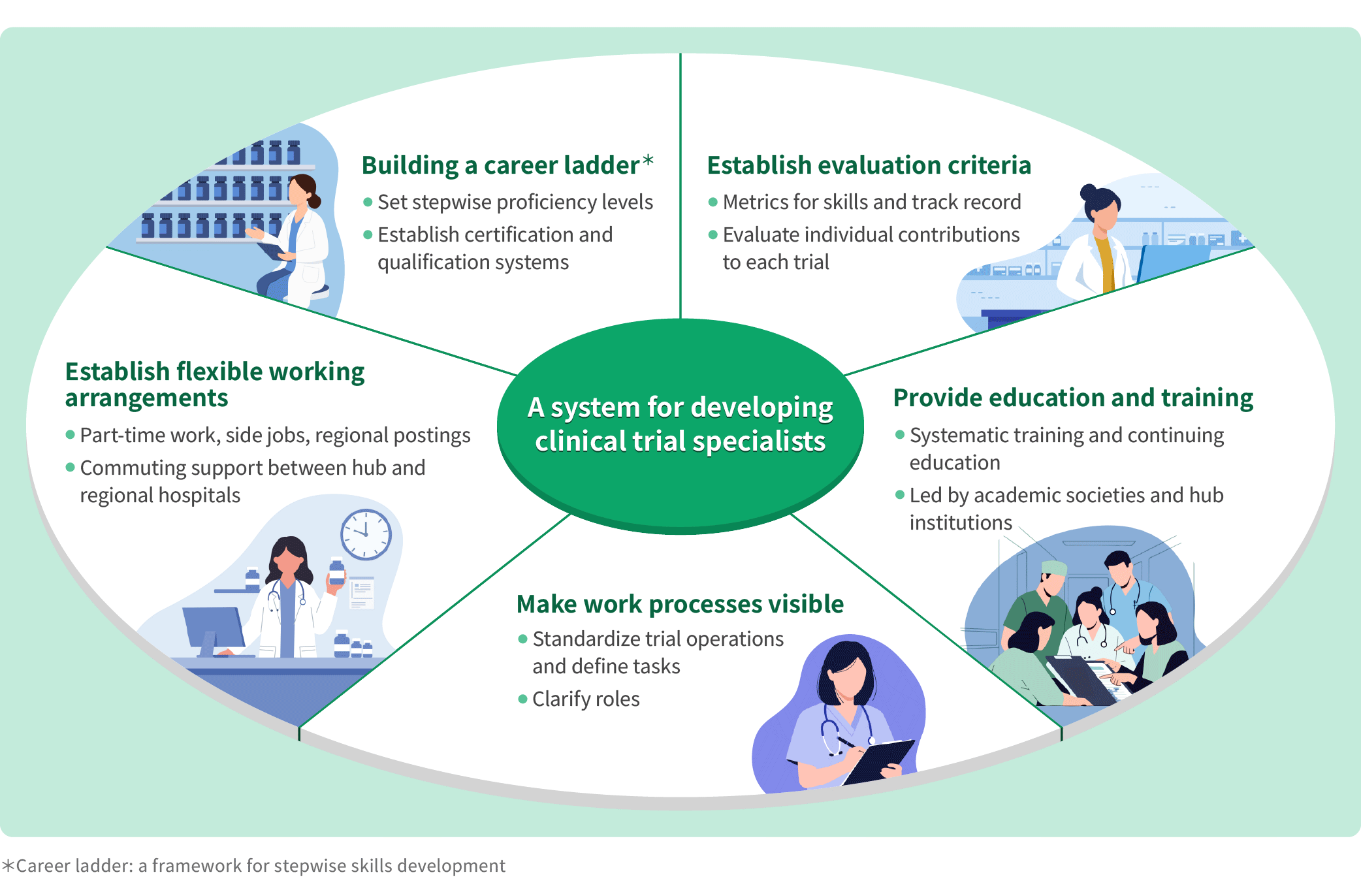
CRC staff need more than general clinical skills; they also need knowledge and expertise in trial-related regulation and participant protection, yet the systems to evaluate this expertise and the career paths built on it remain underdeveloped. This is a global, not just domestic, challenge: establishing a professional identity and career path for clinical trial specialists is a widely cited problem abroad as well.10 In Japan, the way forward is to make trial work visible, build standards to properly evaluate individual contributions, and let academic societies and hub institutions take the lead in developing a highly skilled specialist workforce (Figure 2).
Figure 2: Steps needed to develop and secure specialized personnel
Source: Mitsubishi Research Institute, Inc.
As DCT adoption spreads, areas beyond hub hospitals will also need people to handle trial-related work. Even so, medical institutions outside the hubs need not keep specialists on staff full time. Expanding flexible ways to work in trials—supporting trial preparation part time, or handling remote patients through home visits and home nursing care in regional areas—lets people take part in ways that suit their lifestyles, which in turn helps secure the workforce.
Either way, developing and securing this specialized workforce requires medical institutions to invest ahead of demand. That calls for a mechanism to evaluate each institution’s contribution to drug development—not just the hub hospitals leading trials, but also the institutions that refer patients and run tests—alongside economic incentives that let institutions invest in facilities and people. Achieving this will also require government involvement. The government should clarify the clinical trial ecosystem it wants Japan to build, then calculate the optimal distribution of specialists and the infrastructure the country needs, and translate that into concrete upfront investment of its own.
Building an environment where Japan is chosen as a trial destination serves industrial development and patients alike. Government, medical institutions, and industry need to work together—building collaborative networks among medical institutions while developing and securing the specialized workforce that supports them—to strengthen Japan’s international competitiveness and sustain both access to new drugs and the accumulation of development and trial expertise.
Works Cited
1Higashi Hiroshi (2022) “目で見る製薬産業 近年における国際共同治験の動向調査” [A visual guide to the pharmaceutical industry: a survey of recent trends in international joint clinical trials] Office of Pharmaceutical Industry Research (OPIR), Seisakuken News No. 66
https://www.jpma.or.jp/opir/news/066
2Higashi Hiroshi and Shiraishi Takahiro (2024) “目で見る製薬産業 近年における国際共同治験の動向調査” [A visual guide to the pharmaceutical industry: a survey of recent trends in international joint clinical trials] Office of Pharmaceutical Industry Research (OPIR), Seisakuken News No. 73
https://www.jpma.or.jp/opir/news
3日本がグローバル試験から排除される日~最悪のシナリオを回避するための意識・行動改革~ [The day Japan is shut out of global trials: a shift in mindset and action to avoid the worst-case scenario—18th Conference on the Future of CRCs and Clinical Trials, 2018, Toyama] PhRMA/EFPIA Japan joint seminar
https://www.phrma-jp.org/wordpress
4Ministry of Health, Labour and Welfare, Working Group on Regional Healthcare Visions and Physician Securement Plans (2022) “医療提供体制の国際比較 OECD加盟国との比較” [An international comparison of healthcare delivery systems: benchmarking against OECD members] Working Group 3rd meeting, 2 March 2022, Reference Material 3
https://www.mhlw.go.jp/content/10800000
5グローバル試験から排除されないために~コスト意識が日本の治験を活性化する~ [Staying in the global trial race: how cost awareness can revitalize Japan’s clinical trials—20th Conference on the Future of CRCs and Clinical Trials, 2020, Nagasaki] PhRMA/EFPIA Japan joint seminar
https://www.phrma-jp.org/wordpress/wp-content/uploads
6Japan CTX Study Group (2024) 日本におけるDCT普及に向けた提言 [A proposal for expanding DCT adoption in Japan]
https://j-ctx.mri.co.jp/document
7Aichi Cancer Center (2022) かかりつけ病院と協力して患者さんとオンライン診療を行う完全リモート治験を開始します [Launching a fully remote clinical trial using online medical consultations in partnership with patients’ primary care hospitals]
https://cancer-c.pref.aichi.jp/wp/wp-content/uploads/r40214-1.pdf (accessed 8 June 2026)
8Japan Pharmaceutical Manufacturers Association (JPMA), Drug Evaluation Committee, Data Science Subcommittee (2024) DCTの導入状況およびDCTの各手法に関するアンケート結果 [Survey results on DCT adoption and individual DCT methods] FY2023 Task Force 1-2
https://www.jpma.or.jp/information
9Ministry of Health, Labour and Welfare, Health Science Council, Clinical Research Subcommittee 本邦におけるCRCを取り巻く状況について [The current situation surrounding CRCs in Japan] 45th meeting, 26 March 2026, Document 4
https://www.mhlw.go.jp/content/10808000
10ACRP (2025) Addressing the Clinical Research Workforce Crisis: A Call for Collective Action
https://acrpnet.org/insights/white-papers/addressing-the-clinical-research-workforce-crisis-a-call-for-collective-action (accessed 8 June 2026)
Author profile
Mai Orii
Medicine and Health Ecosystem Division
Mai Orii’s work looks at how advanced medical technologies get implemented, mainly for academia and government agencies, from an R&D and regulatory-affairs perspective. Though not a medical professional, she is committed to helping move treatments from the lab to the clinic so that medicines reach the patients who need them.
Yuri Emoto
Medicine and Health Ecosystem Division
Yuri Emoto researches and analyzes the policy and regulatory framework for drug development and works to put policy recommendations into practice. By getting better information on medicines to the people who need it, and by making Japan an easier place to run clinical trials, she hopes to help resolve drug lag and drug loss and to advance drug development in Japan.