
The use of carbon credits temporarily declined after the Kyoto Protocol, but a common international understanding is gradually emerging through developments such as efforts to address the criticism of “greenwashing” as well as establishment of rules for credit procurement in international aviation. The Joint Crediting Mechanism (JCM), an initiative led by Japan, has developed along a distinct path, although recent efforts toward harmonization are also evident. Depending on how it is implemented, Article 6 of the Paris Agreement could become highly stringent; nevertheless, since carbon credits are an essential tool for achieving carbon neutrality, a flexible approach will be needed to support their continued development. In this column, we identify perspectives required for future rule-making and highlight considerations for companies seeking to use the carbon credit market.
Where are Carbon Credits Headed?
In pursuit of integrity
25 September 2026
Trends in carbon credits
Carbon credits, used to offset the greenhouse gas emissions of countries and companies, became widely adopted through the Clean Development Mechanism (CDM) under the Kyoto Protocol. As the Protocol effectively came to an end, however, the center of activity shifted from compliance schemes to voluntary programs utilized by the private sector. The greater flexibility inherent in voluntary programs also gave rise to doubts about the integrity of carbon credits, as reflected in greenwashing criticism concerning issues such as the over-issuance of carbon credits. Against this backdrop, CORSIA, which sets out emission reduction measures for international aviation, included carbon credits among its options. Its Emissions Unit Eligibility Criteria (EUC)1 published in 2019, consolidated prior knowledge and established requirements for carbon crediting programs and credits themselves. The Core Carbon Principles (CCP)2, adopted in 2023 by the Integrity Council for the Voluntary Carbon Market (ICVCM), an initiative promoting the sound expansion of voluntary credit markets, further developed the EUC. Together, these frameworks are forming a shared understanding of carbon credits, referred to below as the “international standards.”
By contrast, the Japan-led Joint Crediting Mechanism (JCM) developed along a different path. Unlike many other crediting programs, the JCM has not codified, in a program-wide and uniform form, rules concerning baseline scenario establishment, demonstration of additionality, renewal of crediting periods, or responses to non-permanence (the risk of reversal). Instead, these matters are established for individual partner countries or projects. Progress also varies among partner countries in developing registry systems capable of tracking the transfer and use (retirement) of credits and preventing double counting.
These institutional differences may be attributable to several factors. The JCM originated during the Kyoto Protocol era before the Paris Agreement, and its design began in anticipation of the cooperative approaches later set out in Article 6.2 of the Paris Agreement (discussed below). In addition, Japan conducts bilateral deliberations with each of its partner countries—32 as of August 2026—and the mechanism is linked to Japan’s domestic climate measures, making uniform changes to its rules difficult. An application was previously submitted for the bilateral JCM between Japan and Mongolia to be recognized as a CORSIA-eligible program, but it has not been recognized as eligible to date.3
Impacts brought about by Article 6 of the Paris Agreement
Developments related to Article 6 of the Paris Agreement, now entering the operational phase, are beginning to impact the current carbon crediting landscape. Article 6 can broadly be divided into Article 6.2, which mainly establishes rules for the international transfer of carbon credits through cooperative approaches, and Article 6.4, which establishes a carbon crediting program commonly known as the Paris Agreement Crediting Mechanism (PACM).
Article 6.2 is not a specific carbon crediting program like the JCM or CDM; rather, it sets out procedural requirements that countries must follow when transferring carbon credits internationally. One notable feature is the assessment by the United Nations Framework Convention on Climate Change (UNFCCC) of reports submitted by countries on transfers under the Paris Agreement, through the technical expert review (TER). The TER examines international transfers of carbon credits4 from the standpoint of accuracy and transparency. Although its findings do not directly entail penalties or mandatory corrective action, a persistent “significant inconsistency” may, at the reviewers’ request, be considered under the compliance mechanism established by Article 15 of the Paris Agreement. Reports submitted by several countries in 2024 and 2025 were found to contain inconsistencies or insufficient information in their descriptions of transferred carbon credits, some involving the JCM. For example, the TER of Palau’s report concerning ITMOs issued under the JCM identified that the country had not prepared and reported an up-to-date emissions inventory and had provided insufficient information on the method used to calculate emission reductions. Japan submitted reports in 2024 and 2025, but as of August 2026 the corresponding TER findings had not yet been published.
By contrast, Article 6.4 (PACM) is the successor to CDM under the Kyoto Protocol. Institutional development accelerated following the establishment of the Supervisory Body in 2022 and the Methodological Expert Panel in 2024.5 PACM is largely built upon the features of the international standards developed since CDM, while introducing new elements such as downward adjustment of baseline emissions and prevention of carbon lock-in risks. It is also characterized by the introduction of more stringent approaches that place greater emphasis than previous carbon credit methodologies on avoiding the overestimation of credits.
Prospects and challenges of convergence toward PACM
The development of PACM rules is also influencing other carbon crediting programs. Gold Standard, a major voluntary crediting program, is aligning its program rules and quantification methodologies with PACM, while Thailand’s Premium T-VER program has announced that it will achieve alignment during 2026. CORSIA, whose EUC significantly influenced the design of carbon credits, also appears to be considering alignment with PACM. Moreover, the EU, which had long been skeptical of carbon credits, decided to allow a limited use of credits toward its 2040 target, envisaging high-quality credits under Article 6 of the Paris Agreement. These developments indicate that several international frameworks for using carbon credits are beginning to position PACM as a benchmark for integrity. The relationships among JCM, the international standards, and PACM may be illustrated as shown below.
Figure: Schematic diagram of the relationships among JCM, the international standards, and PACM
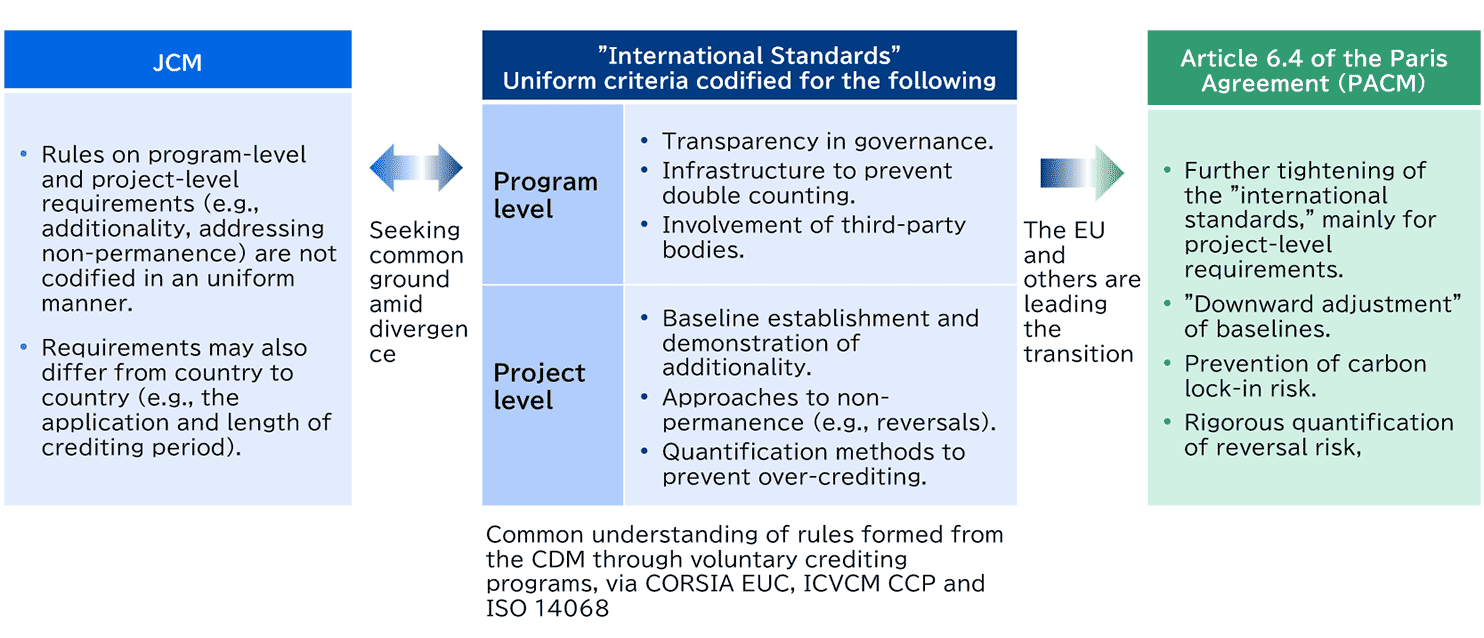
Source: Mitsubishi Research Institute, Inc.
One possible future development is that TER assessments of international credit transfers under Article 6.2 may place increasing emphasis on consistency with PACM rules. If such convergence toward the PACM occurs, independently developed mechanisms such as JCM may face more stringent scrutiny. It should be noted that, although PACM is being developed based on the international standards described above, no projects have yet been registered and no credits have yet been issued under PACM-specific quantification methodologies. Its implementation is therefore still at an early stage, and how new concepts such as reducing carbon lock-in risk will be applied remains uncertain. Accordingly, aligning carbon crediting rules strictly with PACM at this stage could create operational risks arising from uncertainty over the application of methodologies and the issuance of credits.
Such differences in understanding as to what carbon credits should be also have implications for the design of Japan’s domestic frameworks. Japan’s emissions trading system, GX-ETS, entered full-scale operation in 2026, and carbon credits that may be used to offset emissions exceeding allocated allowances are limited to those issued under JCM and the J-Credit Scheme. This gives those two programs exclusive access to the GX-ETS market. In international markets such as CORSIA, however, neither program has been recognized as eligible and therefore presently cannot participate. Because simultaneous registration of the same project under multiple programs is generally prohibited, project developers must choose the program under which to register their projects. Such a situation is undesirable both for project developers and for the promotion of greenhouse gas mitigation projects.
Such differences in understanding as to what carbon credits should be also have implications for the design of Japan’s domestic frameworks. Japan’s emissions trading system, GX-ETS, entered full-scale operation in 2026, and carbon credits that may be used to offset emissions exceeding allocated allowances are limited to those issued under JCM and the J-Credit Scheme. This gives those two programs exclusive access to the GX-ETS market. In international markets such as CORSIA, however, neither program has been recognized as eligible and therefore presently cannot participate. Because simultaneous registration of the same project under multiple programs is generally prohibited, project developers must choose the program under which to register their projects. Such a situation is undesirable both for project developers and for the promotion of greenhouse gas mitigation projects.
Toward a shared understanding of integrity
Against this backdrop, efforts are also being made to promote convergence between the international standards and JCM. As of September 2026, JCM has incorporated provisions on establishing and renewing crediting periods consistent with the Paris Agreement into agreements with many JCM partner countries and is advancing the development of registry systems. Since September 2024, the JCM between Japan and Thailand has been implemented under the Premium T-VER rules described above. This has introduced concepts not previously present in the JCM such as demonstration of additionality, and may consequently have brought the JCM closer to the international standards. Examples of cooperation among different programs include mutual recognition between Indonesia’s domestic crediting scheme and major voluntary programs such as Verra and Gold Standard, as well as Singapore’s establishment of cooperative relationships with Verra and Gold Standard concerning methodologies applied to carbon credits that the government permits for offsetting carbon tax liabilities. Such initiatives can encourage gradual convergence among carbon credit standards and give both project developers and buyers greater confidence when making business and procurement decisions under a broadly shared set of quality criteria.
As noted above, the EU has allowed the use of “high quality” Article 6 credits as one means of achieving its 2040 target. The private sector initiative SBTi has also released a revised Corporate Net-Zero Standard incorporating the use of “high integrity” carbon credits. The definition of carbon credit integrity remains unsettled, and a key challenge will be how to accommodate diverse approaches such as PACM and JCM while using the international standards as a central reference point. JCM was pioneered as a carbon crediting mechanism intended to enable transactions with a degree of flexibility under bilateral agreements, and many partner countries have accumulated knowledge and experience in carbon credit transactions through it. JCM should closely monitor international discussions and coordinate and cooperate with partner countries in ways suited to changing circumstances. Flexible standards that converge in stages can also build trust among project developers, companies using carbon credits, and governments. From this perspective, it is hoped that the UNFCCC, which supports implementation of the Paris Agreement, will recognize a reasonable degree of diversity in approaches to carbon credits. On that basis, flexible transfer rules should be designed to foster a shared understanding of integrity without placing excessive emphasis on PACM.
As noted above, the EU has allowed the use of “high quality” Article 6 credits as one means of achieving its 2040 target. The private sector initiative SBTi has also released a revised Corporate Net-Zero Standard incorporating the use of “high integrity” carbon credits. The definition of carbon credit integrity remains unsettled, and a key challenge will be how to accommodate diverse approaches such as PACM and JCM while using the international standards as a central reference point. JCM was pioneered as a carbon crediting mechanism intended to enable transactions with a degree of flexibility under bilateral agreements, and many partner countries have accumulated knowledge and experience in carbon credit transactions through it. JCM should closely monitor international discussions and coordinate and cooperate with partner countries in ways suited to changing circumstances. Flexible standards that converge in stages can also build trust among project developers, companies using carbon credits, and governments. From this perspective, it is hoped that the UNFCCC, which supports implementation of the Paris Agreement, will recognize a reasonable degree of diversity in approaches to carbon credits. On that basis, flexible transfer rules should be designed to foster a shared understanding of integrity without placing excessive emphasis on PACM.
Considerations for companies seeking to use the carbon credit market
Due to factors explained above, the current heterogeneity of the relevant frameworks makes carbon credits difficult for private companies to navigate. When using them to meet voluntary targets, companies must remain mindful of reputational risks such as greenwashing and carefully analyze potential suppliers, crediting programs, and project types, including their historical context and likely future developments. When carbon credits are used for regulatory compliance, such as under an emissions trading system, reputational concerns are comparatively limited. Companies nevertheless face the problem that eligible credits differ from one compliance framework to another.
Yet, despite the uncertainties, given the expected pathway of rising carbon prices and increasingly stringent targets under emissions trading systems, it is reasonable to expect that private companies—particularly those facing significant transition risks and opportunities—will increasingly need to make active use of carbon credits. The types of carbon credits companies require will evolve over time. Credit generation may also create future business opportunities, but desirable project types, host countries, and programs will depend heavily on the design of applicable frameworks. Companies involved in generation or procurement of carbon credits should therefore closely monitor domestic and international developments, continuously review their business strategies, and determine how they should use carbon credits.
Yet, despite the uncertainties, given the expected pathway of rising carbon prices and increasingly stringent targets under emissions trading systems, it is reasonable to expect that private companies—particularly those facing significant transition risks and opportunities—will increasingly need to make active use of carbon credits. The types of carbon credits companies require will evolve over time. Credit generation may also create future business opportunities, but desirable project types, host countries, and programs will depend heavily on the design of applicable frameworks. Companies involved in generation or procurement of carbon credits should therefore closely monitor domestic and international developments, continuously review their business strategies, and determine how they should use carbon credits.
Works Cited
1ICAO, CORSIA Emissions Unit Eligibility Criteria
https://www.icao.int/CORSIA/corsia-eligible-emissions-units (accessed 24 September 2026)
2ICVCM, Core Carbon Principles (revised in 2024)
https://icvcm.org/core-carbon-principles/ (accessed 24 September 2026)
3Japan’s domestic J-Credit Scheme also applied at approximately the same time but has not been deemed eligible.
4Internationally transferred carbon credits are termed ITMOs (internationally transferred mitigation outcomes).
5One of the authors (Yamaguchi) has been a member of the Methodological Expert Panel since 2024.
Author profile

Kenichiro Yamaguchi
Green Transformation Division
Kenichiro Yamaguchi is a member of the Methodological Expert Panel under Article 6.4 of the Paris Agreement and a leading expert on carbon credit quantification methodologies. He has participated in almost every COP since COP3 (Kyoto) and has broad knowledge of as well as an extensive network on climate change measures.

Kikuko Shinchi
Green Transformation Division
Kikuko Shinchi has extensive knowledge of domestic and international CCUS policies and project development gained through initiatives undertaken by Japan’s Ministry of Economy, Trade and Industry (METI), JOGMEC, and the Asia CCUS Network. She serves as a member of the Working Group on Support Measures for CCS Projects and the Working Group on the Development of a Regulatory Framework for CCS Projects under the Subcommittee on Carbon Management.

Akiko Ishii
Green Transformation Division
Akiko Ishii supports the overseas deployment of technologies and businesses in the fields of decarbonization and the energy transition. With particularly extensive experience in the ASEAN region, she has been involved in a broad range of climate change policymaking, carbon crediting schemes, and the development of carbon credit projects.

Yuika Iwabuchi
Green Transformation Division
Yuika Iwabuchi conducts a broad range of research and analysis on domestic and international CCUS as well as carbon market policies and trends, with particular focus in Southeast Asian countries. She also supports methodology development and strategy formulation and has extensive expertise in measures for the aviation sector.