
Across ASEAN, efforts to establish carbon market rules are accelerating, with countries aiming both to achieve their Paris Agreement targets and to enhance the competitiveness of domestic industries. Carbon markets are now transitioning from the design phase to the implementation and operational phases. In addition to domestic systems such as carbon taxes and emissions trading systems (ETS), rules governing the international transfer and use of carbon credits are also under development. Here, companies must respond strategically from both the perspectives of regulatory compliance and market opportunities.
ASEAN Carbon Markets: Latest developments in policy frameworks
From regulatory compliance to business opportunities: A new perspective for companies
1 October 2026
The accelerated development of carbon pricing mechanisms across ASEAN
ASEAN countries are rapidly developing carbon pricing mechanisms. This is underpinned by strong policy motivations: achieving nationally determined contribution (NDC) targets under the Paris Agreement and maintaining the international competitiveness of supply chains centered on manufacturing. In particular, countries are rushing to establish domestic emissions-management systems in response to tighter regulations, such as the EU Carbon Border Adjustment Mechanism (CBAM), in order to minimize impacts on their export-oriented industries.
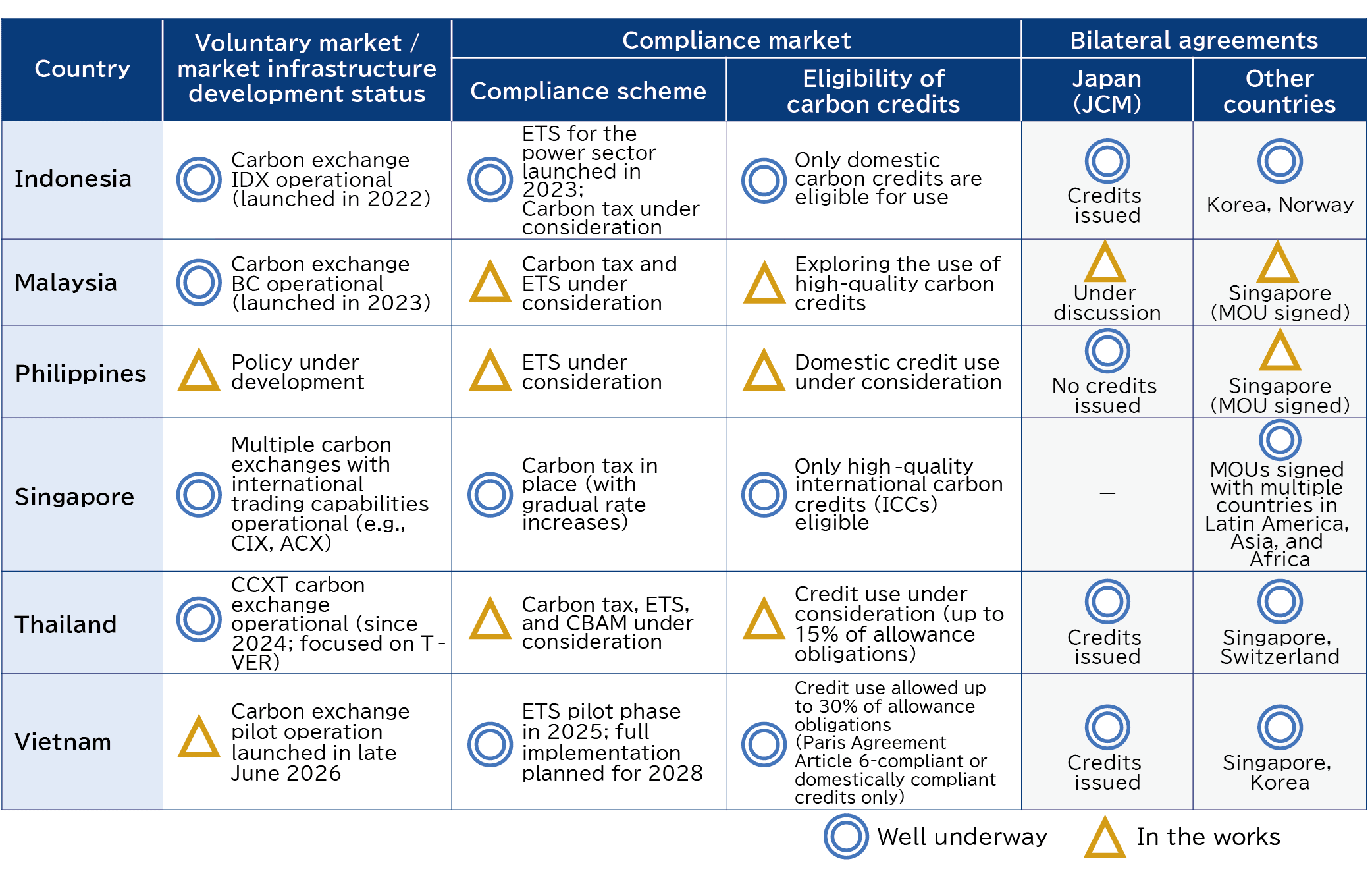
Figure 1: Trends in carbon markets in major ASEAN countries (as of June 2026)
Source: Mitsubishi Research Institute, Inc.
Singapore introduced a carbon tax in 2019 at S$5/tCO2, raised it to S$45/tCO2 in 2026, and plans to continue increasing the carbon price in stages.
Recently, Viet Nam has been particularly active in advancing the details of institutional design as well as their implementation. Following the revision of the Environmental Protection Law in 2020, Viet Nam has been rapidly developing its carbon pricing framework. Specifically, under Decree No. 06 of 2022 and Decree No. 119 of 2025, facilities with annual emissions of 3,000 tCO2 or more are required to report emissions. In addition, a pilot Emissions Trading System (ETS) covering selected facilities in the power, steel, and cement sectors was launched in 2025, with full implementation planned for 2028. On 29 June 2026, pilot trading of emission allowances commenced on the carbon exchange.
Thailand is also moving forward with the enactment of a climate change law through which it plans to introduce an ETS, a carbon tax, and a carbon border adjustment mechanism (CBAM). Furthermore, Malaysia announced its National Carbon Market Policy in April 2026, and it plans to introduce a carbon tax and an ETS through its climate change law, targeted for enactment in 2026.
Recently, Viet Nam has been particularly active in advancing the details of institutional design as well as their implementation. Following the revision of the Environmental Protection Law in 2020, Viet Nam has been rapidly developing its carbon pricing framework. Specifically, under Decree No. 06 of 2022 and Decree No. 119 of 2025, facilities with annual emissions of 3,000 tCO2 or more are required to report emissions. In addition, a pilot Emissions Trading System (ETS) covering selected facilities in the power, steel, and cement sectors was launched in 2025, with full implementation planned for 2028. On 29 June 2026, pilot trading of emission allowances commenced on the carbon exchange.
Thailand is also moving forward with the enactment of a climate change law through which it plans to introduce an ETS, a carbon tax, and a carbon border adjustment mechanism (CBAM). Furthermore, Malaysia announced its National Carbon Market Policy in April 2026, and it plans to introduce a carbon tax and an ETS through its climate change law, targeted for enactment in 2026.
Latest trends in rulemaking for carbon credit trading
Countries across the region are also developing carbon-crediting mechanisms alongside compliance systems such as carbon taxes and ETSs. In many cases, the use of carbon credits is permitted for compliance purposes, with rulemaking underway to establish domestic carbon-crediting mechanisms that generate eligible credits, as well as to define the conditions under which international credits may be accepted.
Singapore permits the use of certain international credits that meet specified conditions—International Carbon Credits, or ICCs—under its carbon tax system, and Indonesia and Viet Nam have indicated similar plans. In particular, both are considering the treatment of international credits in a manner consistent with Article 6 of the Paris Agreement.
Singapore’s ICC framework recognizes ITMOs (Internationally Transferred Mitigation Outcomes) traded under Article 6.2 of the Paris Agreement* as eligible credits. Singapore has concluded bilateral implementation agreements under Article 6 of the Paris Agreement with Thailand and Viet Nam, and has also signed memoranda of understanding on carbon-market cooperation with other ASEAN countries.
Viet Nam allows the use of carbon credits for up to 30% of ETS compliance obligations and recognizes international credits issued pursuant to Article 6.2 of the Paris Agreement as eligible credits. Viet Nam is designing its carbon-credit framework with both domestic and international markets in mind, positioning credits for use within its ETS while also enabling the international transfer of credits under mechanisms such as Japan’s Joint Crediting Mechanism (JCM) and Singapore’s ICC framework. In April 2026, Viet Nam enacted Decree No. 112, establishing procedures for the international transfer of carbon credits and setting project-specific limits on the proportion of credits eligible for international transfer.
Thailand, a regional frontrunner in developing carbon crediting mechanisms, has established the Premium T-VER scheme in 2022. Built upon its domestic T-VER, Premium T-VER serves to facilitate the international transfer of credits. Designed to align closely with international standards, including stricter requirements for additionality and baseline setting, Premium T-VER was recognized as a CORSIA Eligible Emissions Unit† at the end of 2025. This is an example of how Thailand is steadily building mechanisms that allow its domestic credits to be accepted in international markets.
Singapore permits the use of certain international credits that meet specified conditions—International Carbon Credits, or ICCs—under its carbon tax system, and Indonesia and Viet Nam have indicated similar plans. In particular, both are considering the treatment of international credits in a manner consistent with Article 6 of the Paris Agreement.
Singapore’s ICC framework recognizes ITMOs (Internationally Transferred Mitigation Outcomes) traded under Article 6.2 of the Paris Agreement* as eligible credits. Singapore has concluded bilateral implementation agreements under Article 6 of the Paris Agreement with Thailand and Viet Nam, and has also signed memoranda of understanding on carbon-market cooperation with other ASEAN countries.
Viet Nam allows the use of carbon credits for up to 30% of ETS compliance obligations and recognizes international credits issued pursuant to Article 6.2 of the Paris Agreement as eligible credits. Viet Nam is designing its carbon-credit framework with both domestic and international markets in mind, positioning credits for use within its ETS while also enabling the international transfer of credits under mechanisms such as Japan’s Joint Crediting Mechanism (JCM) and Singapore’s ICC framework. In April 2026, Viet Nam enacted Decree No. 112, establishing procedures for the international transfer of carbon credits and setting project-specific limits on the proportion of credits eligible for international transfer.
Thailand, a regional frontrunner in developing carbon crediting mechanisms, has established the Premium T-VER scheme in 2022. Built upon its domestic T-VER, Premium T-VER serves to facilitate the international transfer of credits. Designed to align closely with international standards, including stricter requirements for additionality and baseline setting, Premium T-VER was recognized as a CORSIA Eligible Emissions Unit† at the end of 2025. This is an example of how Thailand is steadily building mechanisms that allow its domestic credits to be accepted in international markets.
*Article 6.2 of the Paris Agreement: This article sets out rules, also referred to as cooperative approaches, for international transfer of carbon credits and their use toward national emission-reduction targets and similar purposes
†CORSIA Eligible Emissions Units: CORSIA stands for the Carbon Offsetting and Reduction Scheme for International Aviation. Launched in 2021, airlines are required to purchase and offset the necessary amount of emission units in accordance with prescribed rules. They may purchase the same amount of emission units as their required volume and use them for offsetting
The evolving carbon credit market
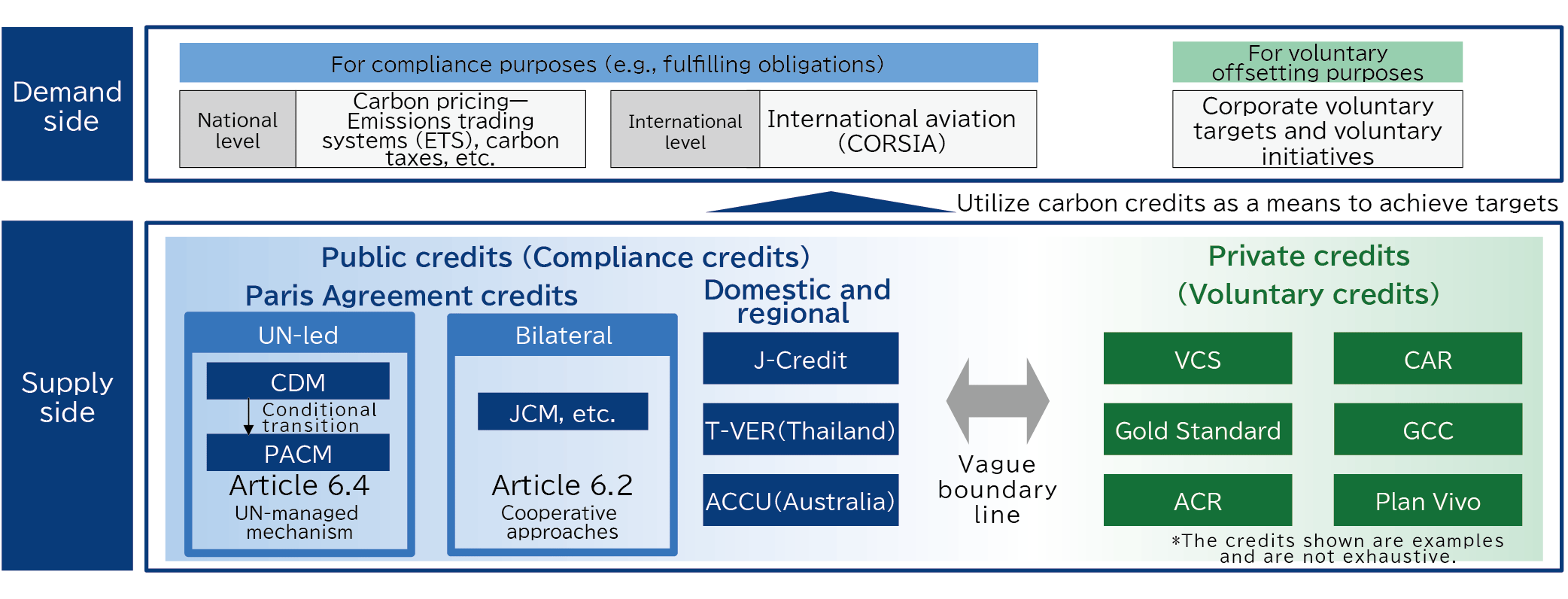
An increasingly blurred boundary between compliance and voluntary carbon markets stands out amid these developments. For example, Singapore’s ICC framework recognizes ITMOs traded under Article 6.2 of the Paris Agreement as eligible credits issued by voluntary certification bodies that meet certain criteria. In this way, schemes that generate voluntary credits, which have traditionally served voluntary offsetting purposes, are beginning to be positioned as institutional infrastructure supporting compliance markets. Particularly in ASEAN, there is a growing trend toward leveraging existing carbon crediting schemes and infrastructure. This is driven by the recognition that interoperable markets offer greater mutual benefits than fragmented carbon markets, as well as the need to facilitate early market development and secure liquidity.
Figure 2: Overview of the carbon-credit market
Source: Mitsubishi Research Institute, Inc.
ASEAN is rapidly advancing the development of rules for carbon-credit markets, with a clear view toward international transactions. As the traditional frameworks of compliance markets and voluntary markets continue to change, businesses also need to closely monitor the direction of these discussions.
A shift in perspective required for companies
For subsidiaries and branches operating in the region, decarbonization efforts can no longer be positioned as initiatives undertaken in response to requests from headquarters. With the introduction of carbon-pricing mechanisms and the tightening of regulations in host countries, companies are increasingly required to take direct action to ensure compliance with local laws and regulations.
At the same time, energy supply risks associated with instability in the Middle East are becoming apparent. Particularly in ASEAN countries that rely heavily on energy imports from the Middle East, efforts to reduce fossil fuel use and advance decarbonization are not receding. Rather, from the perspective of strengthening energy security, they are becoming priorities that call for accelerated action.
However, the situation should not be viewed solely in terms of risk. The development of carbon-pricing systems that are interconnected both domestically and across ASEAN will encourage decarbonization efforts by companies operating in the region and drive the growth of carbon markets. This represents a new business opportunity for companies with advanced energy-saving technologies, highly efficient equipment and services, and businesses related to carbon credit generation. Beyond regulatory compliance, companies have substantial opportunities to build a competitive advantage by leveraging their technologies and services.
At present, there are differences among countries with respect to the stringency and effectiveness of their carbon pricing systems, and it remains unclear whether their impacts will become evident in the short term. Nevertheless, many Asian countries are moving toward the gradual strengthening of their policy frameworks to achieve their NDC targets and enhance industrial competitiveness. This requires companies not only to respond to new regulatory obligations, but also to help make demand for low-carbon products and services more visible, thereby supporting market growth.
Companies must take an active approach in local markets, anticipating emerging trends and translating them into concrete business opportunities.
At the same time, energy supply risks associated with instability in the Middle East are becoming apparent. Particularly in ASEAN countries that rely heavily on energy imports from the Middle East, efforts to reduce fossil fuel use and advance decarbonization are not receding. Rather, from the perspective of strengthening energy security, they are becoming priorities that call for accelerated action.
However, the situation should not be viewed solely in terms of risk. The development of carbon-pricing systems that are interconnected both domestically and across ASEAN will encourage decarbonization efforts by companies operating in the region and drive the growth of carbon markets. This represents a new business opportunity for companies with advanced energy-saving technologies, highly efficient equipment and services, and businesses related to carbon credit generation. Beyond regulatory compliance, companies have substantial opportunities to build a competitive advantage by leveraging their technologies and services.
At present, there are differences among countries with respect to the stringency and effectiveness of their carbon pricing systems, and it remains unclear whether their impacts will become evident in the short term. Nevertheless, many Asian countries are moving toward the gradual strengthening of their policy frameworks to achieve their NDC targets and enhance industrial competitiveness. This requires companies not only to respond to new regulatory obligations, but also to help make demand for low-carbon products and services more visible, thereby supporting market growth.
Companies must take an active approach in local markets, anticipating emerging trends and translating them into concrete business opportunities.
Author profile

Akiko Ishii
Green Transformation Division
Akiko Ishii supports the international expansion of technologies and businesses in the fields of decarbonization and energy transition. With extensive experience across the ASEAN region, she has worked on a broad range of initiatives related to climate policy, carbon credit mechanisms, and the development of carbon credit projects.

Vu Thi Ngoc Ha
Green Transformation Division
Vu Thi Ngoc Ha supports clients’ business expansion across Asia by leveraging a deep understanding of social challenges in Asian countries and fostering collaboration with local stakeholders, with a focus on achieving both economic growth and sustainability in a global society.