Impact of Widespread Use of Generative AI on Japan's Electricity Demand

Overcoming power constraints through optimal AI model selection and semiconductor development

15 November 2024

Japanese version: 28 August 2024

Mitsubishi Research Institute, Inc.

15 November 2024—Mitsubishi Research Institute, Inc. published the English version of its report on the impact of rapidly spreading generative AI on Japan's electricity demand. The report includes recommendations for the proper policies and solutions to sustain both AI uptake and sufficient electricity.

Mitsubishi Research Institute plans to continue integrating its knowledge in the fields of ICT, semiconductors, and energy to produce data-driven analysis and policy proposals on the impacts of generative AI on designing ICT and electricity infrastructure.

The following is an overview of the report.

1. Background

Generative AI technology is evolving rapidly. Not only language processing, but also image and video processing capabilities have reached a practical level with potential expanding significantly. On the other hand, there are concerns about the increase in electricity consumption when training and inferencing with generative AI. Even discussions surrounding Japan’s Seventh Strategic Energy Plan, which began in 2024, cover the impact of electricity consumption by generative AI on future electricity supply and demand.

This report features Mitsubishi Research Institute analysis of the electricity consumption of generative AI using an original quantitative model. The report also includes forecasts of impacts through the long-term and proposals for policies to promote the use of generative AI in Japan under these power constraints.

2. Outline of the Proposals

Due to two factors—the growing presence of generative AI and the scaling-up of foundation models—the total data processing volume in Japan in 2040 could reach five orders of magnitude more than in 2020. The ICT sector, including data centers where training and inferencing of generative AI takes place, could experience a sharp increase in demand for electricity.

There are two solutions to balance generative AI and ballooning electricity consumption. The first is to mitigate the rapid increase in computational volume by using energy-saving generative AI. The second calls to improve power efficiency through the development of semiconductor technology.

(1) Effects of using energy-saving generative AI

In the utilization of energy-saving generative AI, it is estimated that the amount of processing volume in data centers in 2040 could be curbed to about one fourteenth of the maximum scenario by using an appropriately sized foundation model for each use case—in other words a model selection scenario.
Generative AI foundation model utilization assumptions and data center computational load
Source: Mitsubishi Research Institute, Inc.

(2) Effects of advances in semiconductor technology

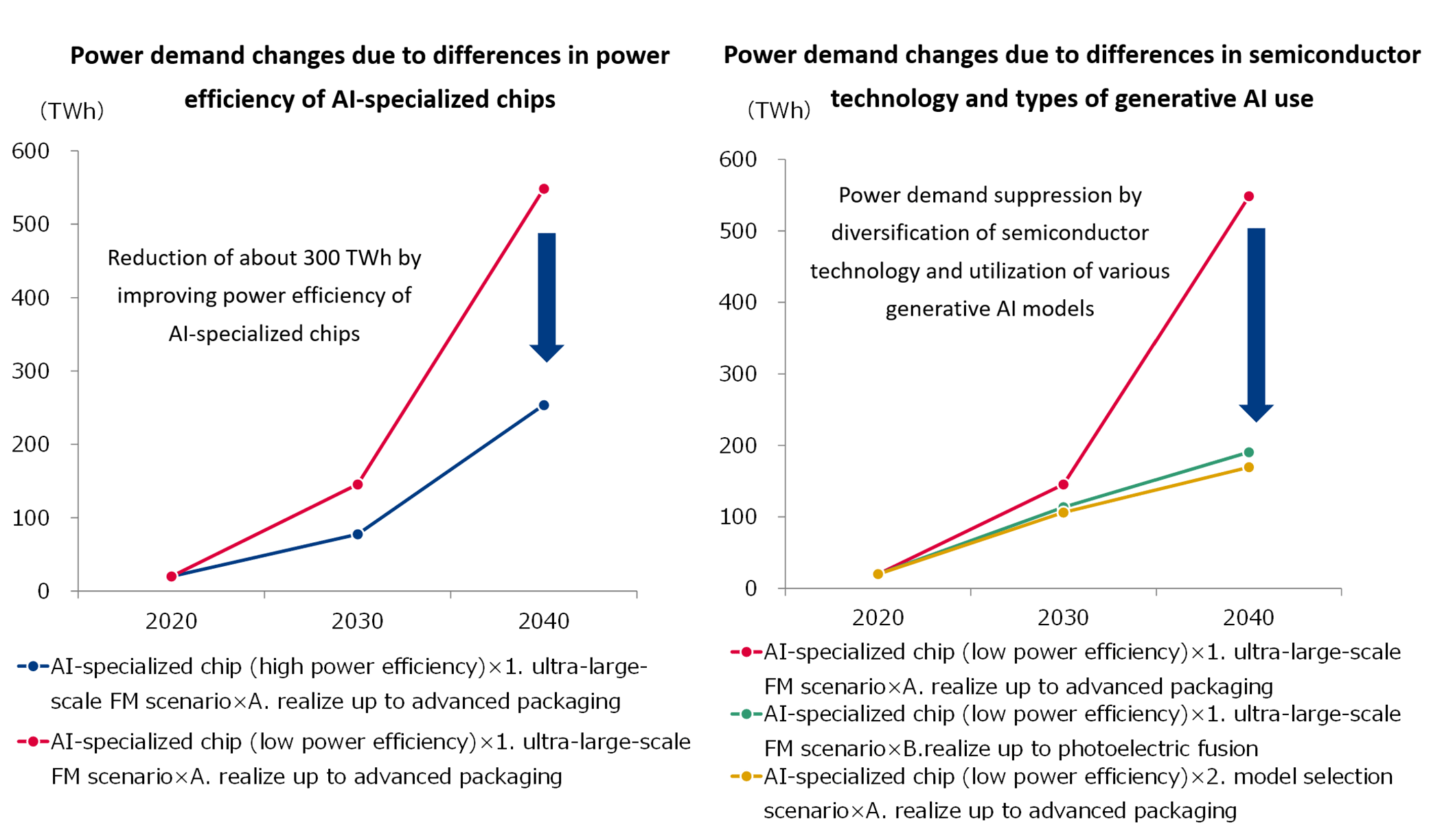
Advances in semiconductor technology have the potential to bring about power efficiency improvements up 60,000-fold by 2040. Four technologies will fuel this trend: semiconductor integration, advanced packaging*, photoelectronic fusion†, and AI-specialized chips‡.

Through the use of energy-saving generative AI and the development of leading semiconductor technologies, each of these measures alone can reduce electricity demand in the ICT sector to less than half of what it will be in 2040. By combining multiple measures, electricity demand can be reduced to 1/10 or less compared to the scenario with the highest electricity demand.

* A packaging technology that combines multiple semiconductor chips to improve performance as a single device

†A technology that increases power efficiency by combining optical wiring with information transmission in semiconductors, which is currently carried out using electrical wiring

‡A dedicated chip with improved processing performance and power efficiency by using circuit technology specialized for processing such as massively parallel computing in AI. For applications where it is difficult to apply AI-specialized chips, a 600-fold increase in power efficiency is expected

Impact of advances in semiconductor technology and generative AI usage patterns on electricity demand in the ICT sector
Source: Mitsubishi Research Institute, Inc.

(3) Scenarios for using generative AI under power constraints

In order to promote the use of generative AI while aiming for carbon neutrality, it is important for Japan to actively invest in semiconductor technologies, such as photoelectronic fusion, where the country has an advantage. It is also necessary to utilize the optimal generative AI model in order to reduce the volume of computations. In particular, the development and utilization of small-scale AI, which plays an important role in the model selection scenario, must be promoted mainly among corporations.

These efforts will alleviate power constraints, contribute to strengthening Japan's international competitiveness, and reduce its digital trade deficit.
Three scenarios for utilizing generative AI under power constraints
Source: Mitsubishi Research Institute, Inc.

About Mitsubishi Research Institute, Inc.

Mitsubishi Research Institute, Inc. is one of Japan’s foremost think tanks. For the last 50 years, it has provided the public and private sectors with research and consulting services in fields spanning the environment, energy, healthcare, and digital transformation. This is accompanied by policy recommendations and the real-world application of solutions. Mitsubishi Research Institute will continue to envision the future, resolve societal issues, and lead change to build a sustainable and prosperous world. For more information, please visit: www.mri.co.jp/en/

For more information

General contact

Center for Policy and the Economy
Mitsubishi Research Institute, Inc.
10-3, Nagatacho 2-chome, Chiyoda-ku, Tokyo 100-8141, Japan
Tel:03-6858-2717
E-mail: pecgroup@mri.co.jp

Media contact

Group Corporate Communications Division
Mitsubishi Research Institute, Inc.
10-3, Nagatacho 2-chome, Chiyoda-ku, Tokyo 100-8141, Japan
E-mail: media@mri.co.jp