
COP30 in Belém, Brazil mustered a degree of consensus and some commitments on cooperation concerning climate change. But countries are still struggling to find solid footing, and circularity and carbon neutrality are threatening to stall amid global disarray. Meanwhile, Japan—which is about to select localities for strategic development of its green transformation industry—has to ensure that its next moves are truly effective. In energy, nuclear looks set to account for more than 10% of generation in fiscal 2026, and how such stable sources get positioned will directly impact competitiveness given the variability of renewables and constraints on decarbonized fuels. At this green-transformation juncture, Japan needs to forge deeper-reaching policies and corporate strategies.
Green Transformation Offense and Defense for Competitiveness
Global disarray as an opportunity for business growth
15 May 2026
Green transformation disarray necessitates deeper integration into strategies
At the global level the mainstream expectation for progress in climate-change mitigation has shifted from the originally envisioned smooth and ever-faster ride down a straight road to decarbonization to a rocky one full of twists and turns. Clouds of energy insecurity, drawn-out inflation, and growing geopolitical risk are gathering to create a darkened world where countries, somewhat like someone trying to navigate their way down an unlit corridor, have to touch-and-feel their way forward. One of the biggest currents is a policy swing from priority for the Big E—the environment—to rebalancing the Three Es—the environment, economic efficiency, and energy security.
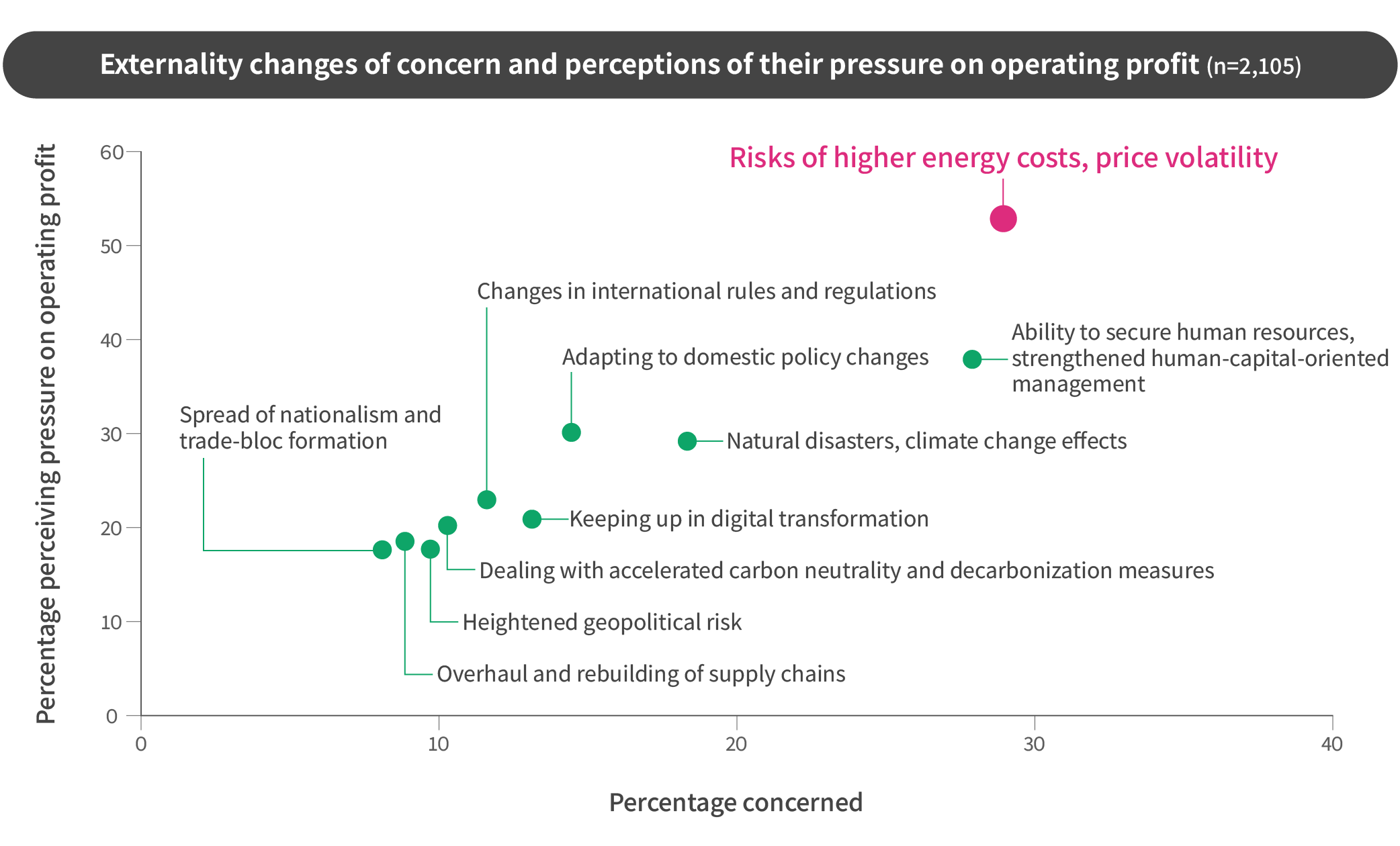
Even the results of an opinion survey we did*—about the externality changes that preoccupy managers and executives in Japan—found that risks associated with higher energy costs and cost volatility took up far-greater mindshare than decarbonization itself. Right now, the most pressing issues for those trying to run a business are access to the energy they need and price stability (Figure 1).
*Online survey of managers and executives at Japanese corporations conducted in August 2025. Valid responses: 2,105
Figure 1: Externalities corporate managers and executives follow closely
Source: Mitsubishi Research Institute, Inc. August 2025 opinion survey of managers and executives at Japanese corporations nationwide
Some might interpret this to mean that Japan’s green transformation is in turmoil or has stalled. But according to a quick survey of business leaders who attended Mitsubishi Research Institute’s annual forum,* a solid 90% of respondents replied that they intended to continue actively pursuing programs even in light of recent changes in societal trends. This result suggests that green transformation remains important to businesses given the reality that it is requisite for staying competitive.
These points indicate that the current changes in the externalities are best interpreted as a signal that businesses ought to add depth to their strategic positioning of green transformation. Merely following policy and market trends is not enough: In an era where unpredictable externalities are the norm, the challenge is how to more deeply integrate green transformation into their mid- to long-term sustainable growth strategies.
*A forum held on 27 November 2025 featuring offensive and defensive green-transformation actions and attended by 190 management-level executives. The question and response options of the live questionnaire were:
Question: Has your company's green-transformation engagement changed in light of the latest societal trends?
Responses:
-Will continue active pursuit
-Will continue but keep an eye on trends
-Reviewing whether to continue or terminate
-Relaxed pursuit somewhat/somewhat negative on further pursuit
-Put on a back burner/negative on further pursuit
The presentation is available for viewing below
https://youtu.be/X82aYpByy5Q
Systemic changes spurring uncertainty and Japan’s core issues
Often giving decision-makers pause, structural issues also necessitate deeper integration of green transformation into strategies.
The first such issue is the ongoing oscillation in energy prices and its direct impact on profitability. It robs companies of financial leeway for investing in green transformation. Measures to suppress energy prices (e.g., subsidies), tax relief (termination of “provisional” taxes), and other policy changes contribute to the volatility, hampering companies’ ability to make investment decisions premised on stable assumptions.
The second is the superficial appearance of domestic progress on green transformation. Although the industrial sector’s emissions per unit of GDP have improved, an underlying factor is lower levels of activity in some segments*; so green transformation has not really progressed in a way that substantially benefits competitiveness.
The third is the fragility of cost structures. Only a limited number of businesses are able to pass ongoing inflation-driven cost increases on to their customers. If carbon pricing gets up and running faster than foreseen, it would only encumber the twin pursuits of dealing with cost increases and maintaining competitiveness.
A common thread running through all three issues is that they eviscerate assumptions usually used for medium- to long-term decision-making: They exacerbate uncertainty, thus impeding businesses’ ability to decide on green-transformation actions.
*Ministry of the Environment (2025) 2023年度における地球温暖化対策計画の進捗状況 (FY 2023 global warming measures plan progress report)
https://www.env.go.jp/content/000341351.pdf (accessed 15 December 2025)
Three green-transformation actions integrating defense and the offense
In such a tricky situation, businesses should pursue actions twinning defensive and offensive tactics.
First, for the defensive, firms should mitigate risks to business continuity like energy-price volatility, procurement constraints, and increased costs associated with decarbonization and circular economy initiatives. Adaptation strategies are also needed to prepare for the anticipated tightening of policies* in conjunction with full implementation of Japan’s own emissions trading system (GX-ETS) and the EU Carbon Border Adjustment Mechanism (CBAM). And to address rising costs of green transformation, leveraging long-term contracts and insurance will be crucial for ensuring near-term stability.
With those things done, companies can add offensive tactics: getting the most out of renewable energy sources, storage batteries, demand response mechanisms†, and carbon credits‡—all key for generating green-transformation value. Strategic investment in these domains will give rise to new business opportunities while shoring up revenue bases and competitive advantage. In the process, drawing on financial tools will be essential to fully discern—to visualize—the upside potential (for upswings and profits) of green-transformation investments while acknowledging their inherent uncertainties and downside risks (of downturns and possible losses). This approach will ensure a smooth, sustainable path for moving forward with those investments.
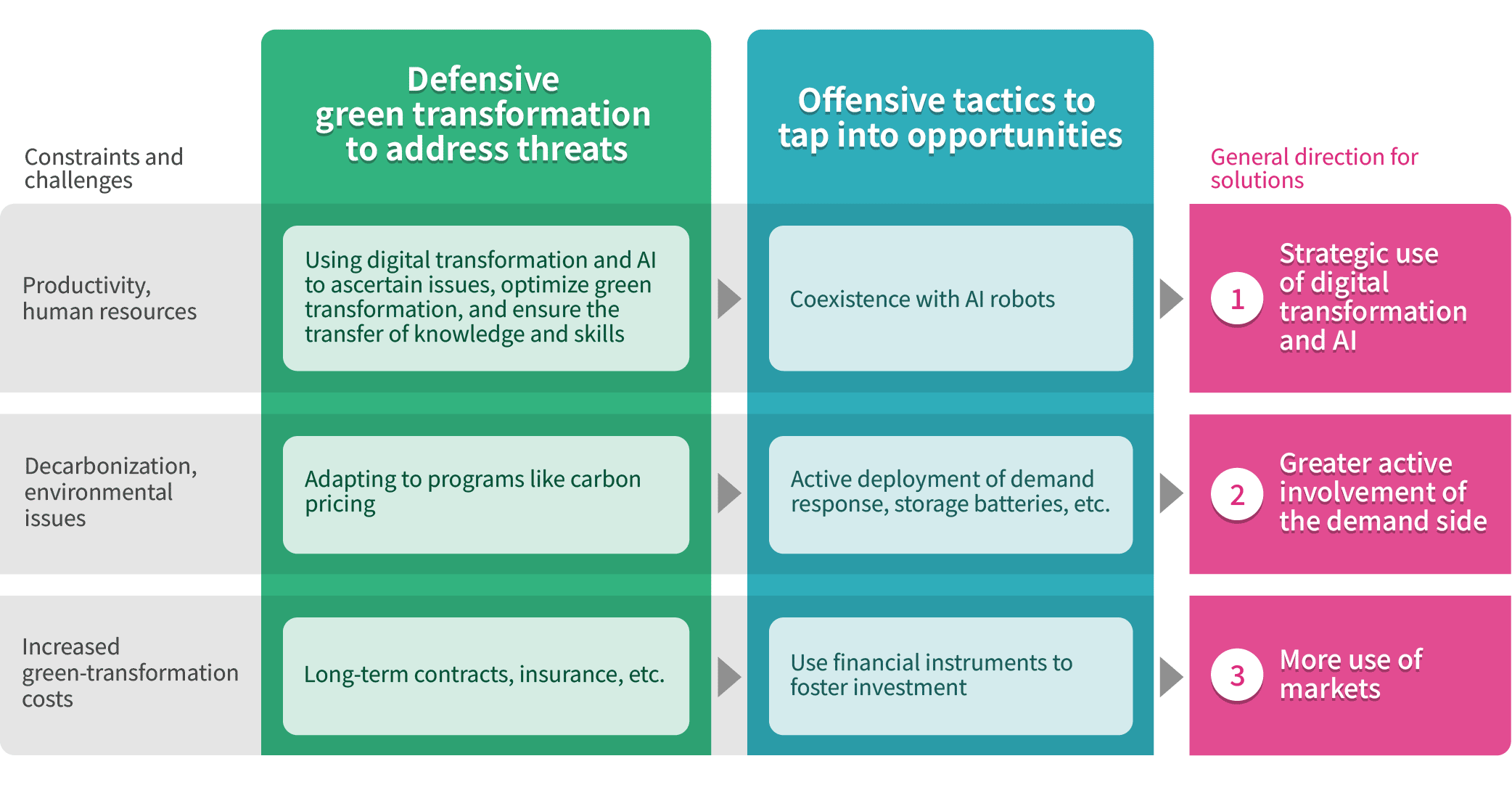
Figure 2 presents a practical framework of actions for enabling both defensive and offensive tactics to work while addressing the structural challenges outlined above. There are three key points: 1) strategic use of digital transformation and AI to unmask uncertainty and control it; 2) greater active involvement of the demand side to enhance investment predictability and drive market formation; and 3) more use of markets to spread price and volume risks and enable sustainable investment.
*Higher carbon prices, tighter regulations, and the like
†Mechanisms that adjust demand-side power usage in real time to accommodate supply-and-demand conditions. The value of demand response lies in its ability to stabilize grids and perform other functions like grid-balancing
‡A scheme for certifying greenhouse gas (GHG) emission reductions and GHG uptake volumes and assigning a tradable environmental value to them
Figure 2: Green transformation actions required of businesses
Source: Mitsubishi Research Institute, Inc.
1) Strategic use of digital transformation and AI: A base for optimization and value creation
Digital transformation and AI are not just for making work more efficient; they serve as foundations for visualizing, optimizing, and valorizing green transformation as well. Adopting them will make it possible to analyze energy-usage and equipment-utilization data to identify opportunities for reducing CO₂ emissions; have AI forecast demand and control equipment operation to optimize power consumption; quantify the outcomes of green transformation and other initiatives to branch out into related businesses dealing in investment assessments, renewable energy certificates, and carbon credits.
Furthermore, technological acceleration has brought deployment of AI robots that collaborate with humans within reach. In the context of green transformation, these technologies are not limited to saving labor or automating jobs. They also serve as enablers for field operations involving physical tasks. These could range from inspecting and maintaining energy infrastructure and working in hazardous environments to remotely monitoring and running equipment in distributed systems. Combined with AI-driven decision-making on robot deployment, AI robotics could form an operational foundation that minimizes the uncertainties that come with using intermittent energy and supply-shock–prone resources.
Key to this will be accumulating the right data—data of utility in the field. That means amassing tacit knowledge and know-how skilled workers traditionally pass on to their juniors in a form AI and robots can use to create intellectual assets—a skills legacy—that will endure indefinitely. This also makes it necessary to transform existing workplaces and operational environments so that they foster coexistence and co-creation between humans and AI robots. In this vein, Mitsubishi Research Institute does research and offers proposals on a future in which humans and AI-powered robots coexist. We foresee significant improvements in motive capabilities and autonomy in specialized domains, with development picking up pace over the coming decade. We anticipate that widespread adoption of general-purpose robots as embodied AGI* will get going around 2035.
*Although not a clearly defined standard term, it refers to artificial general intelligence (AGI) capable of autonomously perceiving, making judgement about, and interacting with the physical world. See our policy proposals on the topic:
Mitsubishi Research Institute, Inc. (2025) 【提言】未来を切り拓くAIロボティクス (Policy proposal: AI robotics for pioneering the future)
2) Greater active involvement of the demand side: Spearheading new markets
Green transformation markets have a chicken-and-egg problem: Without increased supply, new demand will not materialize; and without clear demand, supply will not increase production.
So greater demand-side commitment will be the key to shifting the supply–demand cycle up a gear. Active involvement from the demand side—such as accepting green premiums (higher costs when opting for environment-conscious products and services) and creating requirements in public sector procurement—assures better investment predictability on the supply side, leading to earlier formation of markets and helping investment cycles take hold.
Recently, the innerworkings of large-scale power systems are coming under scrutiny in light of green-transformation developments and changes in externalities. Power suppliers cannot bear regulatory, societal, and other structural risks solely on their own; heightened recognition of this fact makes it obvious that demand-side involvement is pivotal for improving investment predictability. Of course it is essential to ensure that, along with bearing certain risks, the demand side too derives benefits from its involvement—supply stability and favorable pricing, as well as the environmental aspects, to mention a few.
3) More use of markets: Financial instruments and fair value to spur sustainable investment
Japanese companies generally could make better use of markets to hedge against price-fluctuation risk. The immaturity of markets underpinning investment in power infrastructure and green transformation has hindered such moves. But financial instruments to shift price-fluctuation and volume-associated risks are indispensable for coping with mounting uncertainty, and equally integral will be the sharing of fair value.* It serves as a pricing benchmark that enhances investment predictability for both supply and demand sides.
*In this Opinion, fair value refers an intrinsic price level theoretically calculated with reference to policy, programs, and structural factors, not the market-consensus price—the “fair” price level arrived on through transactions
Worldwide disarray as an opportunity for growth
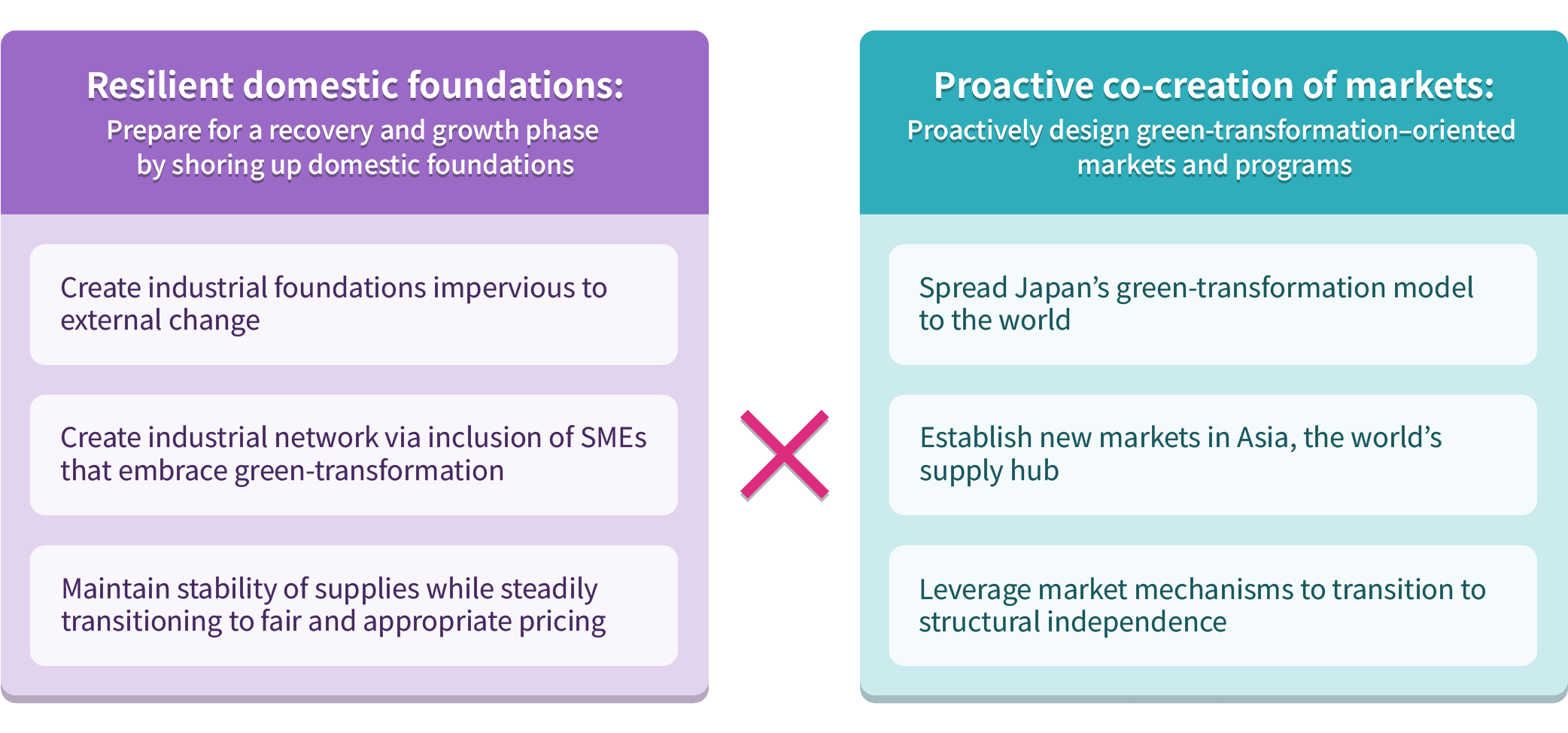
Amid the global climate-change mitigation disarray, Japan must maintain a perspective encompassing both the infrastructure needed to support businesses’ green-transformation actions and the proactive involvement of businesses in strategic areas (Figure 3).
The former will fortify a domestic foundation resilient in the face of volatile externalities. This will enhance the resilience of regional economies and SMEs, empowering them to carry through with their own green transformations. The latter constitutes proactive co-creation of markets, i.e. the involvement of businesses in the design of policies and the markets they regulate. These will bring better investment predictability, key to reshaping green transformation into a strategic business domain instead of a cost domain.
Figure 3: Japan's green-transformation strategy amid global disarray
Source: Mitsubishi Research Institute, Inc.
Widening its perspective, Japan could directly translate the most promising of its domestically established initiatives into overseas-market opportunities: Decarbonization is something many countries and territories find nearly impossible to pursue on principle alone. The approach Japan proposes—a step-by-step transition rooted in reality—is much more credible in the Global South, particularly in Asia. If Japan’s green-transformation model* can be successfully adopted overseas, it could significantly expand Japan’s ability to maintain a competitive edge for its green industry as well as its ability to help shape relevant global rule-making processes.
On the premise that global climate-change mitigation is in a phase of disarray, the time is now ripe for Japan to get ahead of the curve by positioning green transformation as a strategic business domain that will put its economy on a new growth trajectory. The ability of Japan’s companies to deepen their involvement while weathering medium- to long-term competition will demonstrate their true grit going forward.
*In Japan, specific mechanisms for inclusion in green-transformation (GX) market design encompass transition financing, GX economic transition bonds, and GX-ETS. These provide certainty and transparency for corporate GX investment and serve as a foundation for capital circulation
Author profile

Tetsuya Nomoto
Center for Policy and the Economy
Tetsuya Nomoto supports business development in the energy transition and decarbonization sectors, targeting the Southeast Asian market. He helps clients expand their operations, analyzing local market conditions through regulatory and policy trends, researching conditions through real insights from local institutions and potential partners, and facilitating relationship building.

Hiroyuki Ishida
Center for Policy and the Economy
Hiroyuki Ishida primarily provides consulting services centered on medium- to long-term macroeconomic analysis and electricity markets. He meticulously unravels complex challenges, focusing on communicating about and supporting strategy development based on quantitative analysis.