
Big Tech is moving quickly to build open ecosystems that will underpin an economy run by the interaction of AI agents— the agentic economy. The corporate world is already turning toward agentic commerce, and while this has the potential to boost supply-chain efficiency, it could also upend the business of brokers. It is poised to leave a large mark on the world through the ability of AI to coordinate among complex systems spanning society. With a handful of Japanese companies already rethinking their businesses, the country’s private sector as a whole should look to the agentic economy as an opportunity.
Japanese Businesses Amid the Agentic Economy
Agentic commerce: AI agents collaborating to create new value the new norm
7 July 2026
Agentic economy right around the corner
The global AI market, worth some $180 billion in 2024, is forecast to reach $830 billion by 2030.1 As generative AI sets down roots and adoption of AI agents grows, interest in the agentic economy is growing. Big tech is already building frameworks that enable multiple AI agents to autonomously link up with one another, which will give rise to the agentic economy.
One example is the Google–Linux Foundation project Agent2Agent (A2A).2 It brought together over 100 companies, among them Amazon Web Services (AWS), Microsoft, digital transformation services provider Salesforce, and EPR leader SAP, to develop interoperability technology that tech enterprises can deploy freely in their agents.3 New open platforms built around collections of AI agents will emerge down the road,4 bringing a gradual penetration of agentic commerce into enterprise activities from accounting procedures and sales processes to surveys and design.
Agentic commerce to ignite business-to-business trading
As AI agents tailored for business use gain ground, agentic mediation will be incorporated into business-to-business (B2B) transactions. First, in the short-term, existing B2B processes and AI agents will be linked; then, over the long-term, newer mechanisms designed specifically around the agentic model will predominate.*
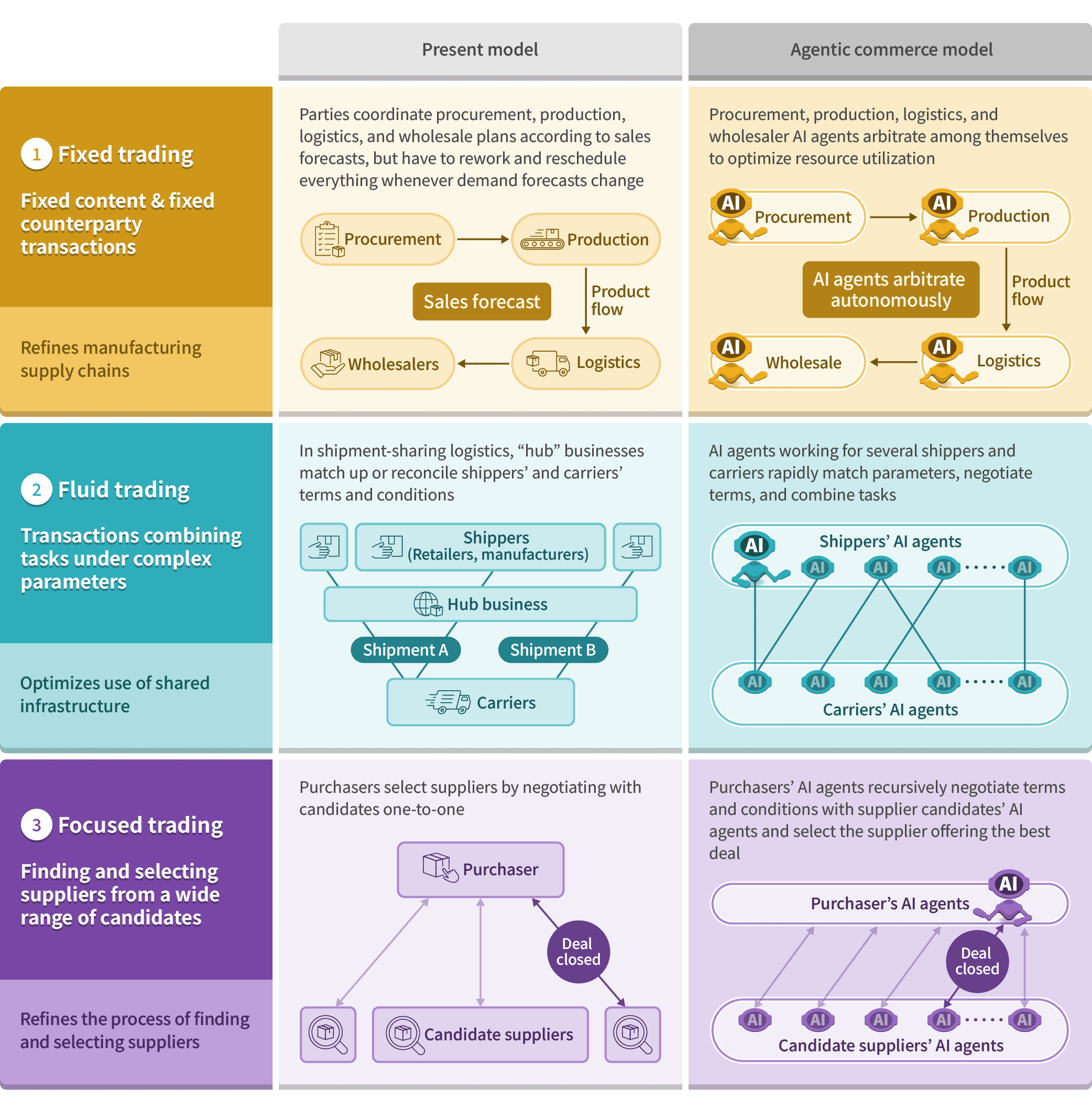
Agentic mediation is effective in areas where its autonomy, flexibility, and speed are of value. One of the most promising is supply-chain management, which involves adapting to frequent, sometimes sudden changes across complex webs of processes involving numerous actors. The sequence of adoption will go something like this: 1) fixed trading, or transactions of fixed content among fixed counterparties, 2) fluid trading, or transactions encompassing combinations of tasks performed under complex parameters, and 3) focused trading, or transactions for finding and selecting the best suppliers from a wide range of candidates. There are several process patterns in which agentic mediation promises benefits (Figure 1).
Agentic mediation is effective in areas where its autonomy, flexibility, and speed are of value. One of the most promising is supply-chain management, which involves adapting to frequent, sometimes sudden changes across complex webs of processes involving numerous actors. The sequence of adoption will go something like this: 1) fixed trading, or transactions of fixed content among fixed counterparties, 2) fluid trading, or transactions encompassing combinations of tasks performed under complex parameters, and 3) focused trading, or transactions for finding and selecting the best suppliers from a wide range of candidates. There are several process patterns in which agentic mediation promises benefits (Figure 1).
*Short-term possibilities include connecting AI agents to existing supply-chain electronic data interchanges (EDIs) and using agentic mediation on exiting systems to execute transactions on behalf of humans. Longer-term possibilities include setting up new agentic-ready marketplaces (e.g., those permitting open access by unspecified parties) or overhauling existing systems as new agent-mediated markets
Figure 1: Agentic commerce use cases
Source: Mitsubishi Research Institute, Inc.
1) Fixed trading: Supply-chain refinement
In many supply chains, computer systems have already been deployed for purchasing processes. Inflexibility in responding to demand fluctuations turned out to be an issue, but incorporating agentic mediation into the systems addresses that: It enables rapid arbitration among multiple counterparties.
A good example in Japan is the agentic technology Fujitsu developed for supply chains. It is now in demonstration trials run in collaboration with Institute of Science Tokyo and Rohto Pharmaceutical.5 Rohto intends to take this as an opportunity to connect its supply chains via agentic mediation and use it to fine-tune production, control inventory, and optimize shipping routes. This, it hopes, will minimize excess inventory and avert supply bottlenecks due to items being out of stock, even when demand fluctuates wildly.6 The technology’s developers also want to enable it to work with different vendors’ AI agents so it will scale better and be interoperable with AI agents in other supply chains.
A good example in Japan is the agentic technology Fujitsu developed for supply chains. It is now in demonstration trials run in collaboration with Institute of Science Tokyo and Rohto Pharmaceutical.5 Rohto intends to take this as an opportunity to connect its supply chains via agentic mediation and use it to fine-tune production, control inventory, and optimize shipping routes. This, it hopes, will minimize excess inventory and avert supply bottlenecks due to items being out of stock, even when demand fluctuates wildly.6 The technology’s developers also want to enable it to work with different vendors’ AI agents so it will scale better and be interoperable with AI agents in other supply chains.
2) Fluid trading: Optimization through shared infrastructure
Plagued by labor shortages, the logistics industry is trying out shipment sharing. Logistics majors and retailers generally work with a limited number of counterparties; deploying agentic mediation will open the door for more shippers and carriers to get into the game thanks to AI’s ability to match customer needs and supplier offers across complex webs of terms and conditions, regardless of industry.
Take the example of Japan Pallet Rental Corporation (JPR) and its AI-powered TranOpt7 logistics matching service. Drawing on a database of possible transport routes, it matches member companies’ transport needs to available shared-shipment opportunities.
When a framework for agentic interfacing is put into place allowing participating companies to connect their own AI agents to matching systems like TranOpt, AI agents will be able to take over the job of negotiating complex terms and conditions, such as for minimizing costs or prioritizing environmental-impact reductions.
3) Focused trading: Refining supplier search and coordination
When a manufacturer launches a new product, a trading house will most likely broker a supplier that takes over the manufacture of parts or their assembly. But the process of finding a supplier and negotiating terms and conditions is time consuming. Delegating this to an agentic-commerce platform significantly expands the field of supplier candidates, speeds negotiations, and expedites deal closing.
A pioneer is already here: Misumi Corporation’s “meviy Marketplace.”8 When a client comes to Misumi looking for, say, a shop to machine components for it, meviy Marketplace’s AI uses design data and other parameters to find candidates among marketplace partners on its roster of suppliers.
Introducing agentic mediation into this process promises to minimize human intervention by having clients’ and meviy members’ respective AI agents perform the time- and resource-intensive–high-level interfacing needed to hammer out details of a collaboration, such as design changes and alternative proposals.
Industry changes and new value
On top of all the above, agentic commerce has the potential to not only revolutionize B2B transactions, but also change the private sector as a whole. Companies’ use of AI agents and deployment of agentic commerce in business dealings, and development of industry-specific middle platforms,* have huge, sweeping positives for Japanese industry (Figure 2).
*In another article, we describe industry-specific middle platforms as frameworks defining standardized transaction rules, industry sector data standards, qualification management, reliability assessments, dispute resolution, compensation and indemnification, log keeping and audits, and safety guardrails
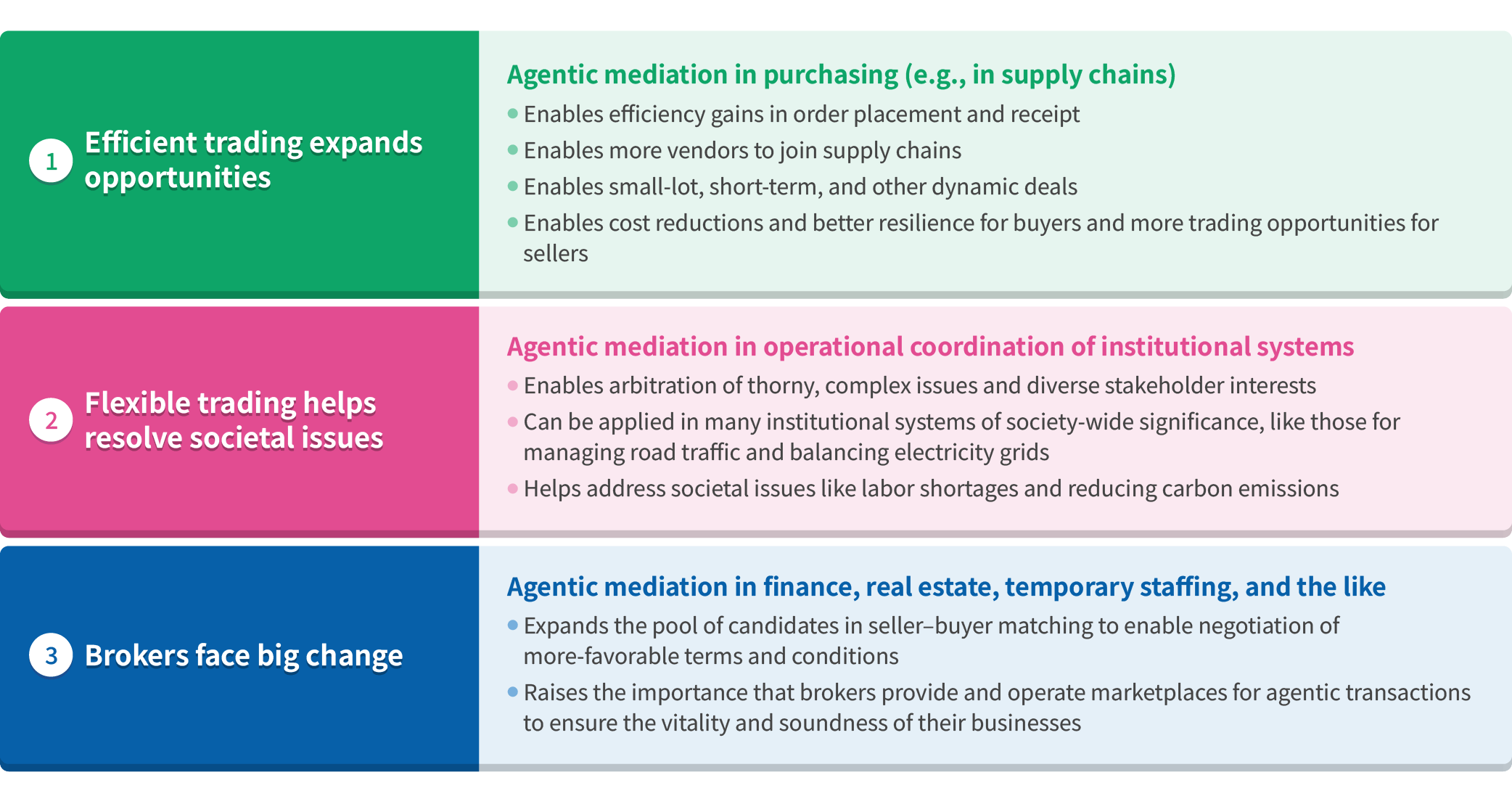
Figure 2: Three transformations agentic commerce will bring to industry
Source: Mitsubishi Research Institute, Inc.
The deployment of agentic commerce will spark three transformations in industry.
1) Efficient trading expands opportunities
Agentic mediation automates presentation of terms and conditions, estimating, closing contracts, and acceptance inspections to streamline purchasing processes while throwing open the supply-chain doors to a broader range of potential suppliers. It also enables microtransactions involving small lots, tight delivery schedules, and fast-changing conditions. Parties looking for suppliers benefit from cost reductions and enhanced supply-chain resilience while suppliers enjoy a broadened range of business opportunities.
Thus, agentic commerce not only streamlines B2B transactions, but also refines and optimizes supply chains across industry as a whole—a huge plus for bolstering and maintaining a country’s international competitiveness. Given its potential to usher in this kind of supply-chain transformation, Japan should get a larger number of businesses to view agentic commerce as a strategic opportunity.
Thus, agentic commerce not only streamlines B2B transactions, but also refines and optimizes supply chains across industry as a whole—a huge plus for bolstering and maintaining a country’s international competitiveness. Given its potential to usher in this kind of supply-chain transformation, Japan should get a larger number of businesses to view agentic commerce as a strategic opportunity.
2) Flexible trading helps resolve societal issues
Agentic mediation’s ability to coordinate and arbitrate between stakeholders with diverse interests makes it particularly well suited for use in autonomous distributed institutional systems premised on cooperative interactions. It thus holds promise for bringing about the wholistic optimization of institutional systems that work in ways similar to shipment-sharing logistics. Examples include regional power grids and systems controlling urban traffic flow. In the former, agents can mediate between power users and large fleets of renewable energy sources to balance the grid, drawing power from available sources and routing it to users who need it; in the latter, they can use navigation-system AI agents and traffic-signal-control AI agents to alleviate road congestion.
Streamlining the operation of institutional systems in these ways, agentic mediation can contribute to addressing societal issues as well—problems like labor shortages and energy-supply sustainability, both arguably new value spawned by it.
Streamlining the operation of institutional systems in these ways, agentic mediation can contribute to addressing societal issues as well—problems like labor shortages and energy-supply sustainability, both arguably new value spawned by it.
3) Brokers face big change
Digital transformation has already brought much change to intermediary businesses. In wholesaling and retail, direct dealing between manufacturers and retailers and just-in-time delivery are now the norm. This shift took business away from middlemen, but also streamlined supply chains by moving the rationale for product-offering and stocking decisions—previously based on guesswork and informed hunches—to data-driven forecasts of demand and customer wants and needs.
Agentic commerce will transform how brokers do business in sectors like finance, real estate, and staffing, too. In traditional real estate, brokers serve both borrowers and lenders and have led negotiations between them while appropriately managing information—like terms and conditions—for closing deals. When borrowers’ and lenders’ AI agents begin negotiating directly, brokers will have to go beyond their roles as mere intermediaries.
Brokers will need to set up agentic commerce platforms that let buyer (borrower) and lender agents interact. The focus of their role will then shift from just acting as middlemen to ensuring that real-estate markets remain vital and sound. The latter requires them to define qualifications for participating in the agentic markets they provide, keep an eye on ongoing negotiations, ensure legal and regulatory compliance, and resolve any disputes that might arise. Keeping markets vital will entail brokers’ analyzing them and offering terms and conditions popular with buyers as well as competitive prices and unearthing sellers with novel offerings in light of prevailing supply and demand. And when negotiations head south, brokers will have to work to seal deals by nudging borrowers and lenders to adjust their terms and conditions or by introducing more acceptable counterparties to each other.
The increasing use of agentic commerce will generate new value in numerous aspects of industrial activity and provide opportunities for businesses in all sectors. Enterprises of all stripes will have to actively deploy generative AI and AI agents in preparation for the agentic economy’s arrival. An implication of this is that companies and industries need to identify how the agentic economy will transform their businesses and what opportunities to create new value it will bring, then emplace frameworks and technology as well as work with business partners to be able to start making the most of the new environment. And they need to get involved in building industry-specific middle platforms. The preceding three examples ought to be of reference for their agentic-economy–oriented endeavors.
Moreover, for the agentic economy to take widespread root, new mechanisms are needed to ensure soundness. In a related article, we have summarized the risks inherent in agentic commerce and described how soundness should be guaranteed along with other measures businesses should establish.
Moreover, for the agentic economy to take widespread root, new mechanisms are needed to ensure soundness. In a related article, we have summarized the risks inherent in agentic commerce and described how soundness should be guaranteed along with other measures businesses should establish.
Works Cited
1Ministry of Internal Affairs and Communications “Information and Communications in Japan: White Paper 2025”
https://www.soumu.go.jp/
2Rao Surapaneni et al. (2025) “Announcing the Agent2Agent Protocol (A2A)” Google for Developers
https://developers.googleblog.com/
3Surapaneni et al. (2025) “Google Cloud donates A2A to Linux Foundation” Google for Developers
https://developers.googleblog.com/
4In his keynote speech at Microsoft Build 2025 (19 May 2025), CEO Satya Nadella elaborates on one such platform, conceived as Microsoft’s Open Agentic Web.
https://news.microsoft.com/
5Fujitsu (2025) “Fujitsu develops multi-AI agent collaboration technology to optimize supply chains, launches joint trials”
https://global.fujitsu/
6Rohto Pharmaceutical Co., Ltd. (2025) “サプライチェーン最適化に向けて「マルチAIエージェント連携」技術を用いた取り組みを開始” [Launching initiatives using ‘multi-AI agent collaboration’ technology to optimize supply chains]
https://www.rohto.co.jp/
7Japan Pallet Rental Corporation TranOpt
https://lp.tranopt.jpr.jp/ (accessed 13 February 2026)
8Misumi Corporation meviy Marketplace
https://marketplace.meviy.misumi-ec.com/
Author profile

Yoshiki Kinehara
Center for Policy and the Economy
Yoshiki Kinehara pursues research from the scientific and technological as well as socio-economic angles to help create a better tomorrow for all.