
AI-driven work transformation demands structured use of AI across an organization. If AI use remains at the individual level, improvements in sales, quality, and customer experience could fail to transform into outcomes for an organization as a whole. Organizations need to redesign how work is divided between people and AI, identifying where AI can be used to free up time and where that time should be reallocated to create value. The ability to design and implement this approach will directly affect value creation within each division and the competitiveness of an organization as a whole. We have drawn out guidelines for organizational AI use by breaking work down into its constituent elements and examining effective AI deployment in detail.
Work Redesign: Turning AI into organizational capability
Reallocating time freed by AI to growth
11 September 2026
Barriers to companywide benefit
AI uptake among Japanese businesses is accelerating. A survey by the Information-technology Promotion Agency, Japan (IPA) shows nearly fifty percent have implemented, are testing, or are evaluating generative AI.1 Notably, half of firms with over 1,000 employees report full implementation, signaling robust adoption at larger corporations.*
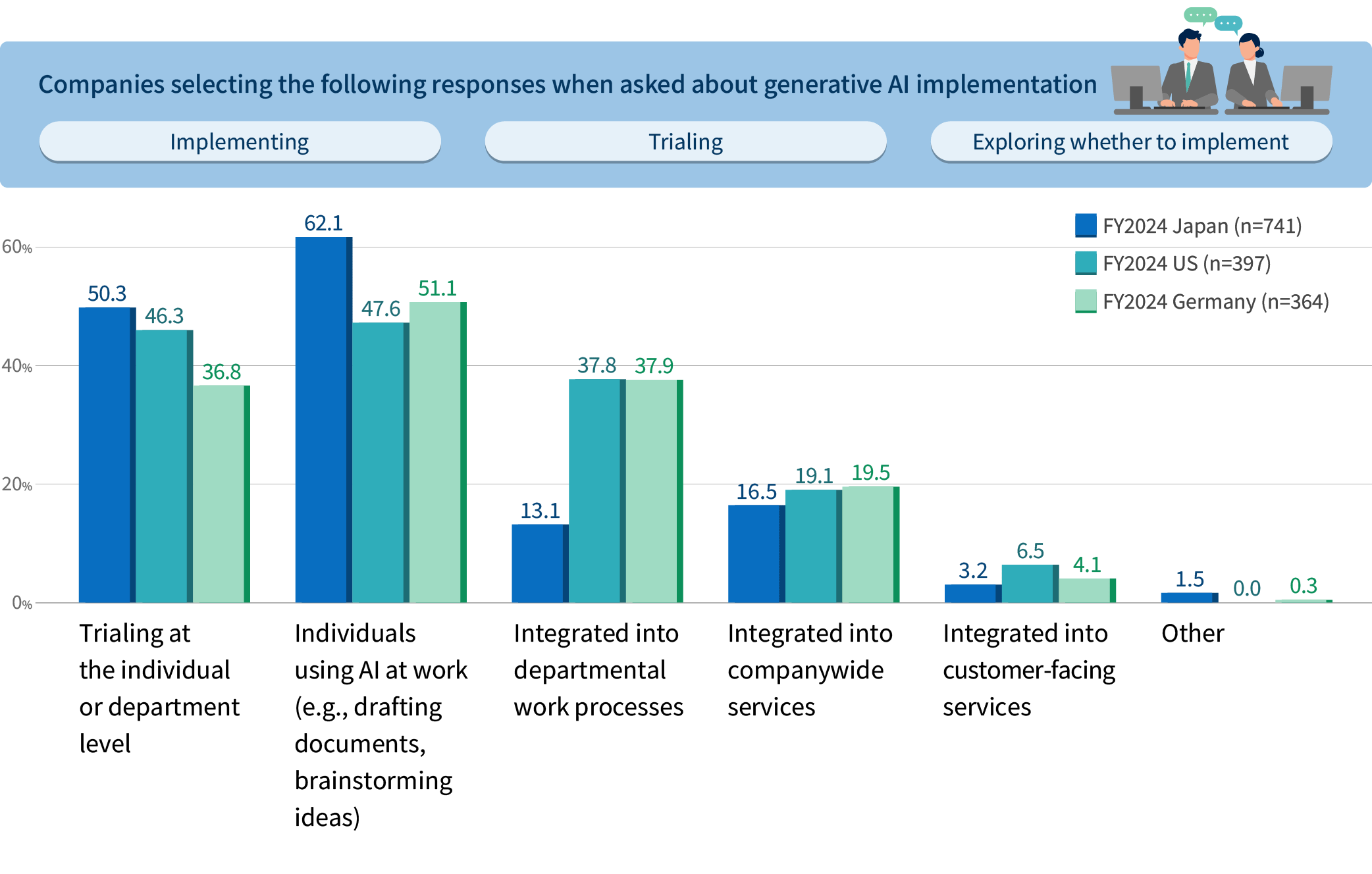
Usage data, however, reveals critical challenges. In Japan, 62.1% report “individual business use,” while just 13.1% report “integration into departmental processes”—far behind the US (37.8%) and Germany (37.9%) (Figure 1). In many Japanese firms, generative AI use still appears to be centered on individual use and has not yet progressed to a fundamental redesign of work processes or organizational roles.
*This figure reflects FY2024 data and likely understates current adoption given generative AI’s rapid spread. A recent survey (Dec 2025–Jan 2026) indicates 75% utilization across all sectors and company sizes2
Figure 1: Corporate generative-AI use by country
Source: Mitsubishi Research Institute, Inc. from Information-technology Promotion Agency, Japan (2025) DX Trends 2025
https://www.ipa.go.jp/digital/chousa/dx-trend/tbl5kb0000001mn2-att/dx-trend-2025.pdf (Contains English abstract; accessed 21 May 2026)
https://www.ipa.go.jp/digital/chousa
A problem with limiting AI to individual use is that personal time savings do not translate directly into organizational gains.* For instance, faster document creation merely boosts individual efficiency unless organizations reallocate the time saved to customer engagement or process optimization.
Further, it is difficult to leave decisions about which duties to apply AI to entirely to individual employees. Determining whether work utilizing AI is effective given current capabilities, or whether it aligns with organizational priorities, requires comprehensive operational review. †‡
Companies need to fundamentally redesign their work processes around AI rather than merely encouraging personal AI use. Strategic decisions on reallocating the time savings to value-adding tasks, alongside corresponding AI investments, are imperative. Moving beyond personal use for individuals’ immediate tasks requires integrating AI-use decisions cohesively across the organization.
*In this article, company refers to the entity establishing companywide investments and policies; organization refers to an implementing organizational unit such as a department or division
†This report broadly defines work to encompass duties, tasks, and work elements. Duties are groups of tasks performed by a department or occupation; tasks are defined work items; and work elements are a task’s smallest discrete units
‡A categorization of features embedded in AI products and services, including document drafting, knowledge retrieval, business-workflow automation, and inspection and verification
Simulating effective AI use
Corporate competitiveness hinges on companies’ being able to rapidly design and pursue AI strategies that generate and effectively reallocate newfound time.
All-out AI deployment is, however, riddled with challenges. Many companies stumble not at the testing stage, but when deciding where to deploy AI first and how to redefine human roles after deployment. Ambiguous cost effectiveness, tasks whose content varies by workplace, and unclear post-deployment benchmarks and accountability create significant hurdles.
To address this, Mitsubishi Research Institute developed a database that breaks work down into occupations, tasks, and work elements and estimates their alignment with AI functions.* We applied this approach to all tasks for every occupation listed on the Ministry of Health, Labour and Welfare (MHLW) job tag website. Specifically, we parsed them into constituent elements, mapping them to AI functions extracted and classified from AI products and services in Japan and overseas. Factoring in time ratios, we then calculated the time reallocation rate (TRR)—the proportion of workers’ time that AI deployment could free up. We had LLMs do the classifying and cross-mapping work, while we manually defined metrics, set calculation rules, and validated the integrity of results.
A key feature of this approach is that it goes beyond occupation-level averages. It maps work elements to AI functions, enabling organizations to identify which occupations would benefit from AI deployment, determine which AI functions could be effective, quantify time saved by specific optimizations, and redefine post-deployment human roles.
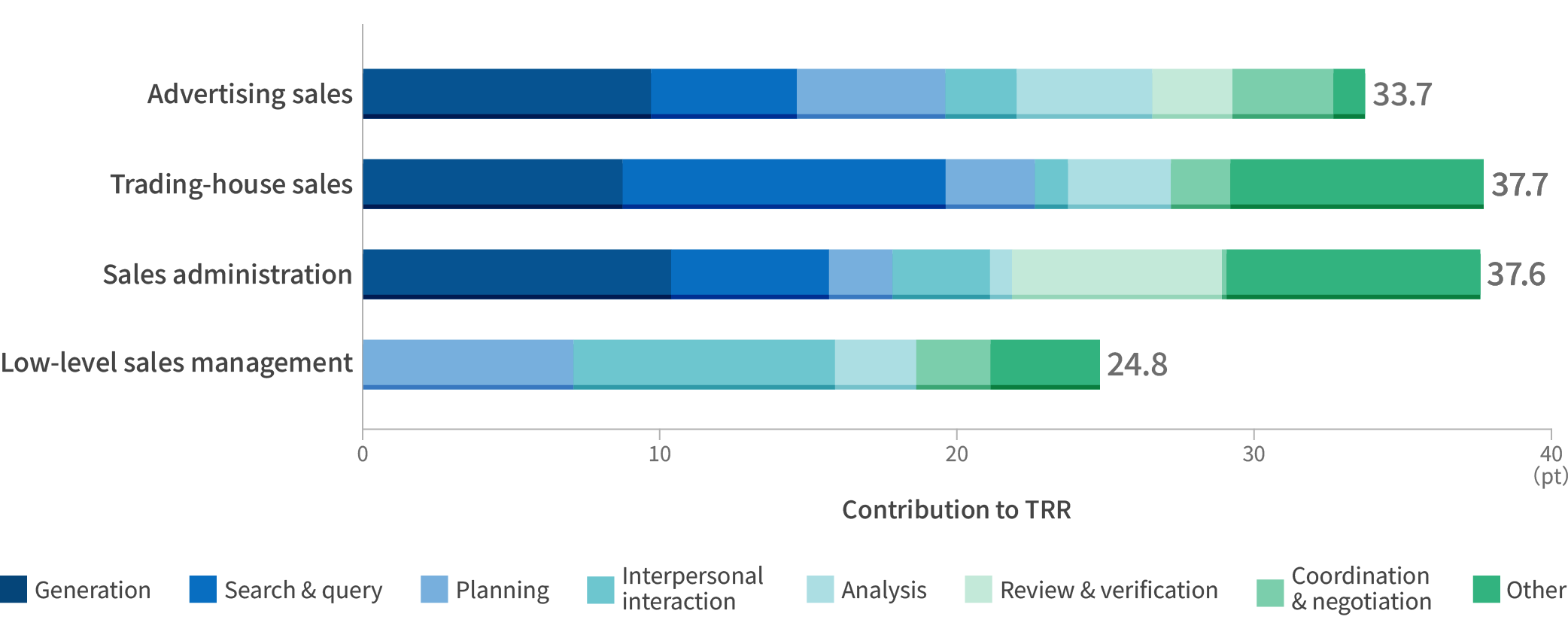
Take sales functions as an example. Analyzing TRR across sales-department roles shows sales at trading houses and sales administration roles exhibit the highest reallocation rates, indicating strong potential for AI-driven time gains (Figure 2). This is followed by advertising sales roles and low-level management roles. Breaking down TRR drivers reveals that coordination and negotiation dominate in advertising sales roles, while search and inquiry top trading-house sales roles. Figure 2 illustrates work elements where AI deployment has potential to deliver actionable time savings, rather than time-savings composition across roles.
*We broke down all tasks for all occupations on the Ministry of Health, Labour and Welfare (MHLW) job tag website into 23,581 work elements and matched them to 70 AI functions extracted from 864 global products. This yielded work-element–level estimates of time freed by AI. Applying time ratios for each occupation, we estimated the time reallocation rates (TRRs) by occupation, task, and work element. TRR measures time redirectable to new work elements via AI and is not an index of headcount reductions3,4
Figure 2: TRR work-element breakdown for sales roles
(Work elements where AI deployment has potential to deliver actionable time savings)
(Work elements where AI deployment has potential to deliver actionable time savings)
Source: Mitsubishi Research Institute, Inc.
Our simulation shows that advertising sales entails strong emphasis on bridging clients and internal teams—proposing ad campaigns, working out content, hammering out how to execute plans, and other similar intensive interfacing. This points to coordination and negotiation work offering substantial time-freeing potential. Major opportunities for time reallocation in trading-house sales exist in search- and inquiry-related tasks such as preparing quotations, readying transaction documents, and checking delivery dates and inventory. In sales administration roles, TRR drivers include document generation, querying, and content verification—work elements associated with drafting replies, checking inventory, arranging shipping, and entering itemized details in quotations. Our database indicates that deploying AI tools supporting document drafting, knowledge retrieval, and answer generation could have significant impact in these areas.*
It is worth noting, though, that a high TRR does not mean that a task can be fully delegated to AI. Though AI tools can aid drafting and querying, humans still have to review their output; so companies need to design processes defining who verifies AI outputs, by what criteria, and to what extent, to make sure terms and conditions, deadlines, and exceptions align with commitments made to customers.
Our database is a gateway for designing business processes incorporating AI; it is a tool to help companies prioritize AI investments. While it highlights occupations, work elements, and AI functions with strong time-freeing potential, companies themselves must define what to delegate to AI, who should verify AI outputs and against what criteria, and how to handle exceptions. People familiar with the immediate work process are best placed to design such guidelines and responsibilities.
In addition to guiding department-specific workflows, data that maps tasks to AI capabilities can also be used for prioritizing broader, company-wide AI investments.
*Our proprietary database matches AI functions to specific products and services, enabling on-target deployment decisions
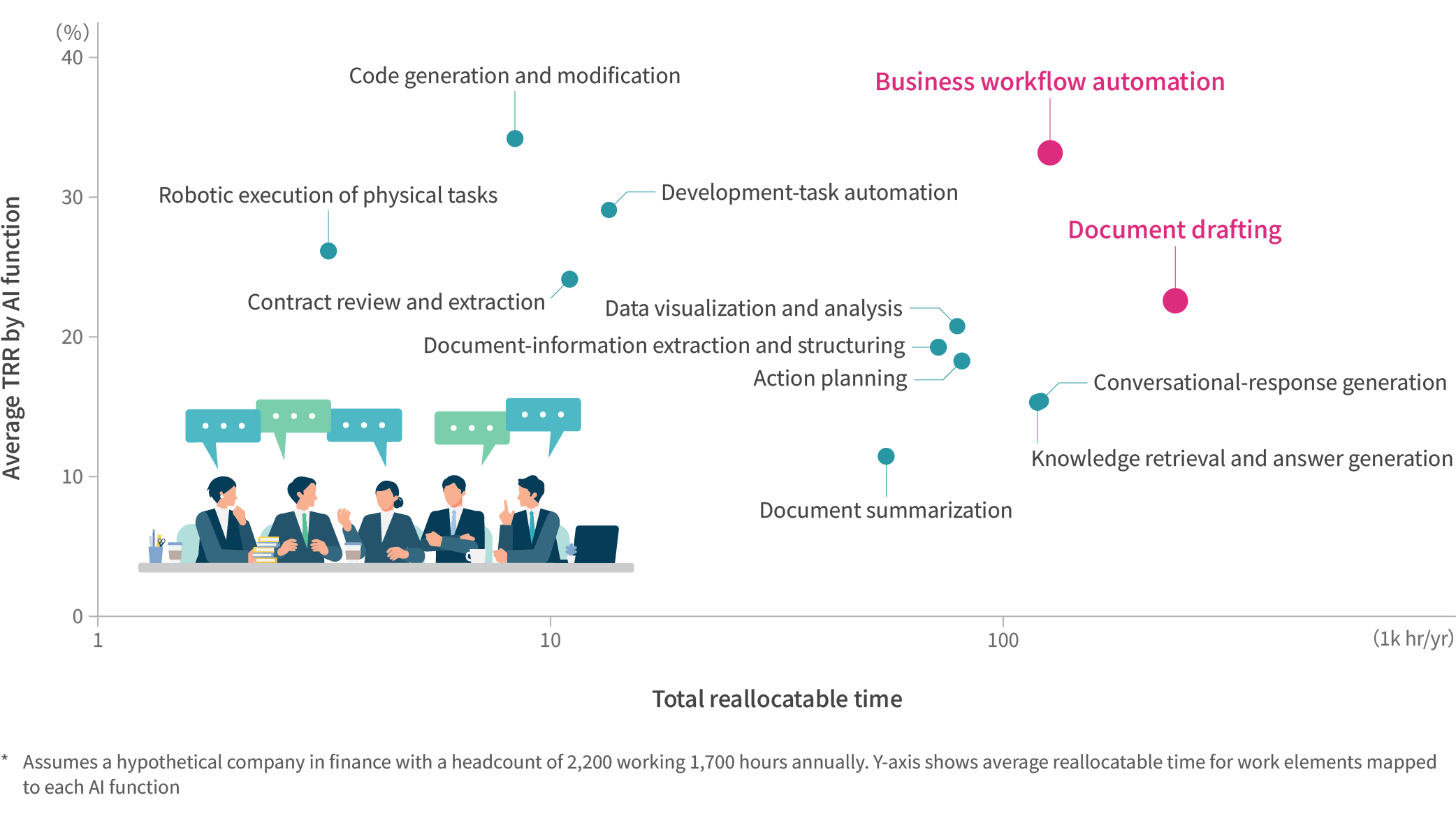
Figure 3: Portfolio by AI function
(Hypothetical company)*
(Hypothetical company)*
Source: Mitsubishi Research Institute, Inc.
Our analysis shows that fully deploying promising AI at our hypothetical firm would theoretically yield some 1.15 million annual reallocatable hours (about 520 per employee). AI functions supporting business-workflow automation and document drafting would be most impactful.*
Multiplying headcount by the occupation-specific TRRs and contributions by AI function provides insights into businesswide AI priorities. Note, however, that such analyses provide only a basis for decision-making; they do not automate the decision itself. Models reveal key time-freeing opportunities, but it is the company’s job to finalize deployments after weighing operational constraints, risks, costs, and strategic value.
*This potentially-created time is a theoretical maximum (occupation-specific TRR × headcount) and assumes sufficient AI use
AI outcomes hinge on managers
Once they have prioritized their AI investments, organizations need to turn their attention to redesigning work processes around AI use. AI deployment will shift task sequences and workers’ roles and focus. For instance, in sales functions, AI handles intelligence gathering and initial proposal drafting, freeing up workers to formulate hypotheses, prompt the AIs, select proposal drafts, and otherwise finetune solutions to clients’ needs.5 Managers play a critical role in this redesign: They will have to redesign roles and reallocate workers’ time freed up by AI to sales growth, quality improvement, customer engagement, product development, and employee development.
First the C suite needs to set the company’s general direction. Managers in each organization then need to translate management’s big-picture plans into concrete processes, roles, and time allocation. AI-accelerated tasks cannot deliver organizational value if output review protocols, decision-making roles, and time reallocation have not been defined.
Deriving organizational value from AI hinges on managers’ ability to effectively redesign work.
Rethinking entry-level duties for training new hires
Redesigning work processes necessitates redefining junior roles, especially given Japan’s widespread practice of batch-hiring new graduates. Historically, basic duties such as record-keeping, research, document preparation, and initial response served as entry-level training for new hires. Automating these with AI could hinder development of personnel capable of dealing with rule exceptions and articulating decision criteria to incoming employee cohorts.
When AI transforms entry-level duties, organizations have to redesign their training methods too. In the AI era, junior staff development needs to shift its emphasis from routine processing toward experience and judgment.
Redesigning work delivers the companywide benefits of AI
It is important to let individual employees try AI tools out in order to get human–AI synergies right. But once an organization starts moving from such discrete use to pursuing organizational impact, its operational units need to dissect their work processes to identify where AI can be effective and pinpoint when and where human judgment is needed, then decide how to reallocate the time gains. Companies that do this right redirect workers’ newfound time to customer engagement, quality improvement, and personnel development. Those that don’t squander it on meetings, redundant checks, and miscellaneous tasks, gaining only marginal convenience. Translating AI investment into a stronger organization requires more than just new tools; redesigning work processes and reallocating time gains will be paramount to facilitating growth.
Works Cited
1Information-technology Promotion Agency, Japan (2025) DX Trends 2025
https://www.ipa.go.jp/digital/chousa/dx-trend/tbl5kb0000001mn2-att/dx-trend-2025.pdf (Contains English abstract; accessed 21 May 2026)
2Ministry of Finance (2026) 地域におけるAI活用を巡る現状(特別調査) [Current regional AI utilization (special survey)]
https://www.mof.go.jp/about_mof
3Ministry of Health, Labour and Welfare job tag
https://shigoto.mhlw.go.jp/User/ (accessed 21 May 2026)
4The Japan Institute for Labour Policy and Training (JILPT) 職業情報データベース 詳細版数値系ダウンロードデータver.6.01.01および簡易版数値系ダウンロードver.7.00 [Occupational information database detailed numerical download data ver.6.01.01 and simplified numerical download ver.7.00]
https://shigoto.mhlw.go.jp
Author profile

Muneaki Yokoyama
Center for Policy and the Economy
Muneaki Yokoyama’s experience spans education and human resources (HR) policy, university reform, and HR tech. His current focus is researching and presenting ideas on the relationship between AI and work. He works to make think tanks a catalyst for envisioning the future, setting agendas, and advancing policies through partnerships.