
As the world nears an era where 100-year lifespans are commonplace, medical and long-term care will play a role of ever-growing importance. Dwindling public finances and workforce—both products of societal ageing and a declining birthrate—have put Japan's current programs in a precarious place, and the country needs detailed plans for reforms moving forward. Here, we propose greater local governance to boost effectiveness and digital transformation for much needed momentum. The clock is ticking as the country's elderly population grows toward its 2040 peak.
Making Japan’s Medical and Long-Term Care Systems Self-Sustaining by 2040
Stronger governance by the prefectures and digital transformation essential
Last chance to tackle reform
As Japan’s population ages, social security expenditure, including pensions, medical care, and long-term care, continues to rise. At the same time, the size of the working generation that supports these systems is entering a steep decline. Projections indicate that the elderly population will peak around 2040, so it is clear that there are limits to what can be achieved with the current model where the working generation supports the elderly. Under these challenging circumstances, Japan’s social security system is very much under threat.
Of all the systems covered by social welfare, there are particular concerns over the sustainability of the medical and long-term care systems. While the pension system is designed so that expenditure on pension benefits can be adjusted according to socioeconomic factors,* currently there are no such mechanisms in place for the medical and long-term care systems. According to our estimates, medical and long-term care spending could blow out to ¥80.5 trillion by 2040, a 1.5-fold increase over the 2020 figure (Figure 1). On top of this, the country has to grapple with the major issues of how to fund this spending, where to find sufficient workforce, and how to address instances of insufficient service capacity in regional areas.
The government must act now to tackle reform in the medical and long-term care systems before 2040. It can take at least five or ten years before system reform starts to generate results, so there is not much time left. Politicians need to see this as the last chance to make the medical and long-term care systems more sustainable and ensure that people can lead secure and comfortable lives.
*This system, known as the macroeconomic slide mechanism (MESM), is designed to prevent future working generations from having to pay excessive contributions. It sets the level of contributions (insurance premiums) to maintain a balance between revenue (e.g., premiums) and spending (e.g., pension payments). Specifically, pension benefits are adjusted by deducting from wage and price index adjustments a “slide adjustment rate”, which is calculated based on the shrinking workforce and rising life expectancy1
Figure 1: Demographic outlook and estimates of future medical and long-term care spending
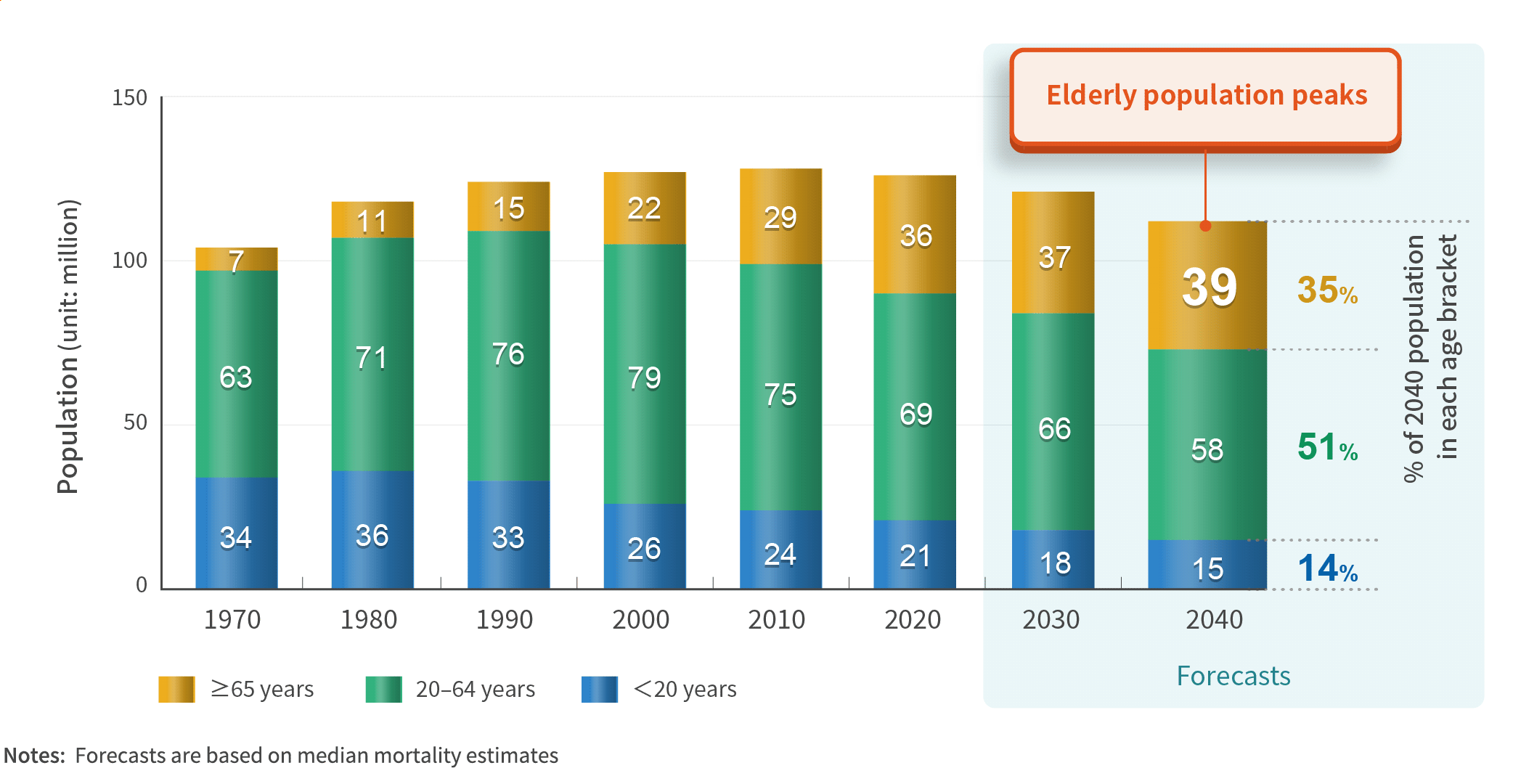
Source: Mitsubishi Research Institute, Inc. from National Institute of Population and Social Security Research (2023) Population Projections for Japan (2023 revision)

Source: Mitsubishi Research Institute, Inc. from Cabinet Secretariat, Cabinet Office, Ministry of Finance, and Ministry of Health, Labour and Welfare (2018) “2040年を見据えた社会保障の将来見通し(議論の素材)” (Future Outlook on Social Security through 2040 (Discussion Materials)); “Healthy Life Expectancy Simulations” from Mitsubishi Research Institute, Inc.; and “Future Population Projections for Japan (2023 Estimates)” and “Social Security Expenditure Statistics for FY2020” from the National Institute of Population and Social Security Research
For self-sustaining medical and long-term care systems
The Japanese economy is at a significant turning point as it emerges from a period of deflation. The situation surrounding the medical and long-term care systems is also changing. For example, there is a pressing need to improve productivity in clinical and long-term care settings because of labor shortages. Positive changes are also arising such as those from advances in digital technologies—i.e., digital transformation in the care sectors. Changes such as these should be seen as opportunities.
Japan needs to make its medical and long-term care system self-sustaining by providing services more efficiently—thus making business operations more sustainable—and moving away from a reliance on public debt. This will require reforms in the following areas (Figure 2): (1) improving healthcare system efficiency; (2) optimizing insurance benefits; and (3) reforming patient payment standards.
Figure 2: Reforms to develop self-sustaining medical and long-term care systems

Source: Mitsubishi Research Institute, Inc.
(1) Improving healthcare system efficiency
Japan needs efficient and appropriate provision of medical and long-term care services. One solution lies in determining the ideal balance of inpatient and outpatient functions by region according to the local conditions of each. The country can also improve efficiency and productivity at long-term care service providers by scaling up facilities and promoting coordination between service providers.
(2) Optimizing insurance benefits
Japan must improve convenience for the general public while also reining in expenditure on coverage payments. It can achieve this by, for example, shifting some traditionally inpatient procedures, requiring overnight hospital stay, to the one-day outpatient approach.
(3) Reforming patient payment standards
Japan can benefit by introducing a system of patient payments based on ability to pay (e.g., means testing or income based) rather than age.
Our estimates suggest that together these system reforms could reduce expenditure on coverage payment by around ¥7.3 trillion in 2040.
Prefectures have a pivotal role to play
The need to improve healthcare system efficiency and optimize insurance benefits have been pointed out before, but reforms have fallen short of initial hopes thus far. There are two factors are behind the delays to system reform.
First, in Japan, most of the organizations delivering medical and long-term care services are private businesses. Each individual operator recognizes the freedom that comes with opening a practice and provides services in line with their own management philosophy. As such, it is difficult to establish effective governance to achieve overall optimization that can satisfy the nation’s medical and long-term care needs.
Second, users can choose which provider they use in a free access system and patient payment rates are relatively low. One of the advantages with this system is ease of access to healthcare, but there are also disadvantages. Patients can make frequent doctor visits for minor ailments as if stopping by a convenience store, or they may visit multiple facilities for the same issue in a what is known as doctor shopping. This makes it difficult to manage patient behavior so that healthcare services are used appropriately. Even if the government introduces policies aimed at more efficient service delivery and appropriate service usage, in practice the system will still be difficult to control.
Here, stronger governance by the prefectures may have a pivotal role to play in making system reform more effective (Figure 3). For reforms to be properly rolled out across society, behavior change is necessary among both the providers delivering services and also the public receiving those services. There is a key role to be played by prefectural governments that are the main entities responsible for provider systems and also function as insurers.*
*An insurer refers to the entity responsible for operating medical insurance and long-term care insurance businesses. Since the reforms to the national health insurance system in 2018, prefectures have been designated alongside municipalities as joint insurers for national health insurance and are the entities responsible for managing the public finances in national health insurance
Figure 3: Policies to strengthen governance by the prefectures

Source: Mitsubishi Research Institute, Inc.
One issue stands out. As a result of various system reforms implemented in recent years, the prefectures now play a much larger role in healthcare and long-term care. In 2018, the prefectures became insurers under the national health system and were designated as the main entities responsible for administering the related public finances. In addition, the prefectural governor was granted greater authority to promote the local regional healthcare vision.* For long-term care as well, the prefectures are expected to play a role in laying the foundations for long-term care insurance and supporting the municipalities that are also insurers.
Creating systems that will allow the prefectures to properly execute these roles and functions will also result in better governance over medical institutions, long-term care providers, and the general public (i.e. patients, service users). The first step needs to be legislative clarification of who is responsible for doing what, so that the prefectures can actually exercise their authority. On top of this, it may be useful to establish mechanisms to assess prefectures generating results, for example improved healthcare system efficiency or optimized insurance benefits, and award financial bonuses in line with these assessments.
*Each prefecture creates its own regional healthcare vision as a part of its Medical Care Plan. The policy establishes long-term plans for regional healthcare aimed at ensuring a system that can efficiently provide high quality and appropriate healthcare services. The planning processes takes into account medium-to-long-term changes in population structures as well as the quality and quantity of regional healthcare needs. The policy also addresses progressing functional differentiation of, and coordination between, medical institutions2
Digital transformation brings added momentum
The prefectures may play a pivotal role in achieving system reform, but simply giving the prefectures greater authority might not be enough for them to actually fulfill their roles. The problem is that prefectures currently lack the resources and knowhow to execute policy measures.
Digital transformation in the medical and care sectors* could be one way to reduce the administrative burden on the prefectures and address resource shortages (Figure 4). In concrete terms, this means using digital technologies to make administrative processes more efficient and to reduce labor. Digital transformation of medical and long-term care services will be essential to ensure the prefectures have the necessary skills to execute and can generate results from policy measures. Amid ongoing concerns over labor shortages, addressing the increasing needs of the elderly with limited resources will require local governments, medical institutions, and long-term care providers to collaborate closely through data sharing and to work toward optimizing outcomes for regional healthcare.
Moreover, evaluating the outcomes of medical and long-term care policy measures using data from public databases† will enable prefectures to use the PDCA cycle to further increase the effectiveness of their programs.
*According to the Ministry of Health, Labour and Welfare, digital transformation of the medical and long-term care fields can be defined as the process of using information and data generated at all stages of preventive health care, medical care, and long-term care (e.g., disease prevention; consultation; diagnosis, treatment, prescribing; preparation of medical certificates; billing for medical service fees; integrated care through medical and long-term care coordination; regional healthcare coordination; and R&D) through an optimized platform (e.g., cloud-based systems). This use serves to externalize, harmonize, and standardize the processes, systems, and data storage of service providers in preventive health, medical, and long-term care. The goal is to promote personal preventive healthcare by the general public and ensure that higher-quality medical care and support can be provided, thus transforming society and the way we live3
†General term for databases of medical and long-term care information held by the Minister for Health, Labour and Welfare, including the National Data Base of Health Insurance Claims and Specific Health Checkups of Japan (NDB), the Diagnosis and Procedure Combination database (DPC DB), and the comprehensive long-term care insurance database (Kaigo-DB)
Figure 4: Digital transformation of medical and long-term care services to make system reform more effective

Source: Mitsubishi Research Institute, Inc.
Our related articles cover these points in more detail. Insight 1 covers data utilization by the prefectures for evidence-based policy making (EBPM)4. Insight 2 puts forward an approach to digital transformation that will allow more efficient and advanced systems for the delivery of medical and long-term care in the regions throughout Japan.
Security and well-being when people live to 100 and beyond
The social security system, including the medical and long-term care systems, provides a safety net to help everyone enjoy a sense of security and well-being in their lives. It is fundamental support that is becoming increasingly important as more people are living to 100 years and beyond. Tackling social security issues head on and progressing system reform could have effects beyond just building a safety net to support people’s lives in the future. Reforms may help to eliminate uncertainties over the future, have a positive impact on Japan’s low birth rate, and stimulate society as a whole.
The question is whether we can achieve a system that provides security for all generations. All must engage in this debate as a matter of personal importance.
Works Cited
1Japan Pension Service “マクロ経済スライド” (Macroeconomic slide mechanism)
https://www.nenkin.go.jp/
2Ministry of Health, Labour and Welfare “地域医療構想” (Regional Healthcare Vision)
https://www.mhlw.go.jp/
3Ministry of Health, Labour and Welfare “第1回『医療DX令和ビジョン2030』厚生労働省推進チーム” (1st Meeting on the “Medical DX Reiwa Vision 2030” from the Ministry of Health, Labour and Welfare Promotion Team, Document 1)
https://www.mhlw.go.jp/
4Cabinet Office “内閣府におけるEBPMへの取組” (Cabinet Office initiatives in EBPM)
https://www.cao.go.jp/
Author profile
Michiru Kakinuma
Center for Policy and the Economy
Michiru Kakinuma is primarily responsible for research and projects in the healthcare sector. She strives to support the societal implementation of preventive care and health promotion to help create a society where all can live happily and true to themselves.