
Experience shows that delays in getting local commerce and industry back on their feet after major disasters sap communities of vitality and provoke a period of stagnation. We hope Japan’s new agency for disaster preparedness and management, in its function as the country’s central command for emergency response, will also pursue ante-factum recovery, or pre-disaster recovery readiness. Here, local commerce and industry should be kept at front of mind as the agency works through private–public partnerships to enhance industrial resilience.
The perspective Japan’s new disaster management agency needs
Addressing recovery for local commerce and industry before disaster strikes
20 February 2026
Missing from the debate: Post-disaster recovery of local economies
Japan’s new agency for disaster preparedness and management will better the effectiveness of the country’s disaster-related initiatives. In doing so, the agency envisions many ways for the private sector to contribute to this mission. As policymakers and planners iron out the details, we recommend that they incorporate the perspective of local commerce and industry into their work.
We want to consider them here, because they have been missing from the discourse on the new agency just as they were lacking in officials’ previous pre-disaster planning.
To date the Cabinet Office organizations tasked with disaster-response matters have convened consultative councils populated by authorities in numerous fields, foremost among them experts on dealing with massive earthquakes on the Nankai Trough and direct hits on the Capital region. They have, however, rarely called in specialists on regional commerce and industry. A look at the deliberations on establishing the agency reveals that none were on the advisory council set up in the Cabinet Office in January 2025, although there were plenty of experts on subjects like disaster-response operations, digital transformation in disaster mitigation and response, organizing medical attention for victims, and victim assistance. And the council’s report barely even touches on the long-term viability and thriving of regional economies, sparing only a few lines on rebuilding livelihoods in stricken areas.
Given that local commerce and industry provide jobs and help stem post-disaster population flight, shoring them up against disaster, sustaining, and further developing them in an event’s aftermath are absolutely indispensable for ensuring rapid and smooth recovery. Stating this is not to downplay the need to explore more deeply preparations for the initial emergency response and the repair-and-restore phases of a disaster, but to emphasize the concurrent necessity to look into what needs to be done to ensure a smooth transition to the recovery phase and beyond.
Previous disasters show a pattern of stagnation
A glance back to previous major disasters reveals an oft-repeated pattern of sluggish progress in stricken areas’ economic recovery and subsequent extended periods of slow growth.
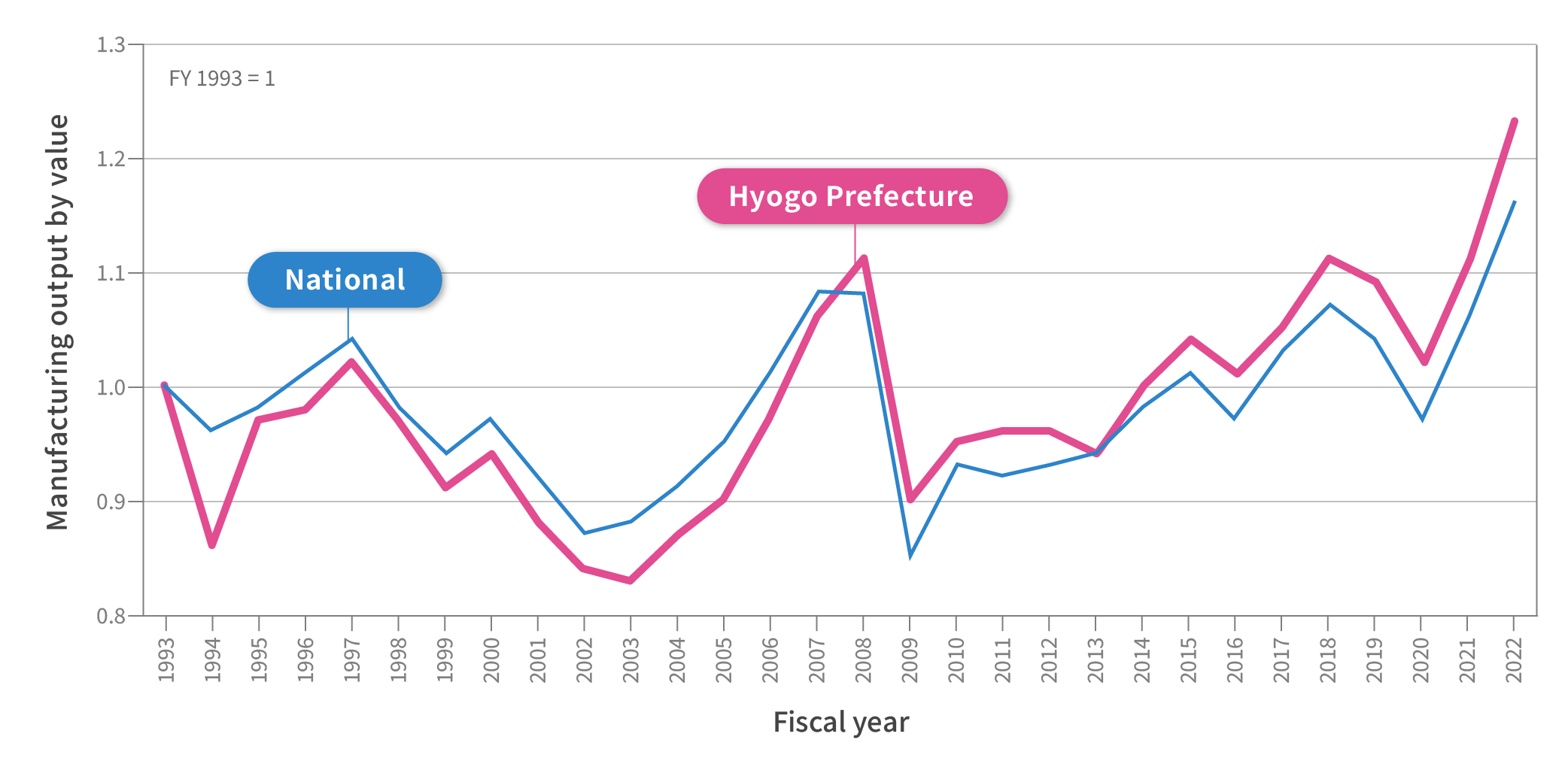
Take the experience of 1995’s Great Hanshin Earthquake. In its aftermath, the real gross regional product (GRP)* of Hyogo Prefecture and the 12 impacted municipalities initially recovered enough that after five years, growth was back to nearly tracking Japan’s real GDP growth. But then it stalled and, even 30 years on, the gap between it and the national average is yet to close. It took 13 years—until FY 2008—for manufacturing output in Hyogo Prefecture to finally rise above the national average (Figure 1).
*An index of manufacturing value added within each prefecture (“region”). Real GRP is GRP adjusted for price fluctuations
Figure 1: Manufacturing output trends
Source: Mitsubishi Research Institute. Inc. from Ministry of Internal Affairs (1993–2022) “System of Social and Demographic Statistics”
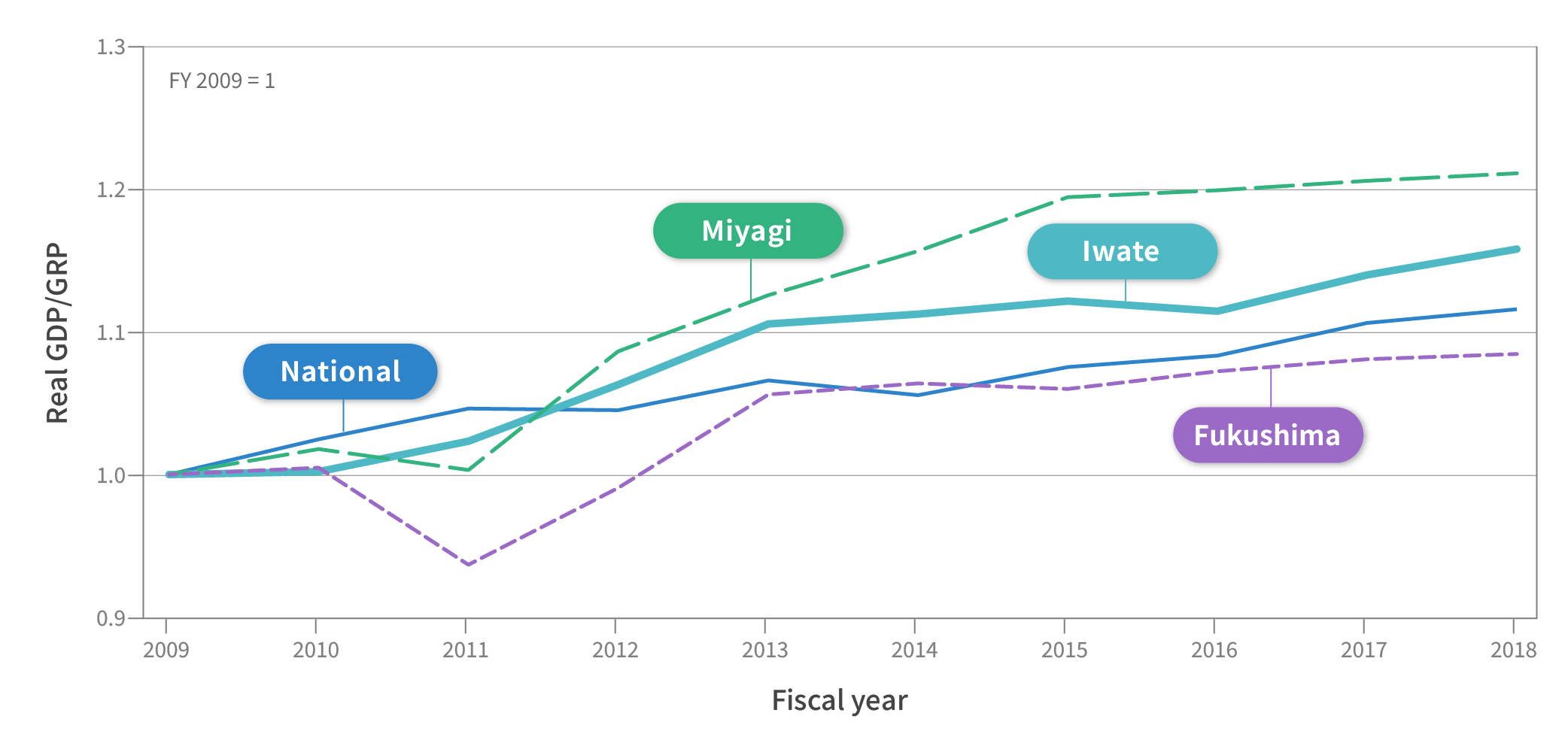
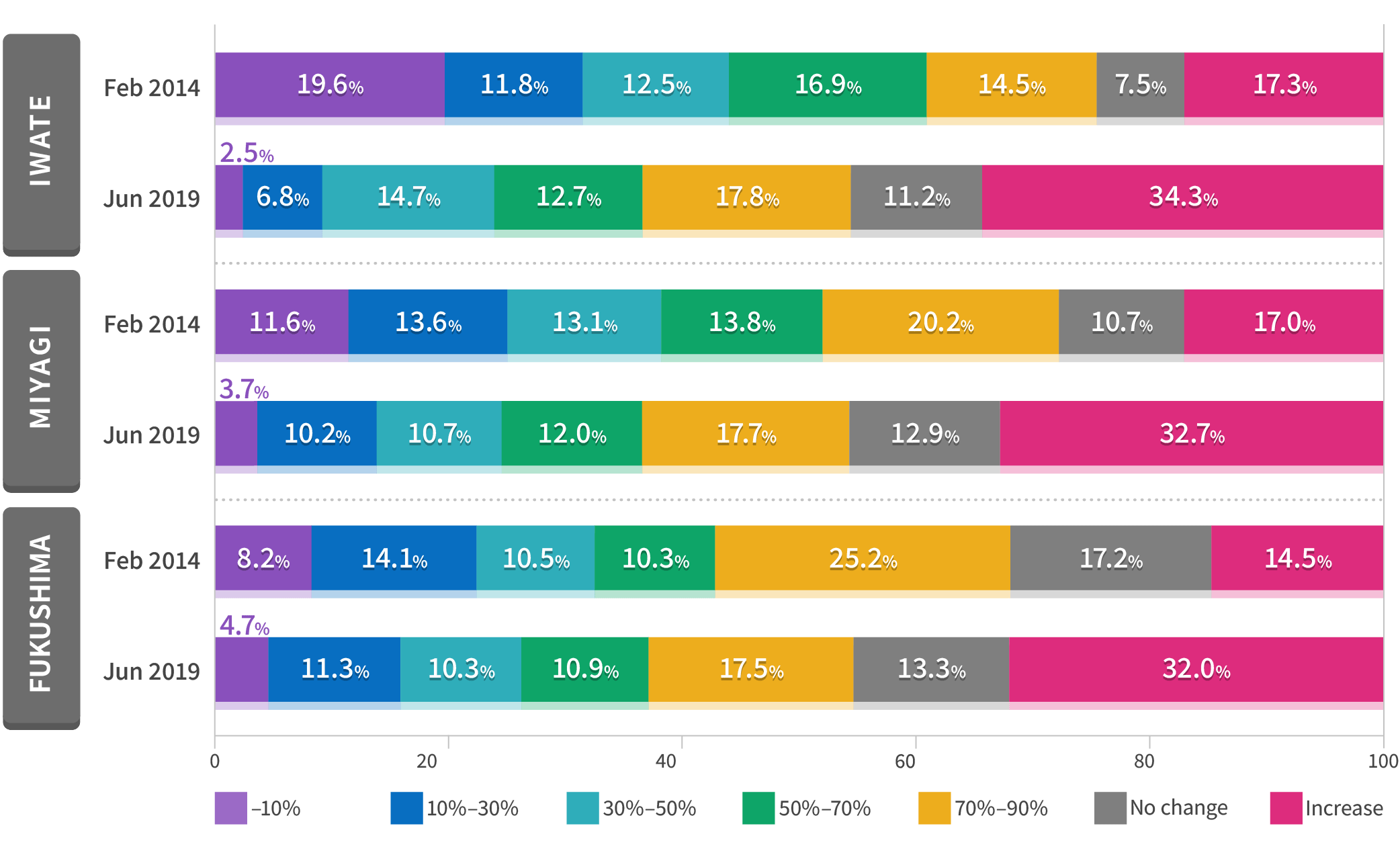
Compare that to the situation in Iwate, Miyagi, and Fukushima, the three prefectures most devastated by the Great East Japan Earthquake of 2011. Although their respective real GRPs dipped after the event, those of Iwate and Miyagi bounced back to exceed national levels in FY 2012. And even in Fukushima, which bore the brunt of the nuclear accident, GRP trajectory once again aligned with the national trend from 2013 onward (Figure 2). It should be noted, however, that reconstruction demand involving massive infrastructure probably played a large part in this. Nevertheless, when analyzing a separate dataset on small- and medium-size enterprises (SMEs), which make up the backbone of their local economies, only about 45% of the three prefectures’ businesses reported in June 2019 that sales were back to or exceeding their pre-disaster levels (Figure 3).
Figure 2: Real GDP and real GRP in the three disaster-stricken prefectures
Source: Mitsubishi Research Institute. Inc from Cabinet Office “県民経済計算(平成23年度-令和4年度)(2008SNA、平成27年基準計数)<30都道府県、2政令指定都市分>” (Prefectural economic accounts [FY2011 - FY2022] [2008 SNA, 2015 SNA benchmark figures]: 30 prefectures and 2 designated cities)
https://www.esri.cao.go.jp/jp/sna/data/data_list/kenmin/files/contents/main_2022.html (accessed 28 July 2025)
https://www.esri.cao.go.jp/jp/sna/
Figure 3: Pre- and post-disaster sales trends at enterprises eligible for the SMEs Group Subsidy in the three prefectures most impacted by the Great East Japan Earthquake
Note: The SMEs Group Subsidy is run by the Small Medium Enterprise Agency for the restoration and maintenance of the facilities of small and medium sized enterprises (SMEs)
Source: Mitsubishi Research Institute, Inc. from Tohoku Bureau of Economy, Trade and Industry, Ministry of Economy, Trade and Industry (2020) 東日本大震災グループ補助金 交付先アンケート調査(中小企業等グループ施設等復旧整備補助金)令和2年6月実施(東北4県版) (Group Subsidy Program for the Great East Japan Earthquake: Survey of subsidy recipients (Group subsidies for recovery and restoration of SME facilities and equipment) June 2020 (edition on four Tohoku prefectures))
https://www.tohoku.meti.go.jp/koho/topics/earthquake/pdf/201013_1.pdf (accessed 28 July 2025)
Source: Mitsubishi Research Institute, Inc. from Tohoku Bureau of Economy, Trade and Industry, Ministry of Economy, Trade and Industry (2020) 東日本大震災グループ補助金 交付先アンケート調査(中小企業等グループ施設等復旧整備補助金)令和2年6月実施(東北4県版) (Group Subsidy Program for the Great East Japan Earthquake: Survey of subsidy recipients (Group subsidies for recovery and restoration of SME facilities and equipment) June 2020 (edition on four Tohoku prefectures))
https://www.tohoku.meti.go.jp/
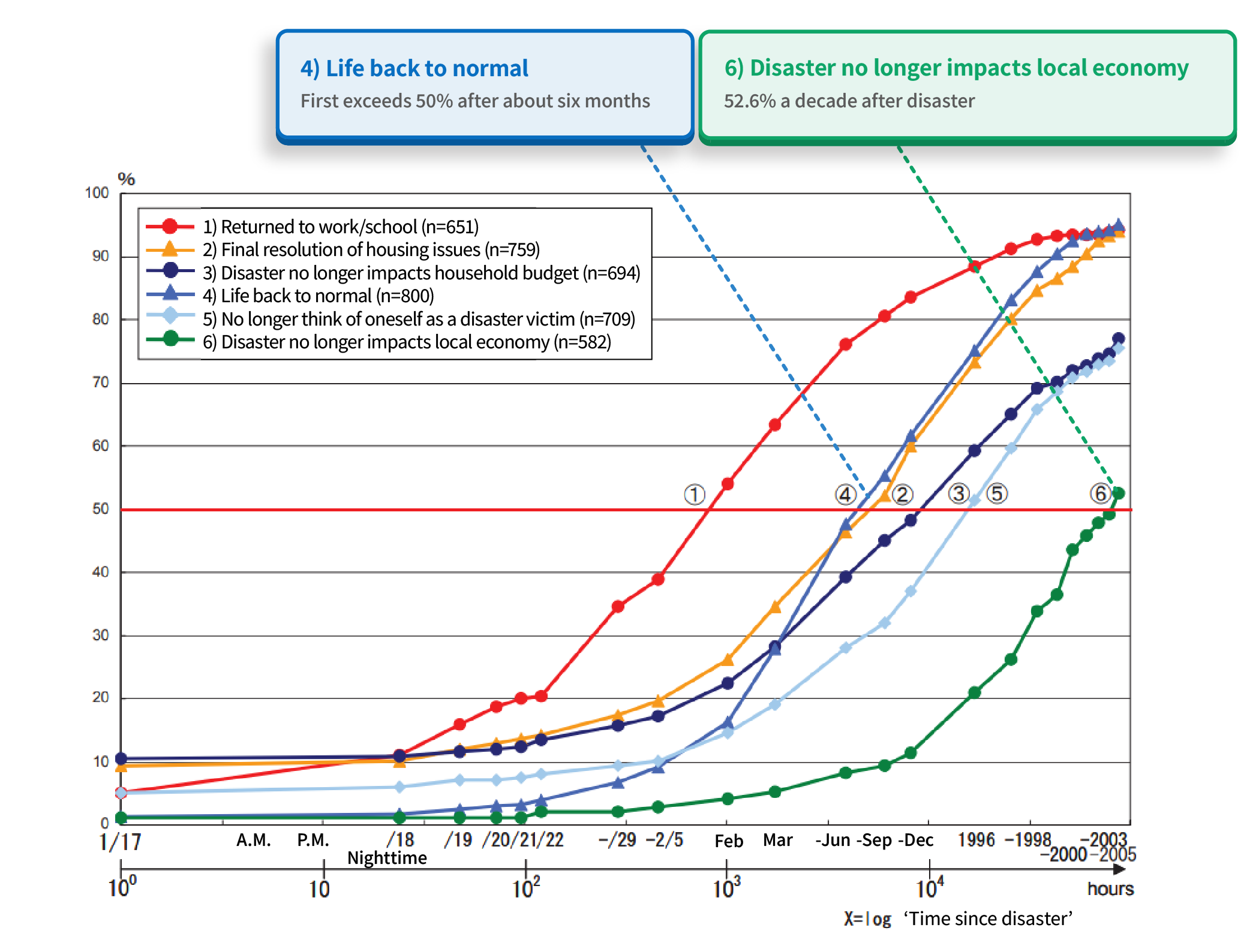
Then there is the question of how disaster victims themselves perceived this debilitation of their local economies. A survey by the Great East Japan Earthquake Life Reconstruction Survey Team (東日本大震災生活復興調査チーム) found that more than half of respondents felt that their daily lives had settled back into a normal routine six months after the Great Hanshin-Awaji Earthquake and three months after the Great East Japan Earthquake. But a different picture emerged when they were asked about the economic situation. After the Great Hanshin Earthquake, about half of respondents felt it had taken nearly a decade for the local economy to break free of the disaster’s aftereffects. For the Great East Japan Earthquake, that proportion had already reached 43.3% five years after the event (Figures 4 and 5).
Figure 4: Results of survey on perceptions of recovery progress (Great Hanshin Earthquake)
Source: Hayashi et al. (2005) Socio-Economic Recovery from the 1995 Hanshin-Awaji Earthquake Disaster – Report of Panel Survey 2005 [p. 62]. Text in balloons and dotted lines added by Mitsubishi Research Institute, Inc.
http://www.drs.dpri.kyoto-u.ac.jp/publications/DRS-2005-02/index.html (accessed 8 July 2025)
http://www.drs.dpri.kyoto-u.ac.jp/
Figure 5: Results of survey on perceptions of recovery progress (Great East Japan Earthquake)
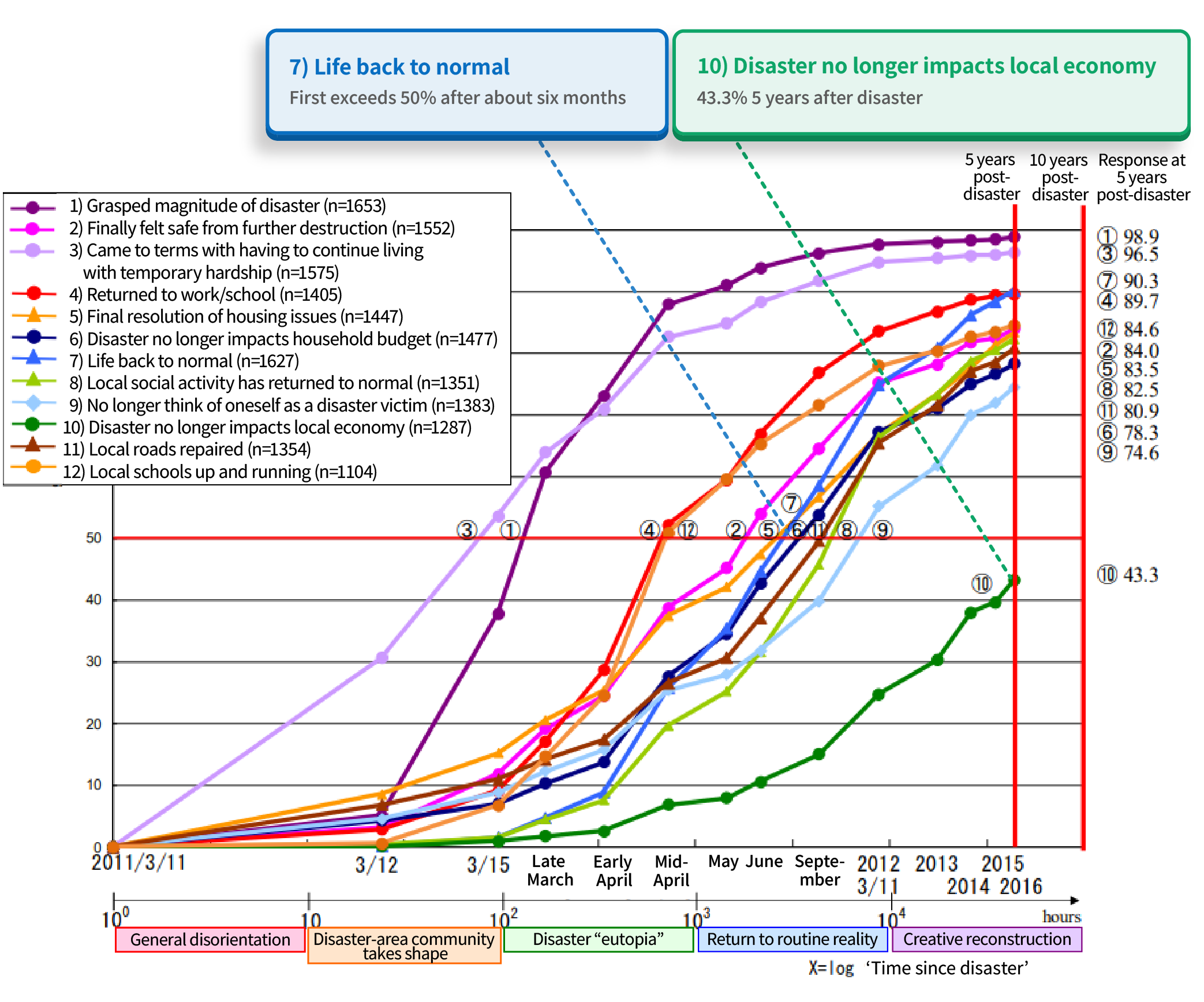
Source: Hayashi et al. (2018) 震災から5年が経過するなかでの東日本大震災生活復興調査 (Survey of livelihood recovery five years after the Great East Japan Earthquake disaster) [p. 107]. Text in balloons and dotted lines added by Mitsubishi Research Institute, Inc.
https://kimurareo.com/images/2021/07/180301_Higashinihon_Report.pdf (accessed 8 July 2025)
https://kimurareo.com/
Given the likely scale of disaster that would follow an anticipated event like a megaquake on the Nankai Trough, there is of course no downplaying the importance of adding depth to measures focused on protecting lives in the immediate aftermath. But nearly as important is incorporating into those explorations the perspective of what can be done during normal times—i.e., before disaster strikes—to ensure the sustainable, long-term growth prospects of local economies and communities where people live, work, and play. This is the impetus behind calls for pre-disaster planning of disaster recovery, or ante-factum recovery planning.
Ante-factum recovery planning: Getting ready during normal times to help local commerce and industry recover post-disaster
We propose specific steps to be taken and preparations to be made in normal times to protect local commerce and industry from disasters, facilitate their viability, and help them grow further down the post-disaster road.
First, local organizations—government, businesses, and academia—should come together to hammer out ways to maintain production and ensure the continuity of local commerce and industry. This should include groups of local enterprises that routinely work with one another and vendors making up local supply chains as well as public and academic institutions. The initiatives underway in the Nishi-Mikawa region of Aichi Prefecture are a prime example of this.
Nishi-Mikawa is home to one of Japan’s greatest concentrations of industry, particularly Toyota and other manufacturers and vendors in the auto industry. Here, local enterprises large and small and infrastructure companies joined Nishi-Mikawa’s ten municipalities, the prefectural government, national agencies, and the University of Nagoya to form the Nishi-Mikawa Disaster Readiness and Mitigation Collaborative Research Association (西三河防災減災連携研究会) in 2013. The association’s mission is to work out ways to protect the area’s industry from the ravages of a disaster. It advances remedies for dealing with calamity including exchanges of information and intelligence and efforts to clarify and communicate anticipated challenges.
Nishi-Mikawa is home to one of Japan’s greatest concentrations of industry, particularly Toyota and other manufacturers and vendors in the auto industry. Here, local enterprises large and small and infrastructure companies joined Nishi-Mikawa’s ten municipalities, the prefectural government, national agencies, and the University of Nagoya to form the Nishi-Mikawa Disaster Readiness and Mitigation Collaborative Research Association (西三河防災減災連携研究会) in 2013. The association’s mission is to work out ways to protect the area’s industry from the ravages of a disaster. It advances remedies for dealing with calamity including exchanges of information and intelligence and efforts to clarify and communicate anticipated challenges.
Another is the concept of ante-factum recovery*, which entails working out ahead of time what needs to be done to facilitate recovery. An essential part of this is envisioning the kind of local industry the community wants to have post-disaster.
One municipality that takes this approach is the city of Kochi, in the eponymous prefecture, which is likely to incur extensive damage when the next Nankai Trough megaquake strikes. Kochi has mapped out a vision for its post-disaster reconstruction, an ante-factum recovery plan for town- and community-building.† Worthy of particular note is its provision of direction for commerce and industry in addition to the usual plans for restoring infrastructure and rebuilding cities and towns. It points out the necessity of creating new industries built around ICT, robotics, and other like technologies in addition to work to ensure the rapid recovery of regional industry and the revival tourism.‡
The plan goes further, including an outline of exactly what the recovery of industry should look like 7–8 years out as well as what kind of new local industries should be fostered. Such conceptualization is typically left to individual municipalities, included as a section of each’s recovery plan drawn up after disaster strikes. Here, Kochi City realized that drafting recovery plans takes substantial time, potentially draining local desire to rebuild. They decided to address the issue before disaster strikes—an extremely valuable decision at that.
Going forward, the new disaster management agency needs to take the lead, at least in partnering with the ministries and national-government agencies in whose purview they fall, in advancing approaches like these. The resurrection of local commerce and industry is not something that can be put on the back burner. The new agency is intended to be the command post for the national government of a country that wants to be a leader in disaster management and mitigation. As such, it needs to ensure that national-government entities responsible for regional commerce and industry work together in a coherent and consistent manner, during normal times, to proactively prepare for the recovery of regional commerce and industry. The idea is to ensure that they survive, and continue to thrive, post-disaster.
*Ante-factum recovery is the concept of ensuring rapid and lasting recovery in disaster areas through policymaking informed by identifying challenges and setting benchmarks, establishing protocols and procedures, and assembling teams to execute them
†Kochi City 高知市事前復興まちづくり計画復興基本方針 (City of Kochi Ante-Factum Recovery Town- and Community-Building Plan: Basic recovery policy)
https://www.city.kochi.
‡As of mid-2025, the city of Kochi has not provided any specifics regarding the “creation of new industries built around ICT, robotics, and other like technologies” in its ante-factum recovery plans. However, Kochi Prefecture’s Exploratory Committee on Ante-Factum Recovery Town- and Community-Building Planning (事前復興まちづくり計画策定指針検討会) recommends pursuing next-generation controlled-environment agriculture leveraging ICT, robotics, AI, and like technologies to maintain and improve productivity amid a shrinking workforce. Details are laid out in the prefecture’s smart-agriculture promotion plan