
Conventional wisdom dictates that the fastest route to reconstruction is the right way forward in the wake of disaster. But with falling populations and tightening labor markets now the norm, this supply side approach falls apart. It fails to meet varied local conditions while forfeiting reconstruction work to entities outside affected communities, imperiling the prospect of restoring regional prosperity. Reconstruction should strive for sustainability over speed, and this shift should sit at the core of disaster-management policy.
Post-Disaster Reconstruction When Labor’s Tight
Shifting focus from speed to sustainability for manageable volumes of local reconstruction work and a healthy local economy
29 June 2026
Locality-centric reconstruction
Fifteen years have now passed since the Great East Japan Earthquake, commonly called 3.11 (“three–eleven”), laid waste to broad swathes of Japan’s northeast. Research looking back on the progress of the still-ongoing reconstruction is amassing insights for policymaking as the country prepares for its next big one.
Examples include the findings of the Comprehensive Research on Local Contexts of Disaster Reconstruction1 undertaken from 2019 to 2023. The study points to government-led, supply-side–driven reconstruction policies as the cause of a variety of unintended consequences, attributing them to insensitivity to local circumstances. These can be nuanced and variable, and ignoring them gives rise to conflicts with residents and outcomes like unanticipatedly high population shrinkage, hollowing of local industry, and greater difficulty in retaining local historical and cultural traditions. The researchers also emphasized that just as important are locality-centric reconstruction policies; i.e., policies whose formulation takes local situations, community attributes, and acute damage as their baseline.
This local orientation is crucial for achieving reconstruction that keeps disaster areas economically viable, even vital, as well as fulfilling residents’ desire to retain historical and cultural traditions for their descendants.
Labor shortages the biggest bottleneck
How much reconstruction work can be met by local businesses and the local workforce is key to reconstruction that directly benefits a disaster-stricken area. Unfortunately, hazard-prone localities are today in an even worse situation than the one at the time of 3.11.
When that disaster struck, labor was plentiful, the surplus somewhat intensified by the 2008 global financial crisis; so despite a spike in demand for workers, a massive labor shortage did not ensue. But today is vastly different.
Across the country the labor–supply balance has shifted from surplus to shortage. By the time of the 2016 Kumamoto earthquakes, a tight labor market was already hampering recovery and reconstruction; labor was scarcer still when the 2025 Noto Peninsula events hit (Figure 1).
Across the country the labor–supply balance has shifted from surplus to shortage. By the time of the 2016 Kumamoto earthquakes, a tight labor market was already hampering recovery and reconstruction; labor was scarcer still when the 2025 Noto Peninsula events hit (Figure 1).
Figure 1: Labor supply balance

Note: Calculated by dividing (A – B) by the number of employed. Nationwide and Ishikawa Prefecture numbers are Jan–Nov averages
Source: Mitsubishi Research Institute, Inc. from Ministry of Health, Labour and Welfare (MHLW) statistics
Source: Mitsubishi Research Institute, Inc. from Ministry of Health, Labour and Welfare (MHLW) statistics
We forecast that the core working-age population (20–64-year-olds) of areas likely to be affected by a Nankai Trough earthquake will contract by 18% between 2022 and 2040.* A major event on the trough is a genuine threat, as evinced by authorities’ issuing a bulletin in August 2024 after a potentially triggering quake near the tough’s southern tip. As population aging and decline continue, we must remain aware that when the next disaster strikes, the overall situation will be far worse than it was when 3.11 hit.
*Calculated using numbers for the municipalities in the Tokai region that are likely to be heavily damaged in an earthquake on the Nankai Fault System.2 Base case assumes shaking of 6+ or higher on the JMA intensity scale (≈IX or the Modified Mercalli scale)
Affected communities forfeit work to others
When reconstruction is driven by a supply-side emphasis on speed while the labor supply is tight or tightening, demand will outstrip the stricken area’s ability to meet it. Companies and workers from outside the area will come to plug the gap. In the end, reconstruction work will wind up benefitting outsiders—it will “leak”—rather than benefitting local companies and workers.
Curious about how much reconstruction work could leak this way, we decided to quantify it for areas of high seismic hazard along the Nankai Trough using data from the Research Institute of Economy, Trade and Industry (RIETI),3 another think tank.
First, we assumed reconstruction work of the same scale as that for 3.11,* adjusting it for the population and its distribution in the area likely to be impacted by a Nankai Trough megaquake. The part of work that cannot be met from inside the disaster-area prefectures due to a lack of supply capacity must be met by sourcing the shortfall from other prefectures or even overseas. Thus, even without adjustment for labor constraints, leakage (the outflow of reconstruction work) reaches 28% (total for all disaster-stricken prefectures; see the green dots in Figure 2).
*About ¥24 trillion over 10 years. Among disbursements from Great East Japan Earthquake reconstruction budgets, we tabulated for investment expenditure
Figure 2: Percentage of demand for reconstruction work leaking outside the Nankai Trough earthquake disaster area
(Unadjusted for labor-shortage constraints)
(Unadjusted for labor-shortage constraints)
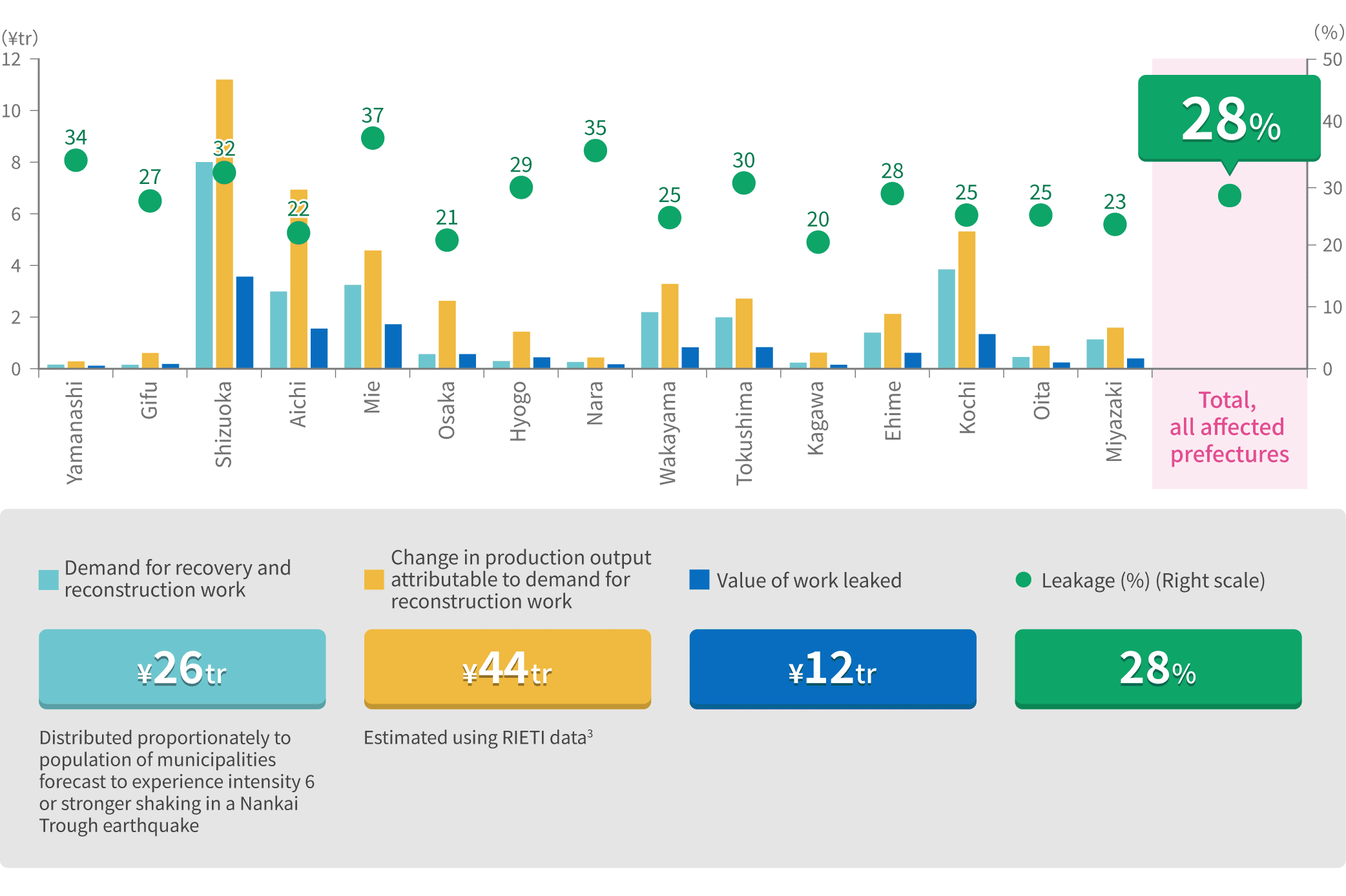
Source: Mitsubishi Research Institute, Inc. from RIETI 都道府県間産業連関表2011 (Prefectural input–output table, 2011)
Next, we estimated how leakage changes when the numbers were adjusted for labor-shortage constraints. First, we set a maximum for the volume of reconstruction work that the affected communities could fill themselves. This is commensurate to the reconstruction-demand–induced production change based on our estimates* of labor-shortage severity (expressed as a percentage) by prefecture. We then postulated that demand exceeding the supply maximum would be met by labor from prefectures with surplus labor available, in the process discovering that leakage of work would jump to 49% (see the purple dots in Figure 3).
*See Mitsubishi Research Institute, Inc. AIロボティクス活用を地域の労働力不足克服の突破口に 技術活用を起点に拓く地域経済の未来(前編)(MRIエコノミックレビュー 2026年1月13日) (Using AI and robotics as a breakthrough to overcome regional labor shortages: Opening up the future of regional economies starting with the application of technology (Part 1)) for details on how we estimated the labor shortage in 2030
Figure 3: Percentage of demand for reconstruction work leaking outside the Nankai Trough earthquake disaster area
(Adjusted for labor-shortage constraints)
(Adjusted for labor-shortage constraints)
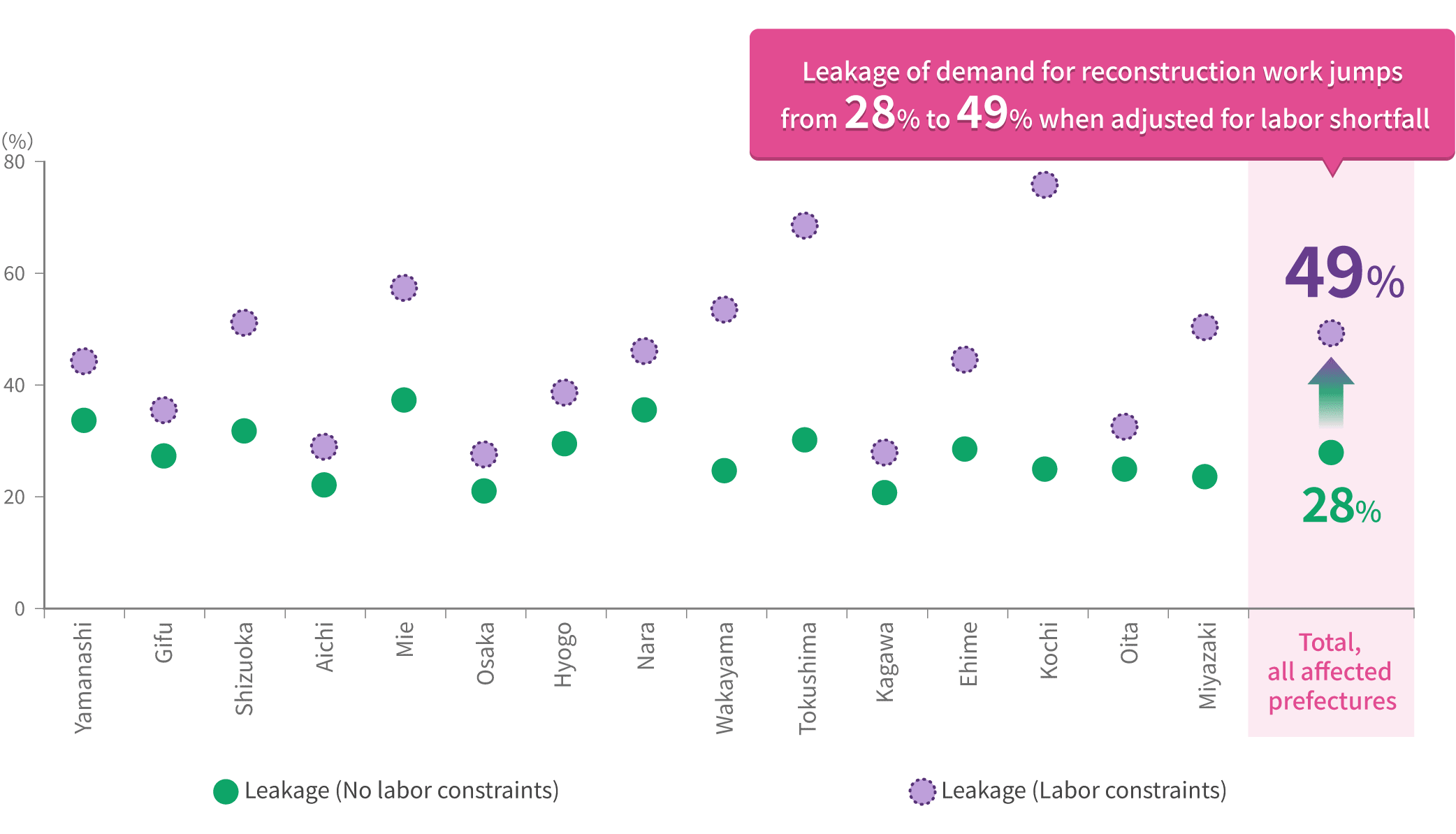
Source: Mitsubishi Research Institute, Inc. from RIETI 都道府県間産業連関表2011 (Prefectural input–output table, 2011)
Reconstruction amid severe labor-market constraints awaits communities after a major disaster, which could occur at any time. The rise in leakage under tight labor availability is especially stark in rural areas, suggesting that the positive effects of reconstruction work on local employment and income will be negligeable.
Reconstruction that benefits local economies
Our digging thus confirmed that supply-side overemphasis on speedy reconstruction misses the target, failing to respond to the local circumstances of the affected areas and holding the potential to exacerbate leakage of reconstruction work to outsiders.
Of course, in a disaster’s acute aftermath, there will be only so much in local human resources that can be allocated to recovery. And making use of outside resources has positives as well, like enhancing the quality of reconstruction and spreading opportunities to businesses and human resources with ties to the affected area; so there’s no need to negate it categorically. But care is needed to ensure that dependency on outside resources does not result in outsiders’ profiting excessively from work that should be benefiting the stricken communities, and over the longer term that would be undesirable for them.
Of course, in a disaster’s acute aftermath, there will be only so much in local human resources that can be allocated to recovery. And making use of outside resources has positives as well, like enhancing the quality of reconstruction and spreading opportunities to businesses and human resources with ties to the affected area; so there’s no need to negate it categorically. But care is needed to ensure that dependency on outside resources does not result in outsiders’ profiting excessively from work that should be benefiting the stricken communities, and over the longer term that would be undesirable for them.
Pivotal for reconstruction benefiting the community is prioritizing reconstruction projects and taking steps to level, or pace, demand so it does not end up concentrated in any given time window. According to progress reports by Japan’s Reconstruction Agency on consumption over time of the budget for reconstruction after 3.11, during the first three years demand spiked so much that it gobbled up over 50 percent of the total earmarked for investment (expenditures minus victim aid) from FY2011 to FY2024, but another five years were needed until budget consumption (dotted line in the upper graph of Figure 4) reached the 90 percent mark.
Figure 4: Reconstruction budget consumption patterns and their effects on disaster-area economies
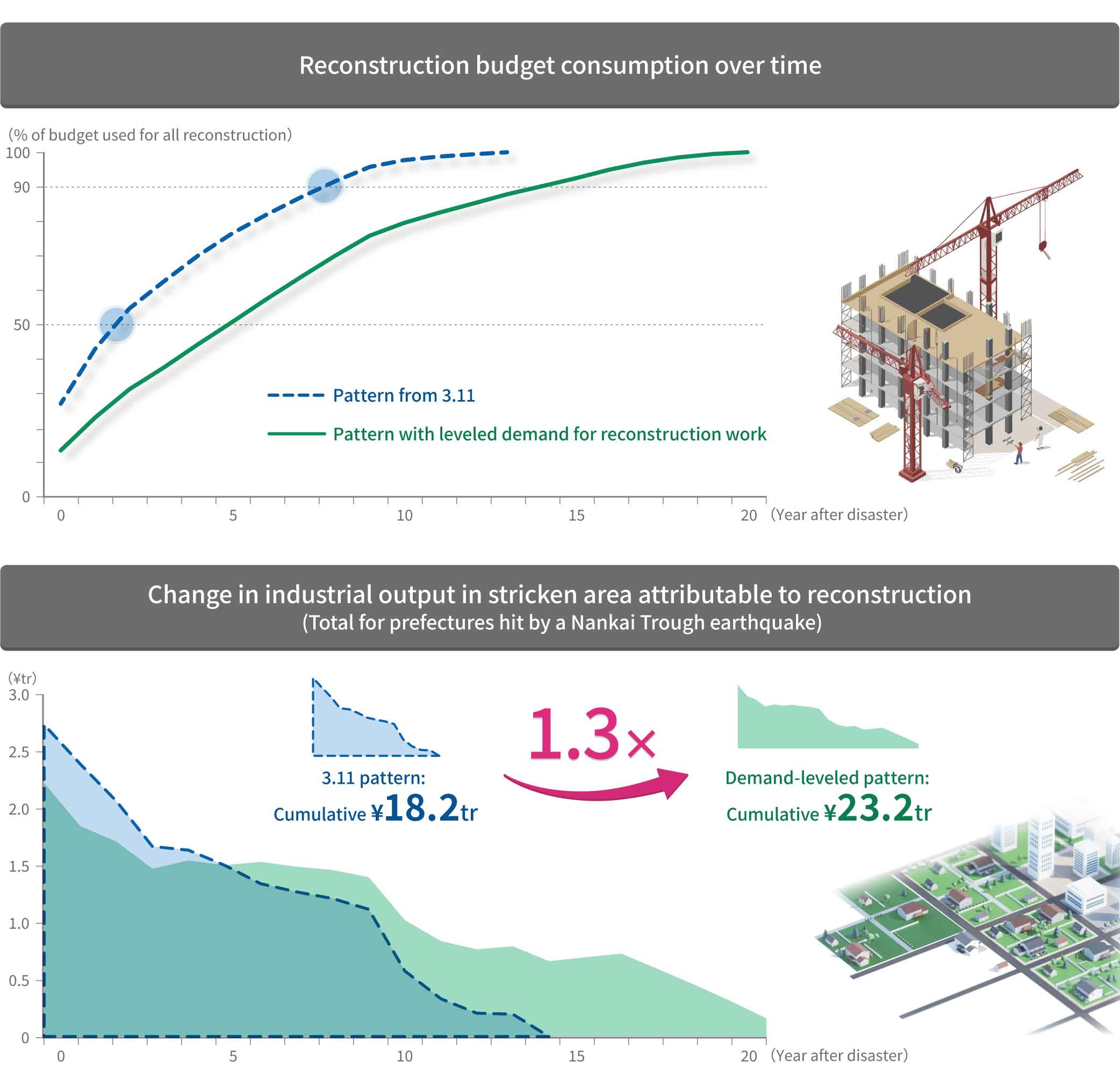
Source: Mitsubishi Research Institute, Inc. from Reconstruction Agency data and RIETI 都道府県間産業連関表2011 (Prefectural input–output table, 2011)
For comparison, we estimated changes in leakage were it paced by liberal distribution over 20 years. We also allowed for an intense spurt during reconstruction’s initial, emergency-response phase.
Our calculations showed that reconstruction-driven change in industrial output under the demand-leveled scenario was one of growth approaching 1.3 times that after 3.11. This expansion is attributable to several factors, among them the affected communities’ greater ability to themselves meet demand because peaks had been eliminated as well as the longer overall reconstruction period. Thus, pacing reconstruction over a longer time span to level the volume of work at any given time gives local businesses greater room for maneuvering and leads to business continuity and fostering of human resources within the disaster area.
Combining the advantages of rapid and paced reconstruction
Of course, spreading reconstruction over a longer timeframe entails care to avert its causing population and business flight. In particular, to prevent population flight, rather than shooting for all-holds-barred pursuit of fast and complete reconstruction, it is more important that authorities be expeditious in providing a roadmap to restoring a degree of normalcy to residents’ everyday lives. They need to promptly present graduated reconstruction plans with milestones for delivering civil functions indispensable to peoples’ routine lives, like housing, healthcare provision, schools, transportation, and shopping, even if these are temporary or provisional. This makes it easier for residents to decide to stay put rather than abandon their communities.
Further, rebuilding shopping streets and markets, transportation hubs, and other features that support community life has a greater positive impact on population retention than even recovery efforts’ economic scope. Early provision of shops and basic integrated community facilities, even when only temporary, effectively stems population drain by providing venues for people to gather and environments conducive to work and interaction among community members.
In this context, there needs to be a good mix of approaches to reconstruction, one rapid and one paced. A minimum of infrastructure needed for daily life and provisional commercial and market functions needs to be restored rapidly to maintain civic life and people’s livelihoods. Once that is done, reconstruction can transition to full-spec rebuilding of a more permanent nature. This gameplan should enable reconstruction that, although progressing more slowly, makes residents less likely to move away.
As an example, consider what happened in the Yuriage area of Natori, a city in Miyagi Prefecture devastated by 3.11. The reconstruction of permanent housing and rezoning of land was delayed in comparison to surrounding areas because residents took their time reaching consensus. But temporary shops and community facilities were erected quickly, preserving employment and community and civic life. This pattern of recovery has drawn praise4 for being, in effect, conducive to population retention.
Preparing policies and procurement
Disaster readiness encompassing post-event reconstruction planning, a concept we call ante-factum recovery, is pivotal for ensuring reconstruction that revitalizes and enriches localities through prioritization of this kind. Such pre-disaster recovery readiness entails setting reconstruction-process priorities and making plans for rebuilding in steps.
Reconstruction is a fraught process of achieving a community model acceptable to most residents while navigating a minefield of issues like where to site housing, how to maintain livelihoods, and balancing budgets. Working these details out ahead of a disaster has at least two benefits for post-disaster reconstruction planning: speeding it up and enhancing its quality.
Nevertheless, progress in establishing ante-factum recovery plans is rather dismal. For instance, a mere two percent of 1,202 Japanese municipalities* have established pre-disaster community-building reconstruction plans (事前復興まちづくり計画), a category of pre-disaster reconstruction plan focusing specifically on land allocation (zoning) and shaping the local townscape. This signals that measures are needed to expedite action by providing financial incentives and institutionalizing the formulation of pre-disaster reconstruction planning via collaboration between neighboring municipalities and drawing in prefectural governments.
Further, it is also crucial to build frameworks for ensuring that the added value from reconstruction remains in the stricken area even while drawing on outside resources to fill gaps in reconstruction workforce. One possibility is that procurement procedures and conditions for tapping into subsidies should be designed so that outside vendors must work through joint ventures with local businesses and train local labor. Another is that though outside entities may be tapped for work during the initial recovery phase, sourcing of management and maintenance work and additional construction should gradually shift to local entities.
*The proportion of municipalities saying they were in the planning or the pre-planning stage was 23 percent5
Making the shift to locality-centric reconstruction
Reconstruction should not be plodding; it should revitalize and enrich the communities rebuilt. Communities first need to determine what they want to preserve and what they want to change, a slow and deliberate process with the local workforce and businesses shouldering the resulting locality-centric reconstruction themselves.
Amid irreversible labor shortages, the perception of reconstruction value needs to shift from speed to sustainability. The situation demands that this perspective be core to the formulation of disaster-mitigation policy.
Works cited
1Urano (2024) Comprehensive Research on Local Contexts of Disaster Reconstruction
KAKEN
https://kaken.nii.ac.jp/ja/file/KAKENHI-PROJECT-
2National Institute of Population and Social Security Research (2023) 日本の地域別将来推計人口 令和5(2023)年推計 [2023 forecast of Japanese population by region]
https://www.ipss.go.jp/pp-shicyoson/j/shicyoson23
3Research Institute of Economy, Trade and Industry 都道府県間産業連関表2011 [Prefectural input–output table, 2011]
https://www.rieti.go.jp/jp/database/r-io2011
4Tsuji, Takashi et al. “FY 2023 Report of ‘The Past and Future of Town Planning for Disaster Reconstruction in Yuriage: Dialogue with residents based on field research by sociologists’”
https://www.nies.go.jp/social/publications
5Ministry of Land, Infrastructure, Transport and Tourism (2024) 復興まちづくりのための事前準備の取組状況(令和6年7月末時点) [Municipalities’ engagement in pre-event preparations for reconstruction community building]
https://www.mlit.go.jp/toshi/toshi_bosai/content
Author profile
Akihiro Morishige
Center for Policy and the Economy
Akihiro Morishige joined Mitsubishi Research Institute in 2006. He writes short- and longer-term economic outlooks grounded in research revolving around macroeconomic insights focusing on the Japanese economy, macroeconomic models, econometrics, and international input–output analysis. He also does research on economic security.