




ロボットなどが技術進化によって人との類似度が高まると親和感が高まるが、ある程度以上高まると親和感の極小値が現れるという「不気味の谷」現象が知られています。ロボットだけでなく、デジタルヒューマンにも不気味の谷は存在し、普及の足かせになる可能性が指摘されています。今回は不気味の谷の原因を検証した上で、その回避・緩和に向けた7つの方策を示します。
V-Tec/メタバースの活用に向けて 第7回:デジタルヒューマンの「不気味の谷」解消への7つの指針
タグから探す
2025年02月06日

ロボットだけではない「不気味の谷」現象
一般に、ロボットやデジタルヒューマン※1などの人工物は、人と似てくればくるほど親和感が高くなります。ところがあるレベルを超えて似てくると逆に親和感が低下し、さらに類似度が高まると再び親和感が高くなるという傾向が見られることがあります。この概念は「不気味と谷」として知られており、1970年に日本のロボット工学者の森正弘氏により提唱されました。2000年代になるとこの概念が注目を集めるようになり、2012年に英訳が公表されて以後、さまざまな地域で多くの研究が行われるようになりました。図表1に森による「不気味の谷」のイメージ図※2※3を示します。図からもわかるように、親和感が最も下がる地点(極小)が現れることを指して「谷」と称しています。
図表1 森による「不気味の谷」のイメージ図

出所:M. Mori, et.al.(2012)※2のfig.2を基に三菱総合研究所作成
なお、使用した語はM. Mori.(1970)※3による※4
多くの研究により、森が示した曲線に近い事例のほか、森が示した特徴とは異なるものの、類似度と親和感の関係が単純な直線関係にはない(=何らかの谷が現れる)事例などが数多く見いだされています。そこで最近では、「類似度と親和感の関係に極小が現れるなど、単純な直線関係ではないもの」を広い意味で不気味の谷としています。
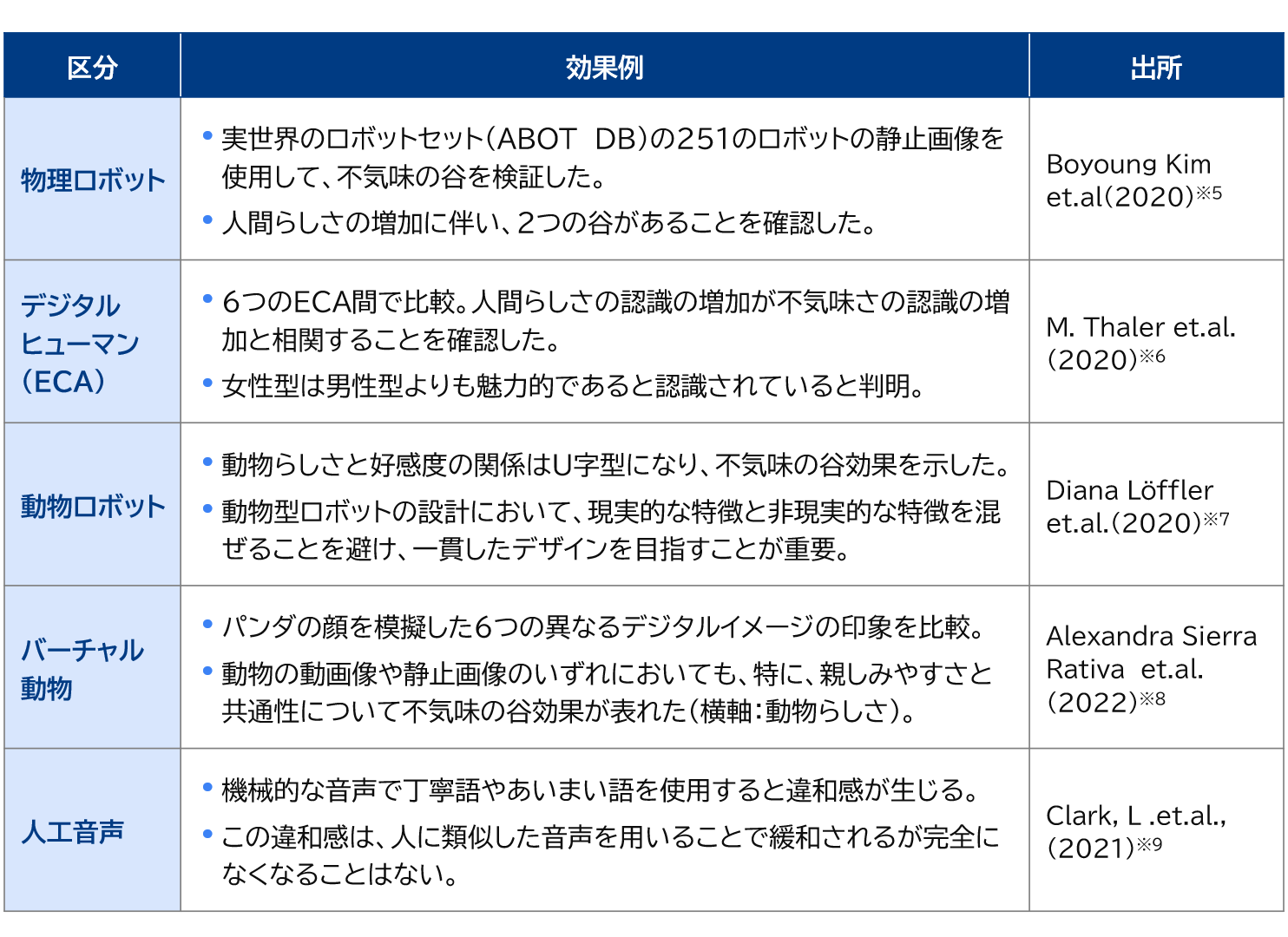
この不気味の谷の現象は、人型ロボットやデジタルヒューマンに加え、動物型ロボット、音声ベースの対話エージェントでも見られることが報告されています。図表2にいくつかの事例を示します。
図表2 さまざまな人工物に現れる不気味の谷の例
出所:各情報を基に三菱総合研究所作成
直近を考えると、不気味の谷を回避することが重要になるのは、ディスプレイ上のキャラクターであるデジタルヒューマン、ならびにスマートスピーカーやカーナビなどの音声である人工音声となります。この2つはCG生成や音声生成などの仕組みにより、人との類似度を柔軟に変えることができるようになっているため、不気味の谷に落ち込む可能性が現実的になっているからです。
不気味の谷の原因は2つに類型化できる
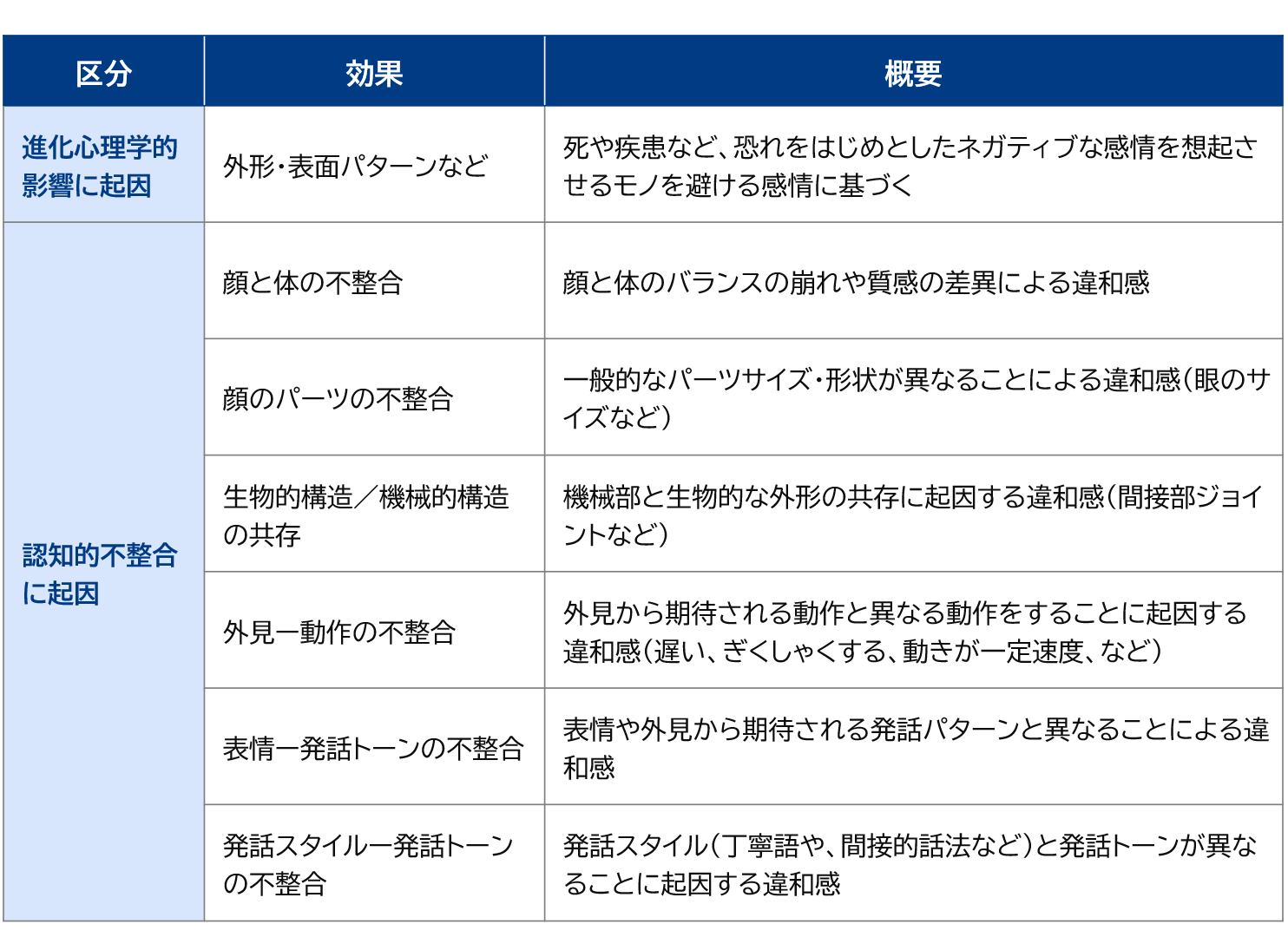
不気味の谷の原因として、多種多様な要素が挙げられています。大まかに原因を類型化すると、進化心理学に基づくものと認知的不整合に基づくものに分けられます(図表3)。進化心理学的な影響とは、不気味さを、自身の生命維持のため危険と感じたり死を連想させたりする要因から遠ざかりたいという心の動きとして解釈するものです。森の当初の概念は、このタイプの解釈が中心となっていました。
一方、認知的不整合に基づく解釈では、不気味さを、本来の自然物ではバランスがとれているさまざまなシグナル(発話や身体言語、全体的なバランスなど)が、人工物では完全には再現できていないことに起因する、と捉えます。最近の研究では、認知的な不整合に基づく説明が多くなっています。どちらが正解というわけではなく、どちらも原因となり得ると考えられます。
図表3 不気味の谷の原因の類型化
三菱総合研究所作成
不気味の谷現象を回避することの重要性
今後、ECA(Embodied Conversational Agents:身体化された対話エージェント)や音声インターフェースが高度化・普及するにつれ、私たちはさまざまな機械やデジタルヒューマンと、対話する機会が増えることになります。しかもこうした対話が、人対人の対話と類似したレベルになる未来が間近に迫っています。
そのような状況では、スマートスピーカーの発話内容と発話スタイルの不整合や、デジタルヒューマンの外見やしぐさ・会話のトーンの不整合が不気味の谷現象を誘発する可能性が高まります。
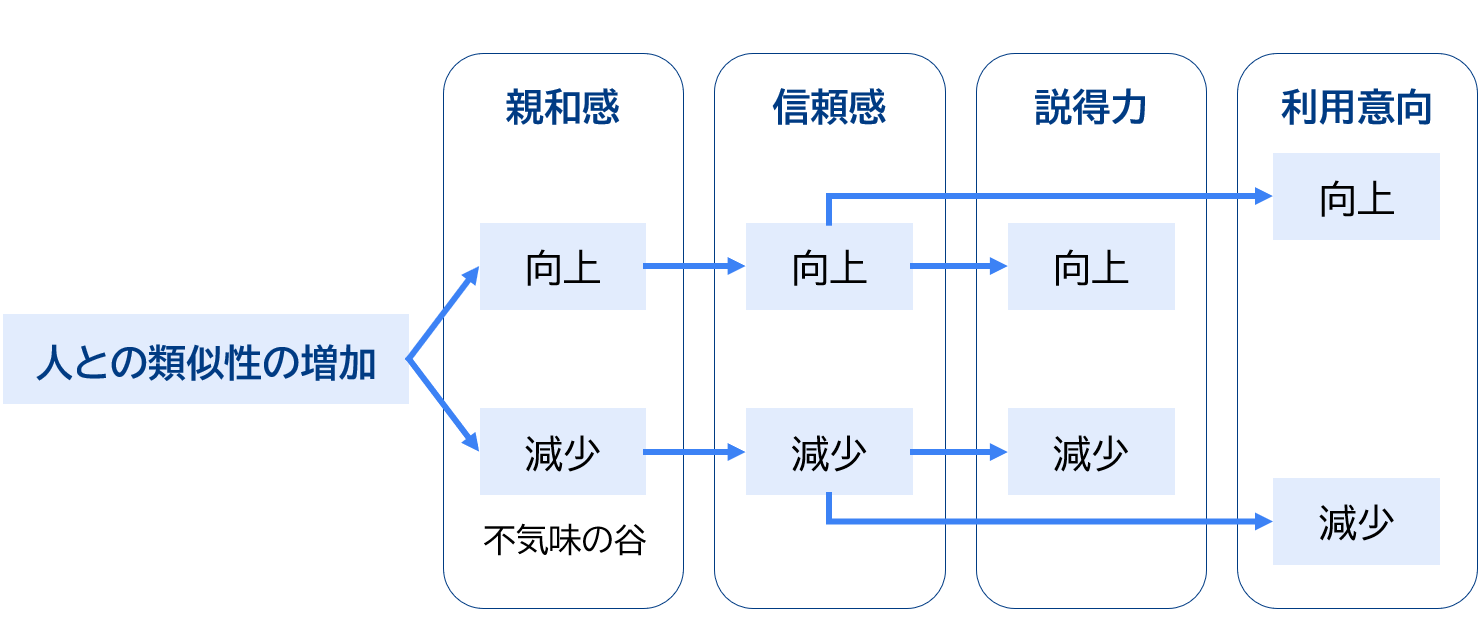
不気味の谷を回避することは、機械やデジタルヒューマンのメッセージの受容性を高めるという点できわめて重要です。今までの多くの研究から、親和感は信頼感と強い相関を持つことが知られています。信頼感が高い相手の場合、説得力や継続的な利用意向も高まります。これは、ECや広告宣伝などにとって不可欠の要件です。
逆に信頼感が低い相手の場合、メッセージの説得力も、継続的な利用意向も低いままです。この信頼感を左右するのが、親和感であり、親和感は不気味の谷を回避することで高めることができます。この関係を図表4に示します。
図表4 不気味の谷回避の重要性を示す模式図
三菱総合研究所作成
不気味の谷を回避・緩和するために
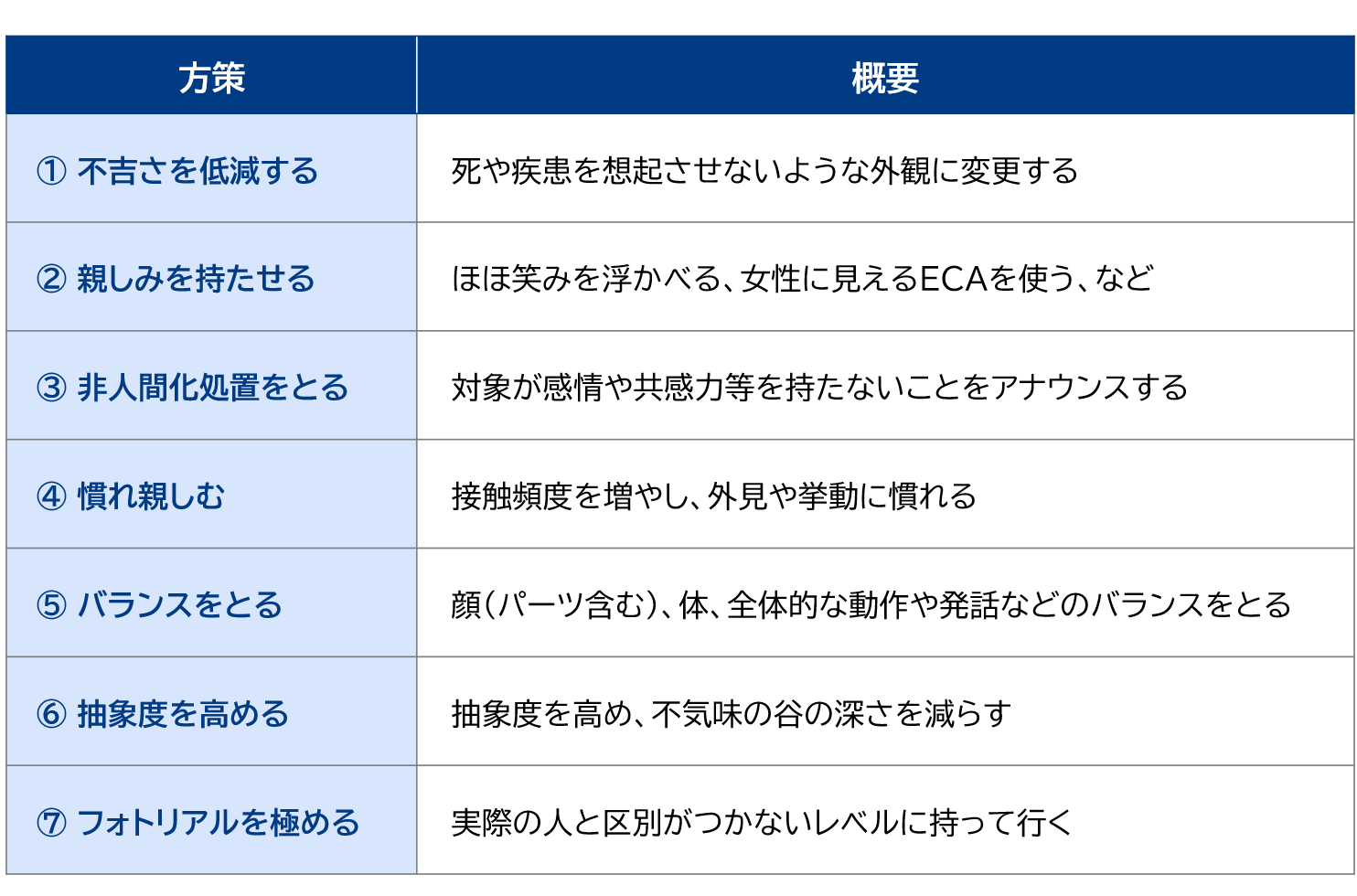
不気味の谷を回避・緩和するため、さまざまな方策が提案されています。ここでは7つの方策として類型化しました。図表5に示します。
図表5 不気味の谷を回避・緩和するための7つの方策
三菱総合研究所作成
①不吉さを低減する
進化心理学的な影響を回避するための方策です。死や疾患を意識させないデザインにすること、危険を想起させる外観(巨大、攻撃的など)を避けることなどが考えられます。
②親しみを持たせる
ほほ笑みを浮かべたデジタルヒューマンは、無表情のものよりも親和感が高まります。また、女性の外観を持ったECAは男性のECAよりも親和感が高まることが知られています※10。このような身体的な特徴を活用することが考えられます。
③非人間化処置をとる
単に、「このデジタルヒューマンは単なるデジタルコンテンツであり、一切の感情や心は持ちません」というメッセージを表示するだけでも、不気味さを抑制することができます。このようなメッセージを使うことが考えられます。
④慣れ親しむ
最初は不気味さを感じても、慣れることにより緩和されることが知られています。ある程度継続的にデジタルヒューマンを使用してもらい、慣れてもらうといった方策が考えられます。
⑤バランスをとる
親和感を低下させる原因として、顔と顔のパーツの不整合や表情と音声・音調の不整合などのミスマッチがあります。このミスマッチを可能な限り減らし、全体として同じような人らしさ・機械らしさになるよう、バランスの取れたデジタルヒューマンとすることが考えられます。
⑥抽象度を高める
リアルな人に近い外見のデジタルヒューマンでは、リアルな人を基準とした条件での違和感となりますので、シビアな評価になり、親和感が低下しがちです。イラスト風やアニメ風の抽象化した表現のデジタルヒューマンにすることで、親和感の低下を避けるという方策が考えられます。
⑦フォトリアルを極める
⑥とは逆に、外形、表情、発話、ジェスチャーなど、あらゆる領域でフォトリアル(写真のような写実性)を極めるという方策も考えられます。この方策は難易度が高いですが、高額商品のEC販売やビジネスシーンでの取引などでは効果的になると期待されます。
このように、デジタルヒューマンやヒューマノイドロボットは、単に高度な技術を採用するだけでは信頼性や安心感は高まりません。伝えたいメッセージによっては機械的な外観、機械的な発話の方が効果的なこともあります。特に欧州ではテキストベースのみのチャットボットからECAへの移行を視野に入れ、さまざまな実証的研究が進められています。
日本でもデジタルヒューマンなどのキャラクターをECなどのビジネスで活用する場合、利便性・機能性に加え、人の感性に関わる要素としての不気味の谷の回避についても十分に考慮した実装を行う必要があります。この要素を考慮することで、キャラクターへの親和感・信頼感が高まり、ビジネスの拡大につながると期待されます。
※1:AIやCG技術を用いて、人間そっくりの外見と対話・感情表現をコンピューター画面上に再現した技術。詳しくは以下参照。
V-Tec/メタバースの活用に向けて 第2回:コミュニケーションを豊かにするデジタルヒューマン(3Xによる行動変容の未来2030 2023.8.8)
※2:Masahiro Mori, Karl F MacDorman, and Norri Kageki.(2012), “The uncanny valley [from the field]", In: IEEERobotics & Automation Magazine 19.2, pp. 98–100.
※3:Masahiro Mori.(1970), “The uncanny valley”, In: Energy 7.4, pp.33–35.
※4:この図において、人との類似度—親和感曲線上に例示されている製品や技術はあくまでも1970年当時のイメージであることに留意。実際、現在では、装飾義手や電動義手、ヒューマノイドロボットの外観や機能は大きく改良され、類似度がかなり変化している。
※5:B. Kim, M. Bruce, L. Brown, E. d. Visser and E. Phillips.(2020), “A Comprehensive Approach to Validating the Uncanny Valley using the Anthropomorphic RoBOT(ABOT) Database”, 2020 Systems and Information Engineering Design Symposium(SIEDS), Charlottesville, VA, USA, pp. 1-6, doi: 10.1109/SIEDS49339.2020.9106675.
※6:M. Thaler, S. Schlögl and A. Growth.(2020), “Agent vs. Avatar: Comparing Embodied Conversational Agents Concerning Characteristics of the Uncanny Valley”, 2020 IEEE International Conference on Human-Machine Systems(ICHMS), Rome, Italy, pp. 1-6, doi: 10.1109/ICHMS49158.2020.9209539.
※7:Diana Löffler, Judith Dörrenbächer, Marc Hassenzahl. “The Uncanny Valley Effect in Zoomorphic Robots: The U-Shaped Relation Between Animal Likeness and Likeability”, HRI '20: Proceedings of the 2020 ACM/IEEE International Conference on Human-Robot Interaction Pages 261–270.
※8:Alexandra Sierra Rativa, Marie Postma, Menno van Zaanen.(2022), “The uncanny valley of a virtual animal”, Computer Animation and Virtual Worlds, Volume33, Issue2, March/April 2022.
※9:Clark, L., Ofemile, A., Cowan, B.R.(2021), “Exploring Verbal Uncanny Valley Effects with Vague Language in Computer Speech”, In: Weiss, B., Trouvain, J., Barkat-Defradas, M., Ohala, J.J.(eds)Voice Attractiveness. Prosody, Phonology and Phonetics. Springer, Singapore.
※10:これはジェンダーバイアスというよりも進化心理学的影響に基づく効果として解釈可能です。
著者紹介

連載一覧
-
2024年12月25日V-Tec/メタバースの活用に向けて 第6回:バーチャル価値のリアル空間への還流で、地域の価値を高める(後編)
-
2024年12月25日V-Tec/メタバースの活用に向けて 第5回:バーチャル価値のリアル空間への還流で、地域の価値を高める(前編)
-
2023年10月13日V-Tec/メタバースの活用に向けて 第4回:裸眼で体験するメタバース
-
2023年10月03日V-Tec/メタバースの活用に向けて 第3回:デジタルツイン的メタバース
-
2023年08月08日V-Tec/メタバースの活用に向けて 第2回:コミュニケーションを豊かにするデジタルヒューマン
-
2023年06月16日V-Tec/メタバースの活用に向けて 第1回:アクセス方法で変わるメタバース体験
関連するナレッジ・コラム
-
 2026年11月24日AIが生んだ「時間とお金」は誰のものか
-
2026年11月17日フィジカルAIの安全を、ロボットの外側からも考える
-
 2026年10月19日【提言】AIロボティクスを「使いこなす」社会へ
-
 2026年10月16日フロンティア(宇宙・海洋・量子)への挑戦で世界はどう変わるか?
-
 2026年10月06日【提言】人の「心」をモデル化するAI
-
 2026年10月01日自社固有技術を実装したフィジカルAIの開発・実装に向けて
-
2026年09月09日フィジカルAI搭載ロボットの積極的な活用を進めよう
-
2026年09月04日専門人材の共有ハブとしてのロボット・サービスプロバイダー
もっと見る
閉じる